

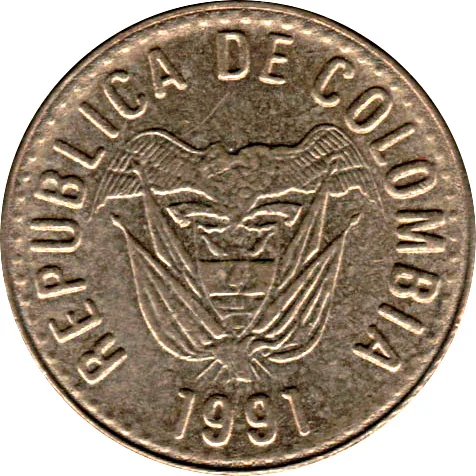
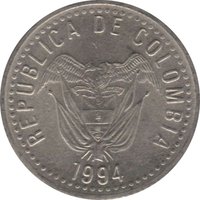
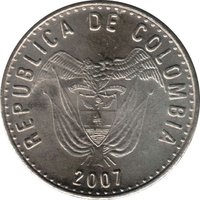
Obverse
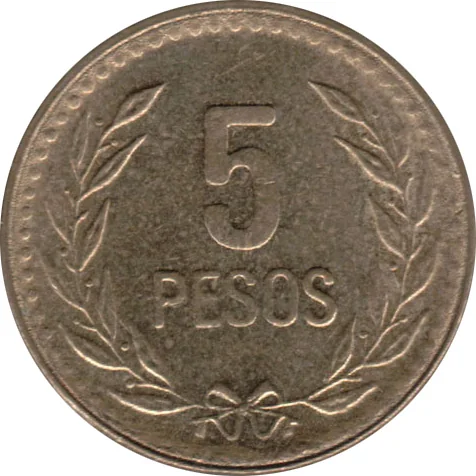
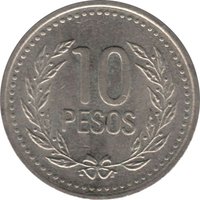
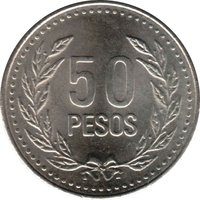
Reverse
Edge
Reeded
Mints
| Name | Mark |
|---|---|
| Fábrica de Moneda de Ibagué | — |
Mintings
| Year | Mint Mark | Mintage | Quality | Collection |
|---|---|---|---|---|
| 1989 | — | 106,825,973 | ||
| 1990 | — | 100,700,000 | ||
| 1991 | — | 60,000,000 | ||
| 1992 | — | 20,000,000 | ||
| 1993 | — | 40,000,000 |
Historical background
In 1989, Colombia's currency situation was characterized by a managed exchange rate regime under a crawling peg system, known as the "mini-devaluations" (minidevaluaciones). The Banco de la República aimed to control inflation and maintain export competitiveness by allowing the Colombian peso (COP) to depreciate gradually and predictably against the US dollar. This policy sought to avoid the shocks of a sudden large devaluation, but it operated within a context of significant external and internal pressures, including high inflation that consistently outpaced that of its major trading partners.
The period was dominated by the profound economic and social destabilization caused by the powerful drug cartels, most notably the Medellín Cartel. Vast inflows of illicit US dollars from the cocaine trade—a phenomenon known as "dollarization from below"—complicated monetary policy and created a volatile parallel foreign exchange market. The central bank struggled to sterilize these inflows to prevent an unwanted appreciation of the peso, which would harm legitimate exports like coffee. Furthermore, the cartels' practice of laundering money through imports and other channels distorted economic data and fueled inflation.
Ultimately, the currency management of 1989 was a fragile holding action within a nation in crisis. While the crawling peg provided a framework, the state's authority over the financial system was being directly challenged by narco-capital. This tense backdrop set the stage for the profound economic reforms that would follow in the early 1990s, including a new constitution in 1991 that granted the Banco de la República formal independence, with a primary mandate to control inflation and a move towards a more flexible exchange rate system.
The period was dominated by the profound economic and social destabilization caused by the powerful drug cartels, most notably the Medellín Cartel. Vast inflows of illicit US dollars from the cocaine trade—a phenomenon known as "dollarization from below"—complicated monetary policy and created a volatile parallel foreign exchange market. The central bank struggled to sterilize these inflows to prevent an unwanted appreciation of the peso, which would harm legitimate exports like coffee. Furthermore, the cartels' practice of laundering money through imports and other channels distorted economic data and fueled inflation.
Ultimately, the currency management of 1989 was a fragile holding action within a nation in crisis. While the crawling peg provided a framework, the state's authority over the financial system was being directly challenged by narco-capital. This tense backdrop set the stage for the profound economic reforms that would follow in the early 1990s, including a new constitution in 1991 that granted the Banco de la República formal independence, with a primary mandate to control inflation and a move towards a more flexible exchange rate system.
Series: 1989 Colombia circulation coins
🌱 Very Common