

1 Centimo – Spain
Spain
Context
Year: 1906
Issuer: Spain 
Ruler: Alfonso XIII
Currency:
(1868—2001)
Demonetization: 29 October 1941
Total mintage: 7,500,000
Material
References
KM: #Click to copy to clipboard726
Numista: #2839
Value
Exchange value: 0.01 ESP
Obverse
Description:
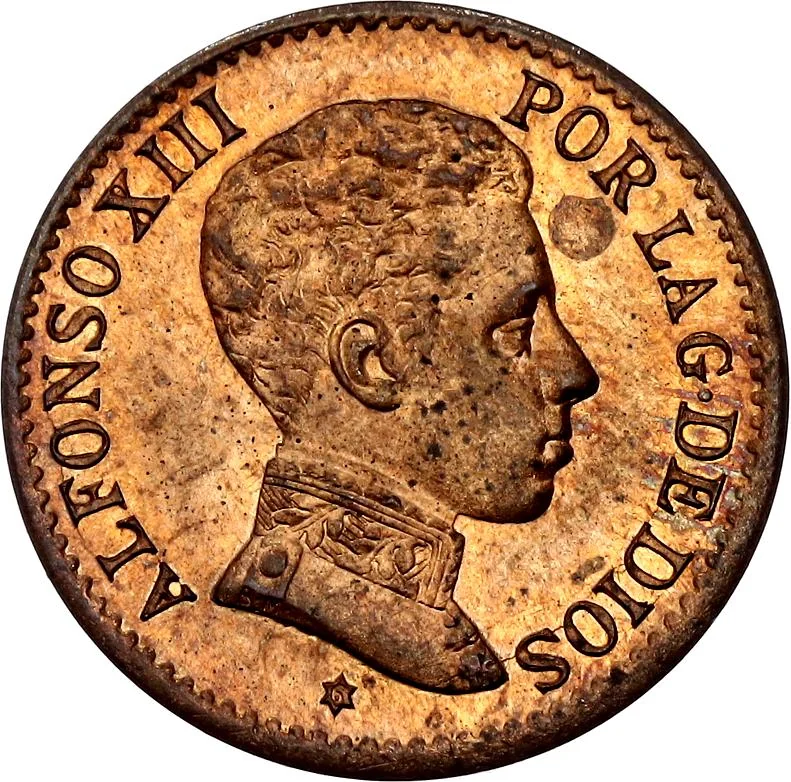
King Alfonso III facing right.
Inscription:
ALFONSO XIII POR LA G· DE DIOS
B· M·
🟌
B· M·
🟌
Translation:
By the Grace of God, Alfonso XIII
B. M.
B. M.
Script: Latin
Language: Spanish
Engraver: Bartolomé Maura Montaner
Reverse
Description:
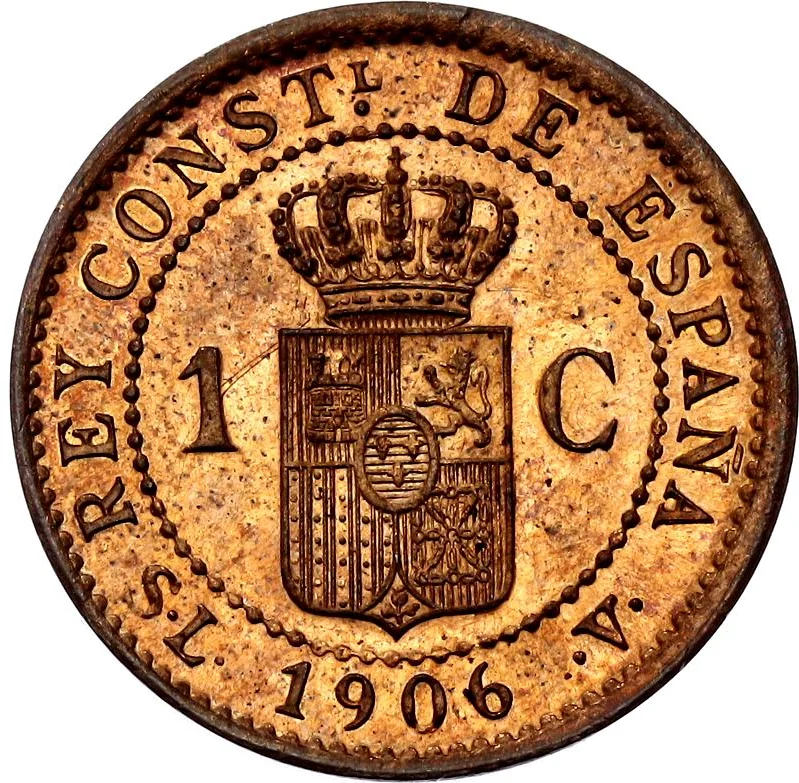
Spanish coat of arms in beaded circle.
Inscription:
REY CONSTL. DE ESPAÑA
1 C
S·L· 1906 ·V·
1 C
S·L· 1906 ·V·
Translation:
KING CONSTITUTIONAL OF SPAIN
1 CENT
S·L· 1906 ·V·
1 CENT
S·L· 1906 ·V·
Script: Latin
Language: Spanish
Engraver: Bartolomé Maura Montaner
Edge
Plain
Categories
| Person> Monarch |
| Symbols> Coat of Arms |
Mints
| Name | Mark |
|---|---|
| Royal Mint of Madrid | (🟌) |
Mintings
| Year | Mint Mark | Mintage | Quality | Collection |
|---|---|---|---|---|
| 1906 | 🟌 | 7,500,000 |
Historical background
In 1906, Spain's currency system was anchored to the bimetallic peseta, which had been the nation's sole legal tender since 1868. However, the country was still grappling with the economic aftershocks of the late 19th century, particularly the "Disaster of '98"—the loss of its final colonial possessions in the Spanish-American War. This event triggered a massive repatriation of capital and a loss of crucial colonial markets, leading to significant government debt, budget deficits, and a strain on the monetary system. While officially on a bimetallic (gold and silver) standard, in practice the silver peseta circulated domestically, but gold was scarce, creating a de facto silver standard that isolated Spain from the core gold-standard economies of Europe.
This isolation contributed to a persistent weakness in the peseta's international exchange rate throughout the period. The currency's value fluctuated and generally trended downward against gold-backed currencies like the British pound sterling and the French franc, reflecting international skepticism about Spain's economic stability and its chronic trade deficits. Inflation was a concern, driven by government spending financed through debt from the Bank of Spain, which led to periodic expansions of the paper money supply. The public's preference for hard currency (silver) over banknotes further highlighted a lack of full confidence in the financial system.
Consequently, the period around 1906 was one of monetary tension and debate. Policymakers and economists were divided between advocates for joining the international gold standard to stabilize trade and attract foreign investment, and those who favored protectionist policies and a managed, independent currency. This debate unfolded against a backdrop of modest industrial growth in regions like Catalonia and the Basque Country, which called for greater financial stability, while the state's fiscal weaknesses and political instability prevented any decisive monetary reform. Thus, the currency situation remained in a fragile and transitional state.
This isolation contributed to a persistent weakness in the peseta's international exchange rate throughout the period. The currency's value fluctuated and generally trended downward against gold-backed currencies like the British pound sterling and the French franc, reflecting international skepticism about Spain's economic stability and its chronic trade deficits. Inflation was a concern, driven by government spending financed through debt from the Bank of Spain, which led to periodic expansions of the paper money supply. The public's preference for hard currency (silver) over banknotes further highlighted a lack of full confidence in the financial system.
Consequently, the period around 1906 was one of monetary tension and debate. Policymakers and economists were divided between advocates for joining the international gold standard to stabilize trade and attract foreign investment, and those who favored protectionist policies and a managed, independent currency. This debate unfolded against a backdrop of modest industrial growth in regions like Catalonia and the Basque Country, which called for greater financial stability, while the state's fiscal weaknesses and political instability prevented any decisive monetary reform. Thus, the currency situation remained in a fragile and transitional state.
🌱 Common