

Spain
Context
Year: 1910
Issuer: Spain 
Ruler: Alfonso XIII
Currency:
(1868—2001)
Demonetization: 20 February 1939
Total mintage: 4,526,000
Material
References
KM: #Click to copy to clipboard730
Numista: #14676
Value
Exchange value: 0.50 ESP
Bullion value: $5.93
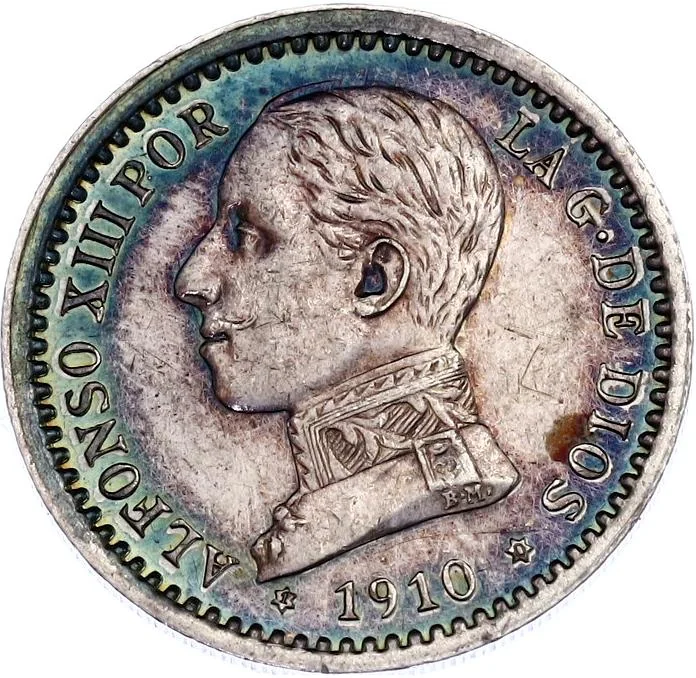
Obverse
Description:
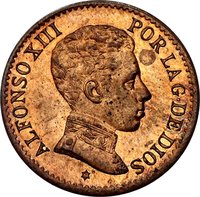
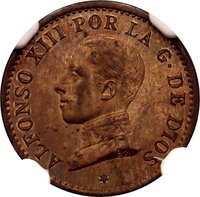
King Alfonso III facing left.
Inscription:
ALFONSO XIII POR LA G· DE DIOS
🟌 1910 🟌
🟌 1910 🟌
Translation:
ALFONSO XIII BY THE GRACE OF GOD
🟌 1910 🟌
🟌 1910 🟌
Script: Latin
Language: Spanish
Engraver: Bartolomé Maura Montaner
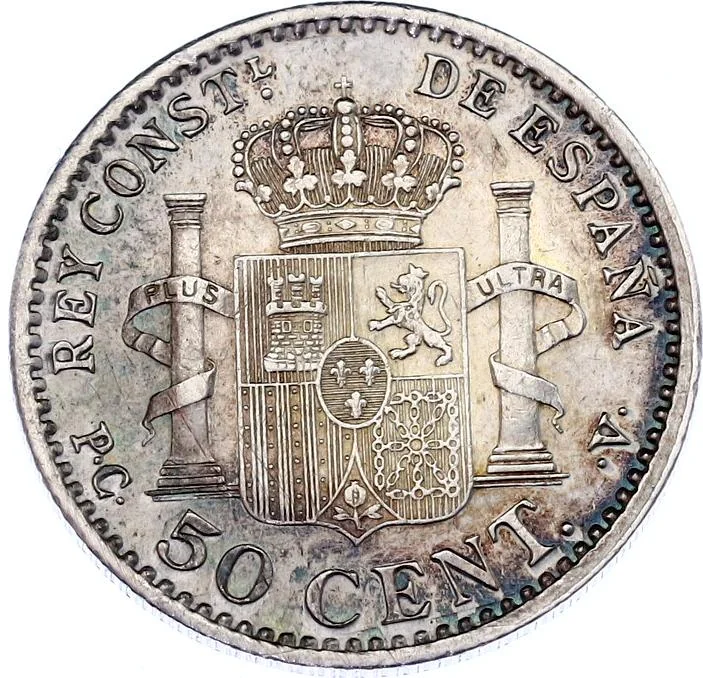
Reverse
Description:
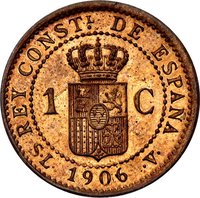
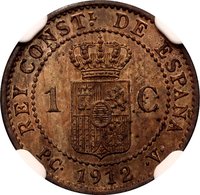
Crowned arms between pillars, value beneath.
Inscription:
REY CONSTL. DE ESPAÑA
PLUS ULTRA
P·C· 50 CENT. ·V·
PLUS ULTRA
P·C· 50 CENT. ·V·
Translation:
King Constitutional of Spain
Further Beyond
P·C· 50 Cents ·V·
Further Beyond
P·C· 50 Cents ·V·
Script: Latin
Engraver: Bartolomé Maura Montaner
Edge
Reeded
Categories
| Person> Monarch |
| Symbols> Coat of Arms |
Mints
| Name | Mark |
|---|---|
| Royal Mint of Madrid | (🟌) |
Mintings
| Year | Mint Mark | Mintage | Quality | Collection |
|---|---|---|---|---|
| 1910 | 🟌 | 4,526,000 |
Historical background
In 1910, Spain's currency system was firmly anchored to the Gold Standard under the Peseta, which had been the nation's sole legal tender since 1868. The Bank of Spain held a monopoly on note issuance, and the theoretical promise existed to convert paper money into gold upon demand. This system aimed to provide monetary stability, integrate Spain into the global financial system, and control inflation. However, the reality was more complex, as the gold convertibility was often more theoretical than practical for ordinary citizens, with silver and banknotes forming the bulk of everyday transactions.
The period leading up to 1910 was one of relative monetary stability, especially compared to the turbulent 19th century. This stability was supported by a period of modest economic growth, increased foreign investment, and a favorable balance of payments fueled by exports like minerals, citrus, and wine. The state's finances were also more orderly, allowing the peseta to maintain a credible fixed exchange rate against other gold-backed currencies like the French Franc and British Pound Sterling. This environment facilitated trade and provided a sense of financial security.
Nevertheless, underlying weaknesses persisted. Spain's industrial development lagged behind its European counterparts, and its economy remained vulnerable to agricultural shocks. The commitment to the Gold Standard also tied the hands of monetary authorities, limiting their ability to respond to economic downturns with flexible policies. Furthermore, the system depended heavily on public confidence and the Bank of Spain's gold reserves. As the political tensions of the early 20th century mounted and the costs of colonial conflicts in Morocco grew, these strains would soon test the resilience of the 1910 currency regime, foreshadowing the monetary challenges that would escalate in the coming decades.
The period leading up to 1910 was one of relative monetary stability, especially compared to the turbulent 19th century. This stability was supported by a period of modest economic growth, increased foreign investment, and a favorable balance of payments fueled by exports like minerals, citrus, and wine. The state's finances were also more orderly, allowing the peseta to maintain a credible fixed exchange rate against other gold-backed currencies like the French Franc and British Pound Sterling. This environment facilitated trade and provided a sense of financial security.
Nevertheless, underlying weaknesses persisted. Spain's industrial development lagged behind its European counterparts, and its economy remained vulnerable to agricultural shocks. The commitment to the Gold Standard also tied the hands of monetary authorities, limiting their ability to respond to economic downturns with flexible policies. Furthermore, the system depended heavily on public confidence and the Bank of Spain's gold reserves. As the political tensions of the early 20th century mounted and the costs of colonial conflicts in Morocco grew, these strains would soon test the resilience of the 1910 currency regime, foreshadowing the monetary challenges that would escalate in the coming decades.
🌱 Common