

2 Pesetas – Spain
Spain
Context
Year: 1905
Issuer: Spain 
Ruler: Alfonso XIII
Currency:
(1868—2001)
Demonetized: Yes
Total mintage: 3,589,000
Material
References
KM: #Click to copy to clipboard725
Numista: #7174
Value
Exchange value: 2 ESP
Bullion value: $23.74
Obverse
Description:
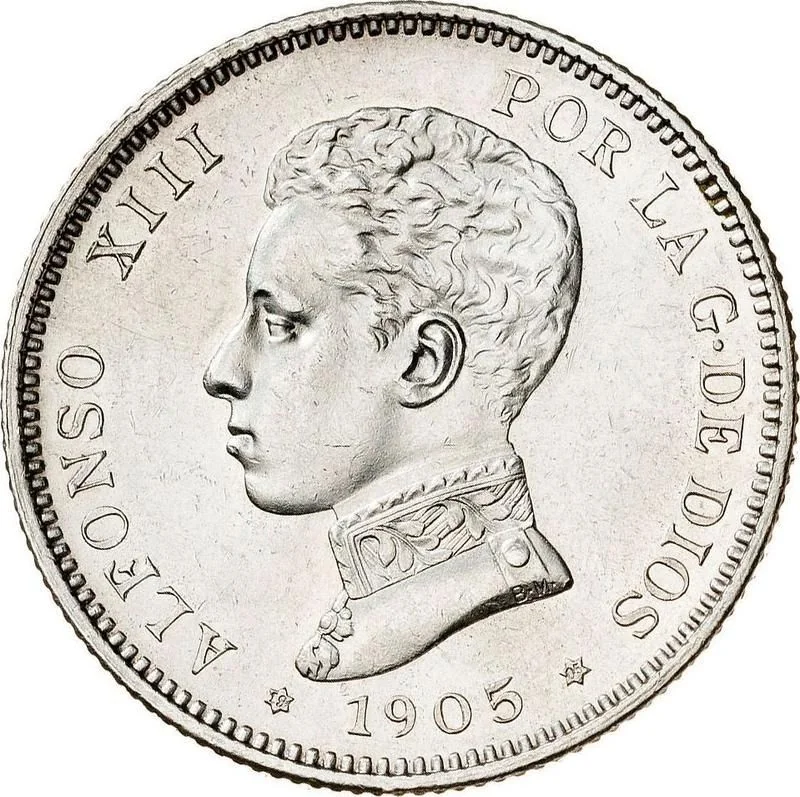
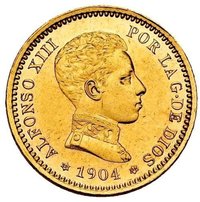
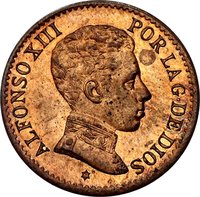
King Alfonso III facing left.
Inscription:
ALFONSO XIII POR LA G· DE DIOS
B· M·
🟌 1905 🟌
B· M·
🟌 1905 🟌
Translation:
By the Grace of God, Alfonso XIII
King and Emperor
🟌 1905 🟌
King and Emperor
🟌 1905 🟌
Script: Latin
Language: Spanish
Engraver: Bartolomé Maura Montaner
Reverse
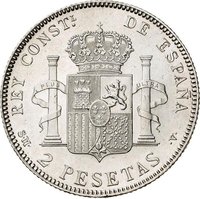
Description:
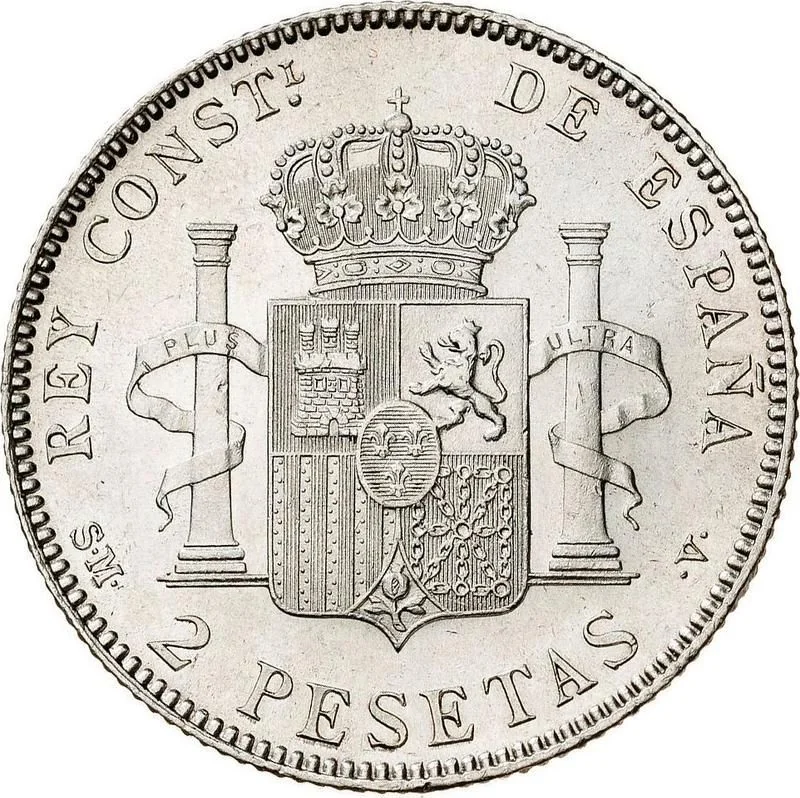
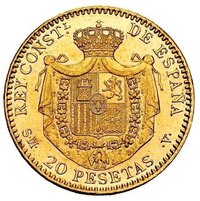
Spanish coat of arms with the Pillars of Hercules.
Inscription:
REY CONSTL. DE ESPAÑA
PLUS ULTRA
S·M· 2 PESETAS ·V·
PLUS ULTRA
S·M· 2 PESETAS ·V·
Translation:
KING CONSTITUTIONAL OF SPAIN
MORE BEYOND
H.M. 2 PESETAS V
MORE BEYOND
H.M. 2 PESETAS V
Script: Latin
Engraver: Bartolomé Maura Montaner
Edge
Reeded
Categories
| Person> Monarch |
| Symbols> Coat of Arms |
Mints
| Name | Mark |
|---|---|
| Royal Mint of Madrid | (🟌) |
Mintings
| Year | Mint Mark | Mintage | Quality | Collection |
|---|---|---|---|---|
| 1905 | 🟌 | 3,589,000 |
Historical background
In 1905, Spain's currency system was anchored to the bimetallic standard of the Latin Monetary Union, though it operated de facto on a gold standard. The official currency was the peseta, introduced in 1868 to replace the complex regional currencies and unify the national economy. While silver coins (pesetas and duros, or 5-peseta pieces) were common in daily circulation, the system's stability was legally tied to gold, with the peseta defined as 0.290322 grams of fine gold. However, Spain was not a formal member of the Union, giving it more flexibility but also less external discipline.
The period was one of relative monetary stability, yet underlying vulnerabilities persisted. A significant challenge was the persistent budget deficit, financed largely by borrowing from the Bank of Spain, which created inflationary pressures. Furthermore, the loss of the final colonies in 1898 had delivered a severe economic shock, depleting gold reserves and causing a sharp devaluation. By 1905, the economy was in a slow recovery phase, but confidence in the peseta internationally was not fully restored, and its exchange rate against major gold-backed currencies like the French franc or British pound remained weaker than its nominal parity.
Consequently, a duality existed: domestically, the currency functioned adequately for commerce and industry, which were experiencing growth, particularly in Catalonia and the Basque Country. Internationally, however, Spain's financial standing was diminished. The government and the Bank of Spain had to carefully manage gold reserves to maintain convertibility, a task complicated by political instability and fiscal shortfalls. This precarious balance foreshadowed the monetary strains that would intensify with the economic demands of World War I, ultimately leading to the suspension of the gold standard in 1914.
The period was one of relative monetary stability, yet underlying vulnerabilities persisted. A significant challenge was the persistent budget deficit, financed largely by borrowing from the Bank of Spain, which created inflationary pressures. Furthermore, the loss of the final colonies in 1898 had delivered a severe economic shock, depleting gold reserves and causing a sharp devaluation. By 1905, the economy was in a slow recovery phase, but confidence in the peseta internationally was not fully restored, and its exchange rate against major gold-backed currencies like the French franc or British pound remained weaker than its nominal parity.
Consequently, a duality existed: domestically, the currency functioned adequately for commerce and industry, which were experiencing growth, particularly in Catalonia and the Basque Country. Internationally, however, Spain's financial standing was diminished. The government and the Bank of Spain had to carefully manage gold reserves to maintain convertibility, a task complicated by political instability and fiscal shortfalls. This precarious balance foreshadowed the monetary strains that would intensify with the economic demands of World War I, ultimately leading to the suspension of the gold standard in 1914.
🌱 Fairly Common