

5 centavos – Venezuela
Add to wishlist
Venezuela
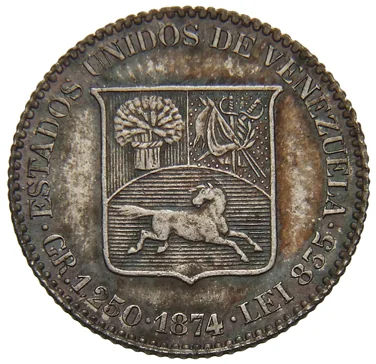
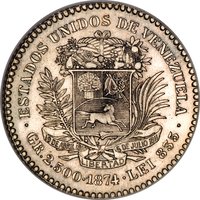
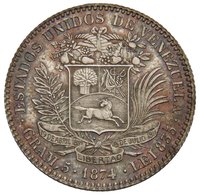
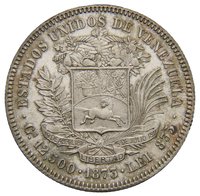
Obverse
Description:
Coat of arms encircled by legend. Weight, date, and fineness below.
Inscription:
•ESTADOS UNIDOS DE VENEZUELA•
GR.1,250•1876•LEI 835
GR.1,250•1876•LEI 835
Translation:
UNITED STATES OF VENEZUELA
1.250 GRAMS•1876•LEI 835
1.250 GRAMS•1876•LEI 835
Script: Latin
Language: Spanish
Engraver: Désiré-Albert Barre
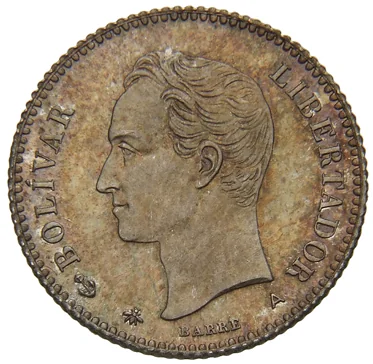
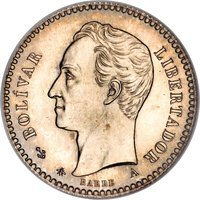
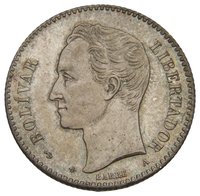
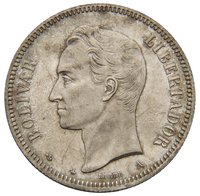
Reverse
Description:
Bust right. Legend on both sides. Privy marks, engraver, and mint at bottom.
Inscription:
BOLÍVAR LIBERTADOR
⚓ * BARRE A
⚓ * BARRE A
Translation:
BOLÍVAR LIBERTADOR
⚓ * BARRE A
⚓ * BARRE A
Script: Latin
Language: Spanish
Engraver: Désiré-Albert Barre
Edge
Reeded
Categories
| Animal> Horse |
| Person> Military leader |
| Person> Politician |
| Symbols> Coat of Arms |
Mints
| Name | Mark |
|---|---|
| Monnaie de Paris | A |
Historical background
In 1874, Venezuela's currency situation was characterized by the persistent circulation of a multitude of foreign and debased coins, a legacy of colonial monetary disorder and post-independence instability. The official currency was the silver Venezolano, introduced in 1843 to replace the old Spanish colonial system, but it failed to establish monopoly circulation. In practice, Spanish-American pesos (pieces of eight), Colombian coins, French francs, and other foreign silver circulated freely alongside it, their value determined by weight and fineness rather than face value. This created a complex and inefficient commercial environment where merchants and the public constantly had to assess the intrinsic metal value of each coin.
The government of President Antonio Guzmán Blanco, in its ongoing push for modernization and centralization, attempted to rectify this through the Monetary Law of March 1874. This law aimed to simplify the system by reaffirming the Venezolano as the sole standard and mandating that all foreign silver coins be withdrawn, recoined, or demonetized. Crucially, it sought to formally align Venezuela with the emerging Latin Monetary Union standard by adopting a bimetallic system pegging the Venezolano to both gold and silver at a fixed ratio. However, this theoretical peg was difficult to maintain in the face of global market fluctuations in the value of precious metals.
Consequently, the reforms of 1874 had limited immediate success. The withdrawal of vast quantities of familiar foreign coinage was a slow and disruptive process, and the bimetallic standard proved unstable. The law did not fully end the circulation of foreign coins, which remained trusted in daily transactions, especially in remote regions. Thus, while 1874 represents a significant legislative attempt to impose monetary order and national sovereignty, the reality on the ground remained a fragmented system of multiple metallic currencies, highlighting the gap between centralized policy and the entrenched practices of a predominantly agricultural economy.
The government of President Antonio Guzmán Blanco, in its ongoing push for modernization and centralization, attempted to rectify this through the Monetary Law of March 1874. This law aimed to simplify the system by reaffirming the Venezolano as the sole standard and mandating that all foreign silver coins be withdrawn, recoined, or demonetized. Crucially, it sought to formally align Venezuela with the emerging Latin Monetary Union standard by adopting a bimetallic system pegging the Venezolano to both gold and silver at a fixed ratio. However, this theoretical peg was difficult to maintain in the face of global market fluctuations in the value of precious metals.
Consequently, the reforms of 1874 had limited immediate success. The withdrawal of vast quantities of familiar foreign coinage was a slow and disruptive process, and the bimetallic standard proved unstable. The law did not fully end the circulation of foreign coins, which remained trusted in daily transactions, especially in remote regions. Thus, while 1874 represents a significant legislative attempt to impose monetary order and national sovereignty, the reality on the ground remained a fragmented system of multiple metallic currencies, highlighting the gap between centralized policy and the entrenched practices of a predominantly agricultural economy.
Series: 1874 Venezuela circulation coins
💎 Very Rare