

1 peso (José Rizal) – Philippines
Add to wishlist
Circulating commemorative coins
Commemoration: 150th Birth Anniversary of José Rizal
Philippines
Context
Year: 2011
Issuer: Philippines
Issuing organization: Central Bank of the Philippines
Period:
(since 1946)
Currency:
(since 1967)
Total mintage: 10,000,000
Material
References
KM: #
Numista: #28276
Value
Exchange value: 1 PHP
Obverse
Description:
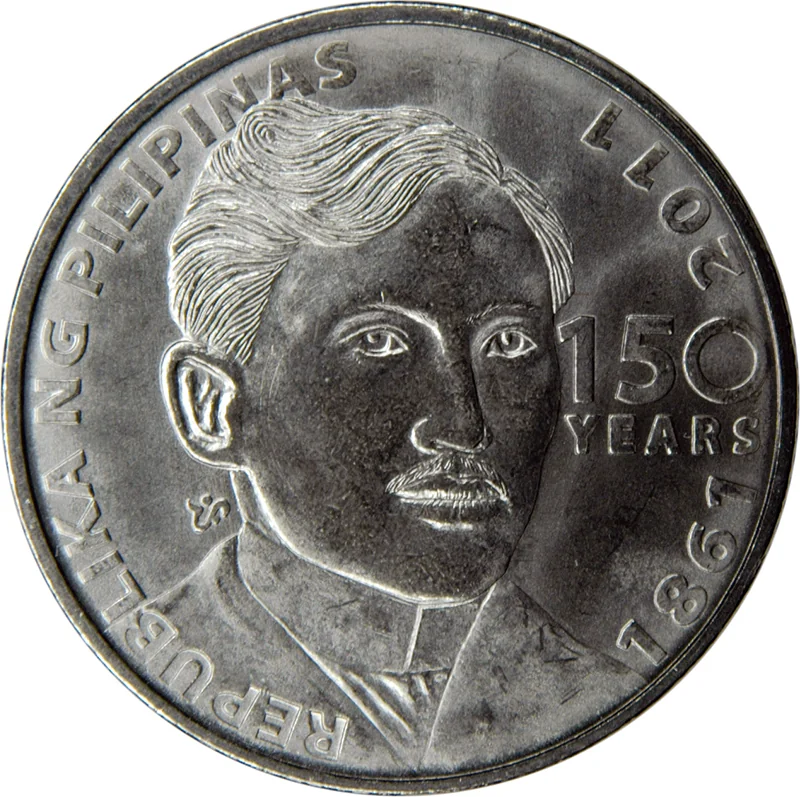
Bust of José Rizal facing forward.
Inscription:
REPUBLIKA NG PILIPINAS
150 YEARS
1861 2011
150 YEARS
1861 2011
Translation:
REPUBLIC OF THE PHILIPPINES
150 YEARS
1861 2011
150 YEARS
1861 2011
Script: Latin
Engraver: Emerson Rg. Abraham
Reverse
Description:
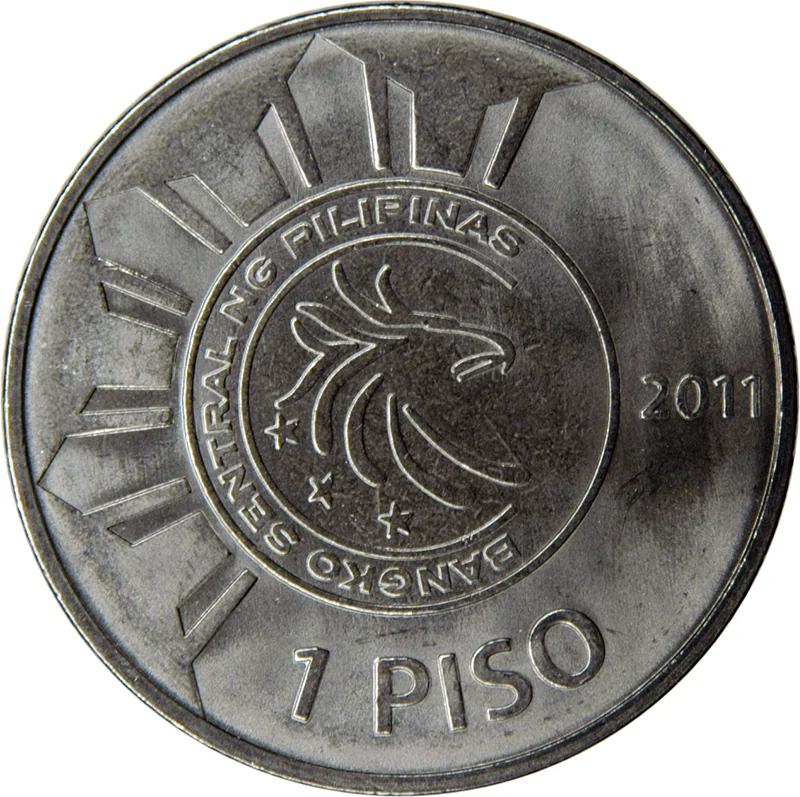
Bank seal centre, rays left.
Inscription:
BANGKO SENTRAL NG PILIPINAS
2011
1 PISO
2011
1 PISO
Translation:
Central Bank of the Philippines
2011
1 Peso
2011
1 Peso
Script: Latin
Engraver: Emerson Rg. Abraham
Edge
Reeded
Mints
| Name | Mark |
|---|---|
| BSP Security Plant Complex | (PI) |
Mintings
| Year | Mint Mark | Mintage | Quality | Collection |
|---|---|---|---|---|
| 2011 | PI | 10,000,000 |
Historical background
In 2011, the Philippine peso (PHP) demonstrated notable resilience and appreciation, largely defying global economic headwinds. The year began with the peso trading at approximately 44.00 against the US dollar, and it strengthened throughout the year, ending near 43.80. This performance was driven by strong inflows from overseas Filipino worker (OFW) remittances, which consistently broke records, and a growing business process outsourcing (BPO) sector. These sources provided a steady stream of US dollars, bolstering the country's foreign exchange reserves and supporting the currency's value despite volatile capital flows in the region.
The Bangko Sentral ng Pilipinas (BSP), under Governor Amando Tetangco Jr., maintained a cautious and proactive monetary policy stance. While inflation remained manageable, averaging around 4.7% for the year, the BSP's primary concern was managing the peso's appreciation to protect the competitiveness of exports. The central bank intervened periodically in the foreign exchange market to smooth volatility and build up international reserves, which reached comfortable levels. Furthermore, the BSP kept its key policy rate low for much of the year to support economic growth, only beginning a tightening cycle in the latter months to pre-empt inflationary pressures.
However, the external environment posed significant challenges. The European sovereign debt crisis and concerns about a global slowdown created risk aversion among international investors, leading to episodic capital outflows from emerging markets like the Philippines. While the peso's fundamentals were strong, these episodes caused temporary volatility and depreciation pressures. Overall, 2011 was characterized by a peso that was fundamentally strong due to structural inflows, but whose trajectory was intermittently tested by external shocks, requiring careful management by the BSP to maintain stability.
The Bangko Sentral ng Pilipinas (BSP), under Governor Amando Tetangco Jr., maintained a cautious and proactive monetary policy stance. While inflation remained manageable, averaging around 4.7% for the year, the BSP's primary concern was managing the peso's appreciation to protect the competitiveness of exports. The central bank intervened periodically in the foreign exchange market to smooth volatility and build up international reserves, which reached comfortable levels. Furthermore, the BSP kept its key policy rate low for much of the year to support economic growth, only beginning a tightening cycle in the latter months to pre-empt inflationary pressures.
However, the external environment posed significant challenges. The European sovereign debt crisis and concerns about a global slowdown created risk aversion among international investors, leading to episodic capital outflows from emerging markets like the Philippines. While the peso's fundamentals were strong, these episodes caused temporary volatility and depreciation pressures. Overall, 2011 was characterized by a peso that was fundamentally strong due to structural inflows, but whose trajectory was intermittently tested by external shocks, requiring careful management by the BSP to maintain stability.

🌱 Common