

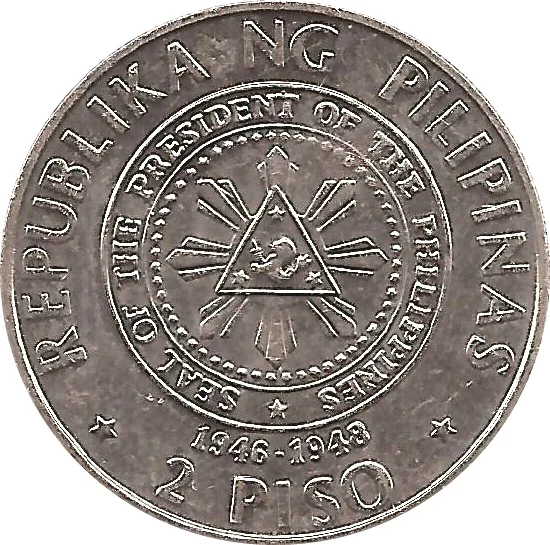
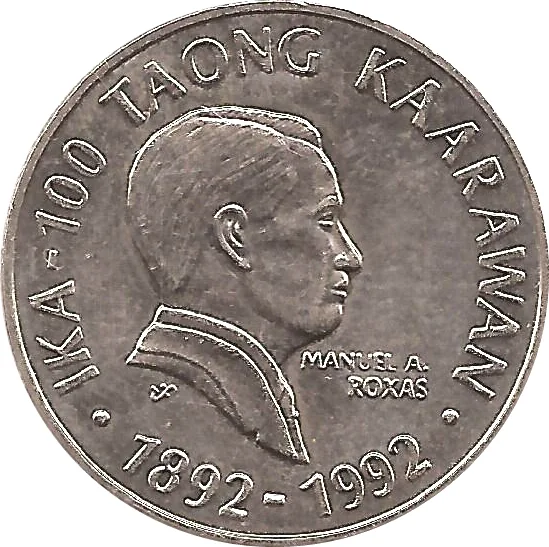
2 pesos – Philippines
Add to wishlist
Circulating commemorative coins
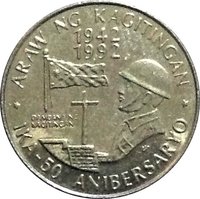
Commemoration: Birth Centennial of Manuel A. Roxas
Philippines
Context
Year: 1992
Issuer: Philippines
Period:
(since 1946)
Currency:
(since 1967)
Demonetization: 2 January 1998
Material
References
KM: #
Numista: #24353
Value
Exchange value: 2 PHP
Obverse
Reverse
Edge
Reeded
Categories
| Person> Politician |
Mints
| Name | Mark |
|---|---|
| BSP Security Plant Complex | (PI) |
Mintings
| Year | Mint Mark | Mintage | Quality | Collection |
|---|---|---|---|---|
| 1992 | PI | — | ||
| 1992 | PI | — | Matte |
Historical background
In 1992, the Philippines was navigating a critical juncture in its economic recovery under the new administration of President Fidel V. Ramos. The period was characterized by the lingering effects of the severe balance of payments crisis of the early 1980s and the political turmoil of the late 1980s, which had led to significant capital flight and a heavy reliance on International Monetary Fund (IMF) stabilization programs. The country's foreign debt remained burdensome, and investor confidence was fragile. The Central Bank of the Philippines, which would be restructured into the Bangko Sentral ng Pilipinas (BSP) just a year later in 1993, was managing a controlled, yet vulnerable, peso exchange rate regime amidst limited foreign reserves.
The Philippine peso was operating under a managed float system, but in practice, it was heavily influenced by Central Bank intervention to maintain stability. After a series of devaluations in the 1980s, the exchange rate in 1992 was relatively stable, trading within a narrow band around 25 to 26 pesos per US dollar. This stability was artificially maintained and costly, requiring the Central Bank to expend scarce foreign reserves to defend the peso's value. The situation created persistent pressure on the currency, as the underlying economic fundamentals—including a widening trade deficit and moderate inflation—suggested the peso was overvalued, hurting the competitiveness of Philippine exports.
President Ramos's ascension marked a deliberate shift toward economic liberalization and deregulation, setting the stage for more profound currency reforms. The immediate focus in 1992 was on building credibility, taming inflation, and implementing structural adjustments mandated by the IMF to qualify for continued financial support. These preparatory measures were essential precursors to the more market-oriented reforms that followed, including the significant step in 1993 of establishing the independent BSP and, ultimately, the shift to a full floating exchange rate system in the mid-1990s. Thus, 1992 represented a year of cautious stabilization, laying the groundwork for the transformative—though later tumultuous—financial liberalization of the subsequent decade.
The Philippine peso was operating under a managed float system, but in practice, it was heavily influenced by Central Bank intervention to maintain stability. After a series of devaluations in the 1980s, the exchange rate in 1992 was relatively stable, trading within a narrow band around 25 to 26 pesos per US dollar. This stability was artificially maintained and costly, requiring the Central Bank to expend scarce foreign reserves to defend the peso's value. The situation created persistent pressure on the currency, as the underlying economic fundamentals—including a widening trade deficit and moderate inflation—suggested the peso was overvalued, hurting the competitiveness of Philippine exports.
President Ramos's ascension marked a deliberate shift toward economic liberalization and deregulation, setting the stage for more profound currency reforms. The immediate focus in 1992 was on building credibility, taming inflation, and implementing structural adjustments mandated by the IMF to qualify for continued financial support. These preparatory measures were essential precursors to the more market-oriented reforms that followed, including the significant step in 1993 of establishing the independent BSP and, ultimately, the shift to a full floating exchange rate system in the mid-1990s. Thus, 1992 represented a year of cautious stabilization, laying the groundwork for the transformative—though later tumultuous—financial liberalization of the subsequent decade.

🌱 Fairly Common