

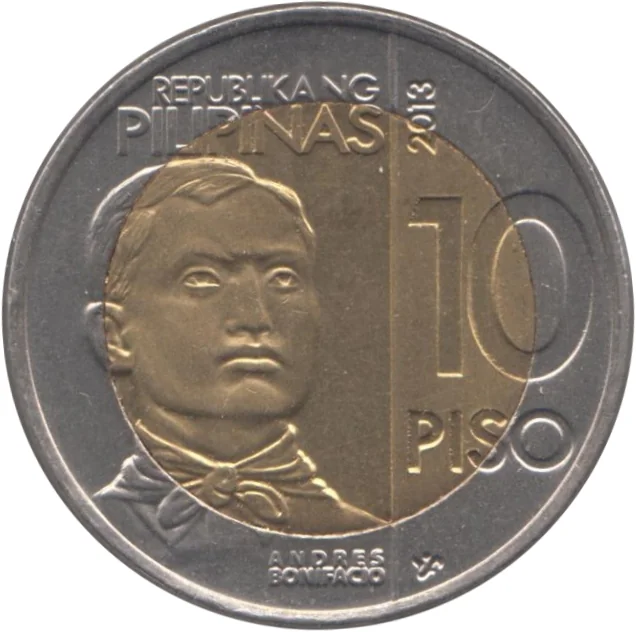
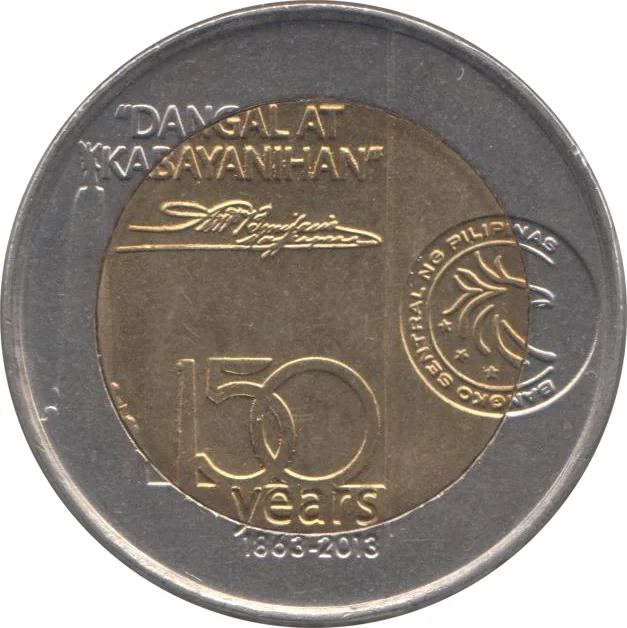
10 Pesos (Andres Bonifacio) – Philippines
Circulating commemorative coins
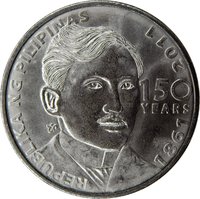
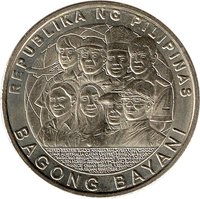
Commemoration: 150th Birth Anniversary of Andres Bonifacio
Philippines
Context
Year: 2013
Issuer: Philippines 
Issuing organization: Central Bank of the Philippines
Period:
(since 1946)
Currency:
(since 1967)
Total mintage: 10,000,000
Material
References
KM: #Click to copy to clipboard285
Numista: #53693
Value
Exchange value: 10 PHP = $0.17
Obverse
Reverse
Edge
Reeded sections
Categories
| Event> Revolution |
Mints
| Name | Mark |
|---|---|
| BSP Security Plant Complex | (PI) |
Mintings
| Year | Mint Mark | Mintage | Quality | Collection |
|---|---|---|---|---|
| 2013 | PI | 10,000,000 |
Historical background
In 2013, the Philippine economy was a notable bright spot in Asia, characterized by strong growth, robust remittance inflows, and a surge in investor confidence. This positive sentiment was reflected in the Philippine Peso (PHP), which traded at an average of approximately ₱42.45 against the US Dollar for the year, marking a period of significant strength. The currency's appreciation was driven by several key factors: record-high Overseas Filipino Worker (OFW) remittances, which provided a steady stream of foreign exchange; a booming Business Process Outsourcing (BPO) sector; and a series of credit rating upgrades that elevated the country to investment-grade status for the first time in its history. This "strong peso" policy was generally welcomed as a sign of economic maturity and reduced the cost of servicing the country's dollar-denominated debt.
However, the currency's strength presented a double-edged sword, creating headwinds for crucial export-oriented industries and families reliant on remittances. A stronger peso meant that the dollar earnings of exporters and the US dollars sent home by OFWs converted into fewer pesos, effectively reducing their local purchasing power. This dynamic sparked concerns among sectors like electronics manufacturing and agriculture, which argued that an overly strong currency was eroding their international competitiveness. The Bangko Sentral ng Pilipinas (BSP) faced the delicate task of managing these inflows to prevent excessive volatility and asset bubbles without stifling the growth momentum.
The broader macroeconomic context was defined by the government's commitment to fiscal discipline under President Benigno Aquino III and the BSP's effective inflation management. Inflation remained within the target range of 3-5% for most of the year, averaging 2.9%, which gave the central bank room to keep its key policy interest rate at a record low of 3.5% to support economic expansion. Consequently, 2013 is remembered as a year of currency strength for the Philippines, symbolizing its transition from a regional economic laggard to a rising star, even as policymakers balanced the benefits of a strong currency against its sectoral costs.
However, the currency's strength presented a double-edged sword, creating headwinds for crucial export-oriented industries and families reliant on remittances. A stronger peso meant that the dollar earnings of exporters and the US dollars sent home by OFWs converted into fewer pesos, effectively reducing their local purchasing power. This dynamic sparked concerns among sectors like electronics manufacturing and agriculture, which argued that an overly strong currency was eroding their international competitiveness. The Bangko Sentral ng Pilipinas (BSP) faced the delicate task of managing these inflows to prevent excessive volatility and asset bubbles without stifling the growth momentum.
The broader macroeconomic context was defined by the government's commitment to fiscal discipline under President Benigno Aquino III and the BSP's effective inflation management. Inflation remained within the target range of 3-5% for most of the year, averaging 2.9%, which gave the central bank room to keep its key policy interest rate at a record low of 3.5% to support economic expansion. Consequently, 2013 is remembered as a year of currency strength for the Philippines, symbolizing its transition from a regional economic laggard to a rising star, even as policymakers balanced the benefits of a strong currency against its sectoral costs.
🌱 Common