

Obverse
Description:
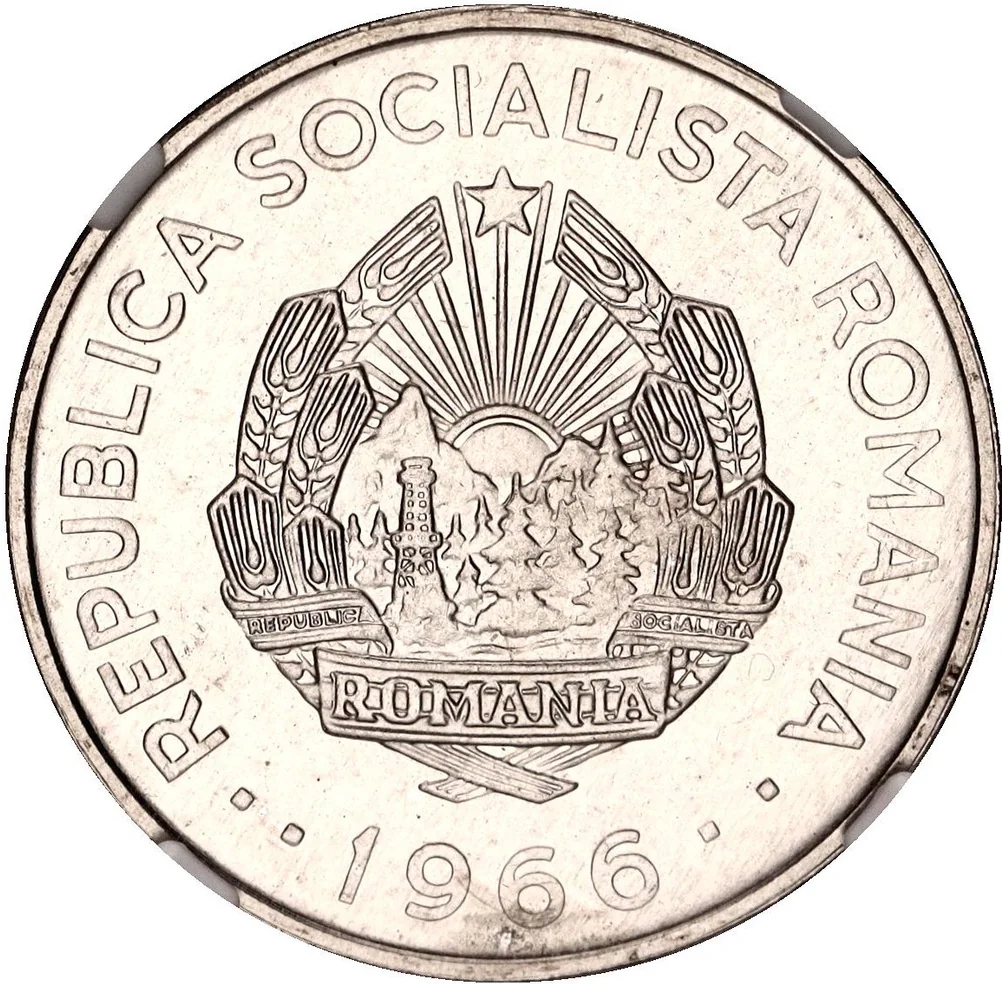
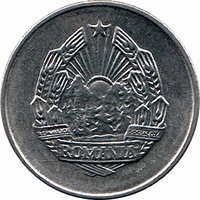
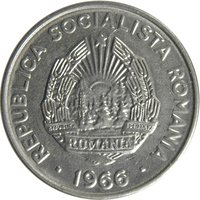
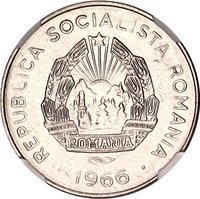
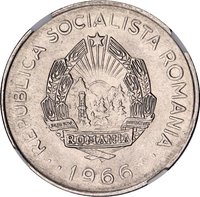
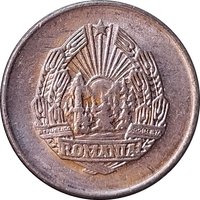
Romania's coat of arms, encircled by the country name, with the date beneath.
Inscription:
REPUBLICA SOCIALISTA ROMANIA
Translation:
SOCIALIST REPUBLIC OF ROMANIA
Script: Latin
Language: Romanian
Engraver: Haralambie Ionescu
Reverse
Description:
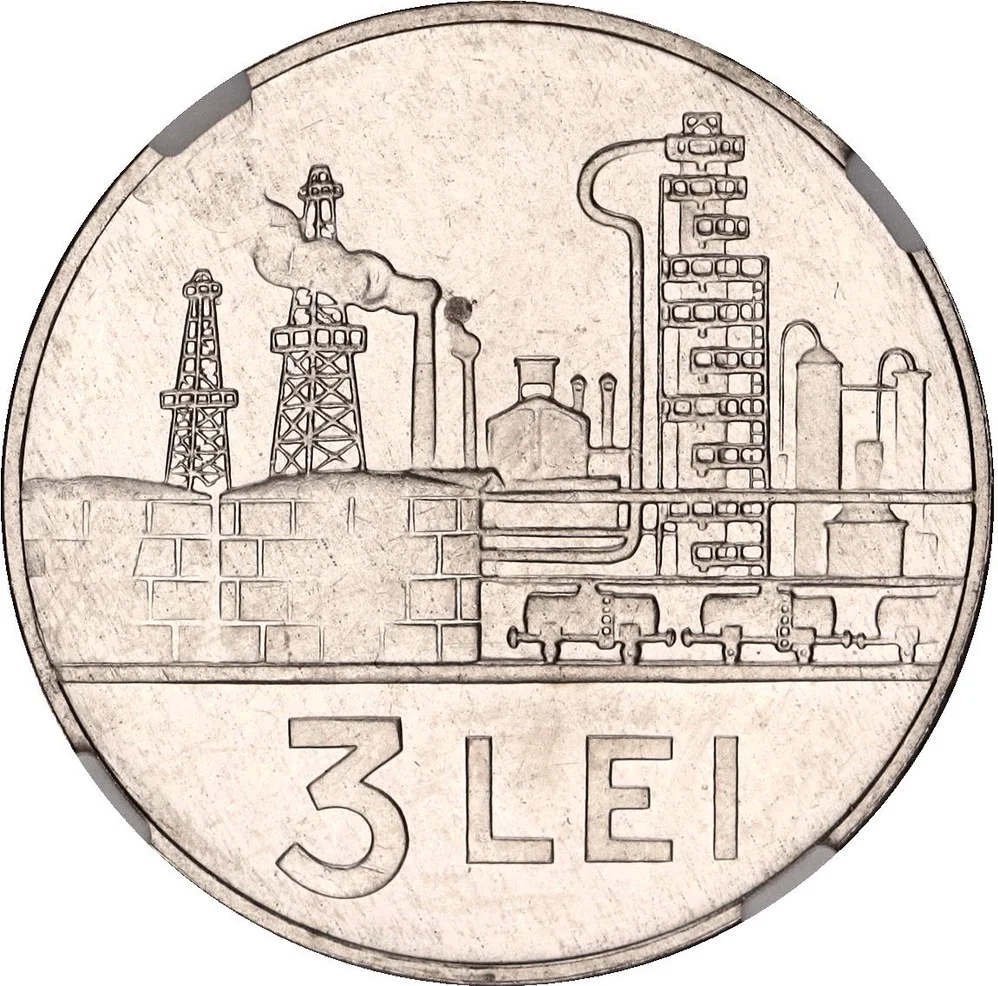
Industrial scene with label.
Inscription:
3 LEI
Script: Latin
Engraver: Haralambie Ionescu
Edge
Categories
| Symbols> Coat of Arms |
| Industry |
| Transportation> Train |
Mints
| Name | Mark |
|---|---|
| State Mint | — |
Mintings
| Year | Mint Mark | Mintage | Quality | Collection |
|---|---|---|---|---|
| 1966 | — | 8,477,000 |
Historical background
In 1966, Romania’s currency situation was defined by its rigid, centrally planned economy and isolation from global financial markets. The national currency, the leu, operated under a non-convertible, fixed exchange rate system set by the state. Its official value was artificially high and bore no relation to market forces, serving primarily as an accounting unit within the command economy. All foreign trade and currency exchange were monopolized by the state, with severe restrictions on citizens' access to foreign currency.
This period fell within the era of Nicolae Ceaușescu’s leadership, which was marked by a drive for economic autarky and rapid industrialization funded by foreign loans. By the mid-1960s, the initial phase of borrowing was underway, but the severe debt crisis that would dictate currency and austerity policies in the 1980s was not yet acute. The primary focus regarding currency was on maintaining strict control to support state planning, suppress inflation administratively, and channel all hard currency earnings toward repaying debts and importing industrial machinery, often at the expense of domestic consumption.
For ordinary Romanians, the state’s currency control meant a stark divide between the worthless official leu for domestic use and the high value placed on hard currencies like the US dollar on the black market. Access to Western goods was virtually impossible through legal channels, creating a thriving underground economy where foreign currency was king. Thus, the 1966 currency situation was one of outward stability enforced by the state, but underpinned by growing distortions that would intensify in the coming decades.
This period fell within the era of Nicolae Ceaușescu’s leadership, which was marked by a drive for economic autarky and rapid industrialization funded by foreign loans. By the mid-1960s, the initial phase of borrowing was underway, but the severe debt crisis that would dictate currency and austerity policies in the 1980s was not yet acute. The primary focus regarding currency was on maintaining strict control to support state planning, suppress inflation administratively, and channel all hard currency earnings toward repaying debts and importing industrial machinery, often at the expense of domestic consumption.
For ordinary Romanians, the state’s currency control meant a stark divide between the worthless official leu for domestic use and the high value placed on hard currencies like the US dollar on the black market. Access to Western goods was virtually impossible through legal channels, creating a thriving underground economy where foreign currency was king. Thus, the 1966 currency situation was one of outward stability enforced by the state, but underpinned by growing distortions that would intensify in the coming decades.
Series: 1966 Romania circulation coins
🌱 Very Common