

Peru
Context

Material
References
KM: #Click to copy to clipboard211
Numista: #28105
Value
Exchange value: 0.01 PEH
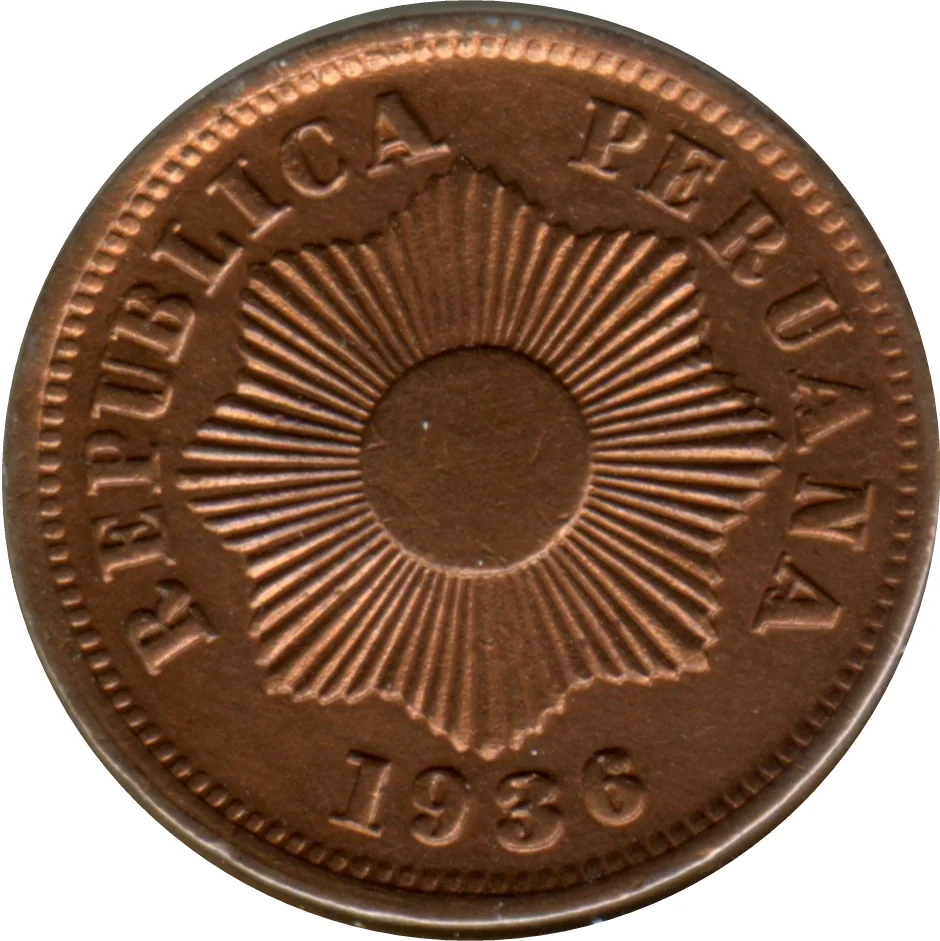
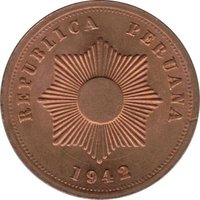
Obverse
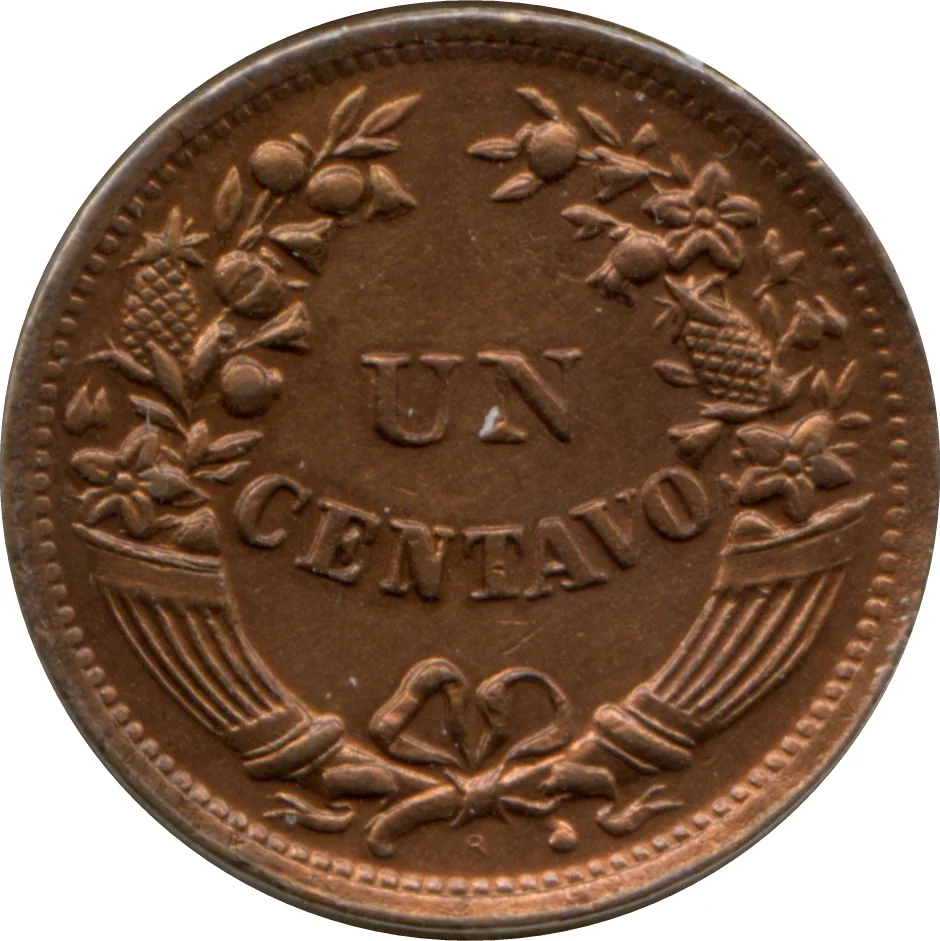
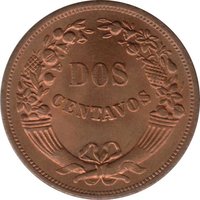
Reverse
Edge
Plain
Mintings
| Year | Mint Mark | Mintage | Quality | Collection |
|---|---|---|---|---|
| 1909 | — | 252,000 | ||
| 1909 | R | — | ||
| 1915 | — | 250,000 | ||
| 1916 | — | 360,000 | ||
| 1916 | R | — | ||
| 1917 | R | — | ||
| 1917 | — | 830,000 | ||
| 1918 | — | 1,800,000 | ||
| 1918 | R | — | ||
| 1920 | R | — | ||
| 1920 | — | 360,000 | ||
| 1933 | R | — | ||
| 1934 | — | — | ||
| 1935 | R | — | ||
| 1936 | R | — | ||
| 1937 | R | — | ||
| 1937 | — | — | ||
| 1939 | R | — |
Historical background
In 1909, Peru’s currency situation was defined by the aftermath of the devastating War of the Pacific (1879-1884) and the subsequent period of national reconstruction known as the "Aristocratic Republic." The country was operating under a de facto silver standard, but the Peruvian sol had suffered severe depreciation and instability for decades. The war's crippling debt, paid in silver, and the global decline in silver's value relative to gold had drastically reduced the sol's purchasing power and international credibility. The government's response, under President Augusto B. Leguía, was a concerted drive toward monetary reform and stabilization to attract foreign investment for infrastructure and export-led growth.
The cornerstone of this reform was the Ley de Conversión Monetaria (Monetary Conversion Law) of December 1901, which established the gold standard. This law defined the sol by a fixed gold content (equivalent to the British pound at a rate of 10 soles = 1 pound sterling) and created the libra peruana (Peruvian pound) as a high-denomination gold currency. By 1909, the system was in its early years of implementation, managed by the newly founded Banco de la Reserva del Perú (1905), which acted as the central bank and sole issuer of paper money fully backed by gold reserves. The goal was to curb inflation, eliminate multiple private banknote issues, and create a uniform, trusted national currency.
Consequently, in 1909, Peru had a bimetallic circulation in transition. Gold libra peruana coins and silver sol coins were legal tender, with the silver sol's value legally pegged to gold. The Banco de la Reserva issued paper notes convertible to gold, aiming to restore public confidence. The system's success relied heavily on healthy fiscal revenues from key exports like copper, cotton, and sugar, and on maintaining sufficient gold reserves. While marking a period of relative stability compared to the previous chaos, this gold-standard regime also tied Peru's economy to volatile international commodity prices and the constraints of classical monetary orthodoxy.
The cornerstone of this reform was the Ley de Conversión Monetaria (Monetary Conversion Law) of December 1901, which established the gold standard. This law defined the sol by a fixed gold content (equivalent to the British pound at a rate of 10 soles = 1 pound sterling) and created the libra peruana (Peruvian pound) as a high-denomination gold currency. By 1909, the system was in its early years of implementation, managed by the newly founded Banco de la Reserva del Perú (1905), which acted as the central bank and sole issuer of paper money fully backed by gold reserves. The goal was to curb inflation, eliminate multiple private banknote issues, and create a uniform, trusted national currency.
Consequently, in 1909, Peru had a bimetallic circulation in transition. Gold libra peruana coins and silver sol coins were legal tender, with the silver sol's value legally pegged to gold. The Banco de la Reserva issued paper notes convertible to gold, aiming to restore public confidence. The system's success relied heavily on healthy fiscal revenues from key exports like copper, cotton, and sugar, and on maintaining sufficient gold reserves. While marking a period of relative stability compared to the previous chaos, this gold-standard regime also tied Peru's economy to volatile international commodity prices and the constraints of classical monetary orthodoxy.
🌱 Fairly Common