

Peru
Context

Material
References
KM: #Click to copy to clipboard212
Numista: #9062
Value
Exchange value: 0.02 PEH
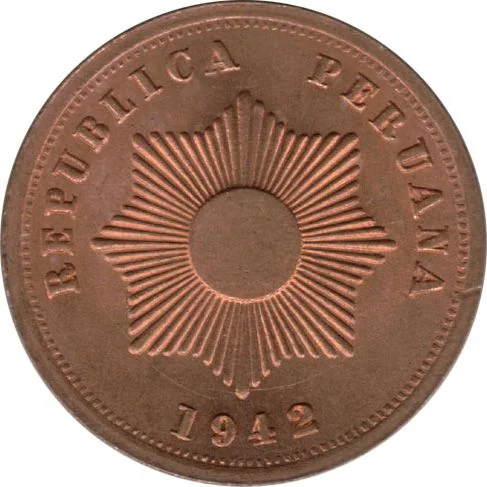
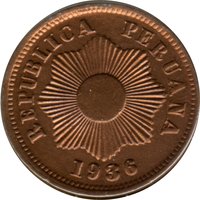
Obverse
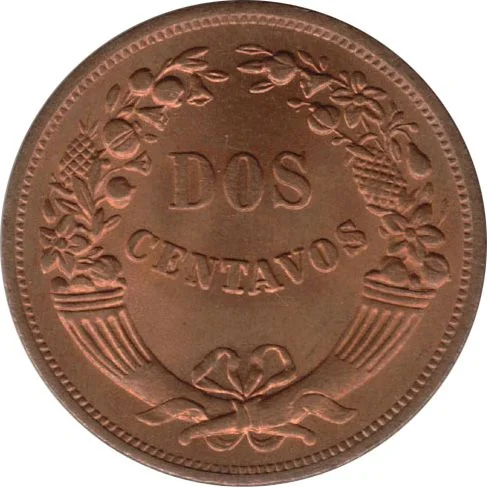
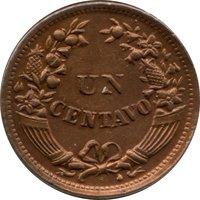
Reverse
Edge
Plain
Categories
| Symbol> Cornucopia |
| Symbol> Sun |
Mintings
| Year | Mint Mark | Mintage | Quality | Collection |
|---|---|---|---|---|
| 1917 | — | 73,000 | ||
| 1918 | — | 580,000 | ||
| 1920 | — | — | ||
| 1933 | — | 285,000 | ||
| 1934 | — | 973,000 | ||
| 1935 | — | 950,000 | ||
| 1936 | — | 763,000 | ||
| 1937 | — | 963,000 | ||
| 1938 | — | — | ||
| 1939 | — | — | ||
| 1940 | — | — | ||
| 1941 | — | — | ||
| 1942 | — | 4,418,000 | ||
| 1943 | — | 1,829,000 | ||
| 1944 | — | 2,068,000 | ||
| 1945 | — | 2,288,000 | ||
| 1946 | — | 2,121,000 | ||
| 1947 | — | 1,280,000 | ||
| 1948 | — | 1,518,000 | ||
| 1949 | — | 938,000 |
Historical background
In 1917, Peru's currency situation was defined by the dominance of the Libra Peruana de Oro (Peruvian Gold Pound), a monetary system established in 1901 to bring stability after a period of severe depreciation. This system placed Peru on the gold standard, pegging the currency directly to the British pound sterling at a fixed rate. The physical circulation consisted primarily of silver coins (soles and centavos) and banknotes issued by private banks, but these were all convertible into gold, theoretically ensuring their value and fostering international trade confidence.
However, the global pressures of World War I (1914-1918) severely strained this system. The conflict disrupted international gold flows and trade, leading to a widespread suspension of the gold standard by many nations. While Peru did not officially abandon the standard, in practice, gold convertibility was suspended. This led to a de facto "paper standard," where the value of banknotes began to fluctuate. The war caused a decline in key export revenues (like copper and cotton) while increasing the cost of imported manufactured goods, creating inflationary pressures and a complex economic environment for the monetary authorities.
Consequently, 1917 was a year of precarious monetary duality. The formal, legal framework of the gold standard remained, but the practical reality was one of inconvertible paper money and economic strain. The government and the Banco del Perú y Londres, the leading note-issuing bank, struggled to manage the money supply and maintain confidence without the anchor of gold redemption. This period laid the groundwork for the monetary reforms that would follow in the 1920s and 1930s, as Peru grappled with the long-term transition away from the classical gold standard.
However, the global pressures of World War I (1914-1918) severely strained this system. The conflict disrupted international gold flows and trade, leading to a widespread suspension of the gold standard by many nations. While Peru did not officially abandon the standard, in practice, gold convertibility was suspended. This led to a de facto "paper standard," where the value of banknotes began to fluctuate. The war caused a decline in key export revenues (like copper and cotton) while increasing the cost of imported manufactured goods, creating inflationary pressures and a complex economic environment for the monetary authorities.
Consequently, 1917 was a year of precarious monetary duality. The formal, legal framework of the gold standard remained, but the practical reality was one of inconvertible paper money and economic strain. The government and the Banco del Perú y Londres, the leading note-issuing bank, struggled to manage the money supply and maintain confidence without the anchor of gold redemption. This period laid the groundwork for the monetary reforms that would follow in the 1920s and 1930s, as Peru grappled with the long-term transition away from the classical gold standard.
🌱 Common