

5 Lepta – Greece
Greece
Context
Material
Diameter: 19 mm
Weight: 3 g
Thickness: 1.6 mm
Shape: Round with a round hole
Composition: Nickel
Magnetic: Yes
Technique: Milled
Alignment: Coin alignment
flip
References
KM: #Click to copy to clipboard62
Numista: #2808
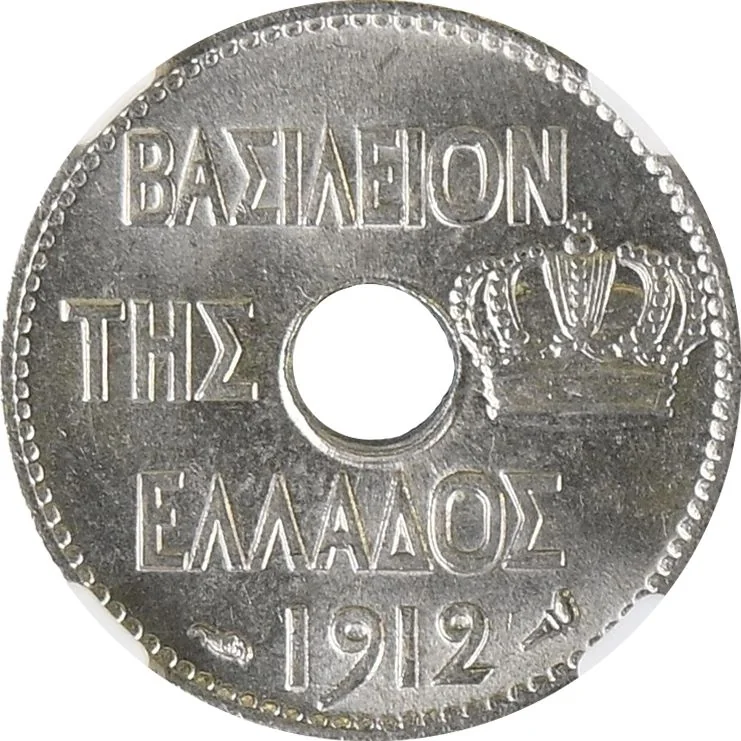
Obverse
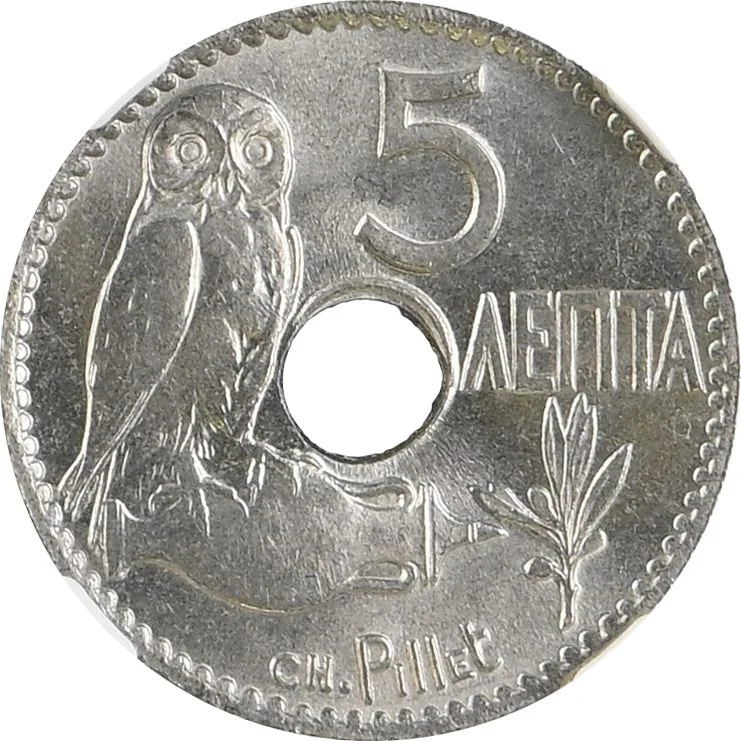
Reverse
Description:
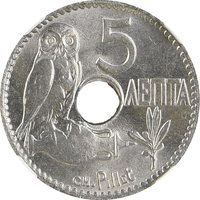
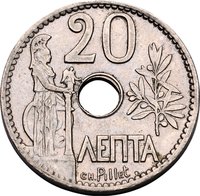
Owl left of hole, denomination right, engraver below.
Inscription:
5
ΛΕΠΤΑ
Ch. PillEt
ΛΕΠΤΑ
Ch. PillEt
Translation:
5
LEPTA
Ch. Pilet
LEPTA
Ch. Pilet
Language: Greek
Engraver: Charles Pillet
Edge
Plain
Mints
| Name | Mark |
|---|---|
| Monnaie de Paris | — |
Mintings
| Year | Mint Mark | Mintage | Quality | Collection |
|---|---|---|---|---|
| 1912 | — | 25,053,000 |
Historical background
In 1912, Greece operated under the Greek drachma (GRD), a currency stabilized by its adherence to the Latin Monetary Union (LMU). The LMU, established in 1865, was a supranational system that aimed to standardize gold and silver coinage across several European nations, facilitating trade. Greece had joined in 1868, but its frequent fiscal deficits and over-issuance of silver coinage had often strained its membership, leading to periods where its coins were not accepted abroad. By 1912, the drachma was on a de facto gold standard, with its value pegged to the French franc, the Union's anchor currency.
This monetary stability, however, existed within a context of chronic state debt and economic underdevelopment. The government's finances were perennially weak, heavily reliant on foreign loans, particularly from French and British banks, to cover budgetary shortfalls and fund infrastructure. The outbreak of the First Balkan War in October 1912 immediately placed severe new demands on the treasury. Mobilizing for war required massive emergency expenditures for military procurement and logistics, threatening to destabilize the carefully managed currency peg and the state's fragile fiscal balance.
Consequently, the currency situation in 1912 was one of precarious equilibrium. While the drachma itself was stable in international exchange due to the LMU framework, the underlying Greek economy and public finances were not. The pressures of the Balkan Wars, which Greece entered with the aim of significant territorial expansion, risked overwhelming this system. The wartime spending would soon lead to inflation, suspension of gold convertibility, and increased foreign borrowing, setting the stage for the monetary and debt crises that would intensify in the years following the wars.
This monetary stability, however, existed within a context of chronic state debt and economic underdevelopment. The government's finances were perennially weak, heavily reliant on foreign loans, particularly from French and British banks, to cover budgetary shortfalls and fund infrastructure. The outbreak of the First Balkan War in October 1912 immediately placed severe new demands on the treasury. Mobilizing for war required massive emergency expenditures for military procurement and logistics, threatening to destabilize the carefully managed currency peg and the state's fragile fiscal balance.
Consequently, the currency situation in 1912 was one of precarious equilibrium. While the drachma itself was stable in international exchange due to the LMU framework, the underlying Greek economy and public finances were not. The pressures of the Balkan Wars, which Greece entered with the aim of significant territorial expansion, risked overwhelming this system. The wartime spending would soon lead to inflation, suspension of gold convertibility, and increased foreign borrowing, setting the stage for the monetary and debt crises that would intensify in the years following the wars.
🌱 Very Common