

20 Kroner (Norwegian Trekking Association) – Norway
Circulating commemorative coins
Commemoration: 150th Anniversary of the Norwegian Trekking Association
Norway
Context
Material
References
KM: #Click to copy to clipboard494
Numista: #133875
Value
Exchange value: 20 NOK = $2.09
Inflation-adjusted value: 25.78 NOK
Obverse
Description:
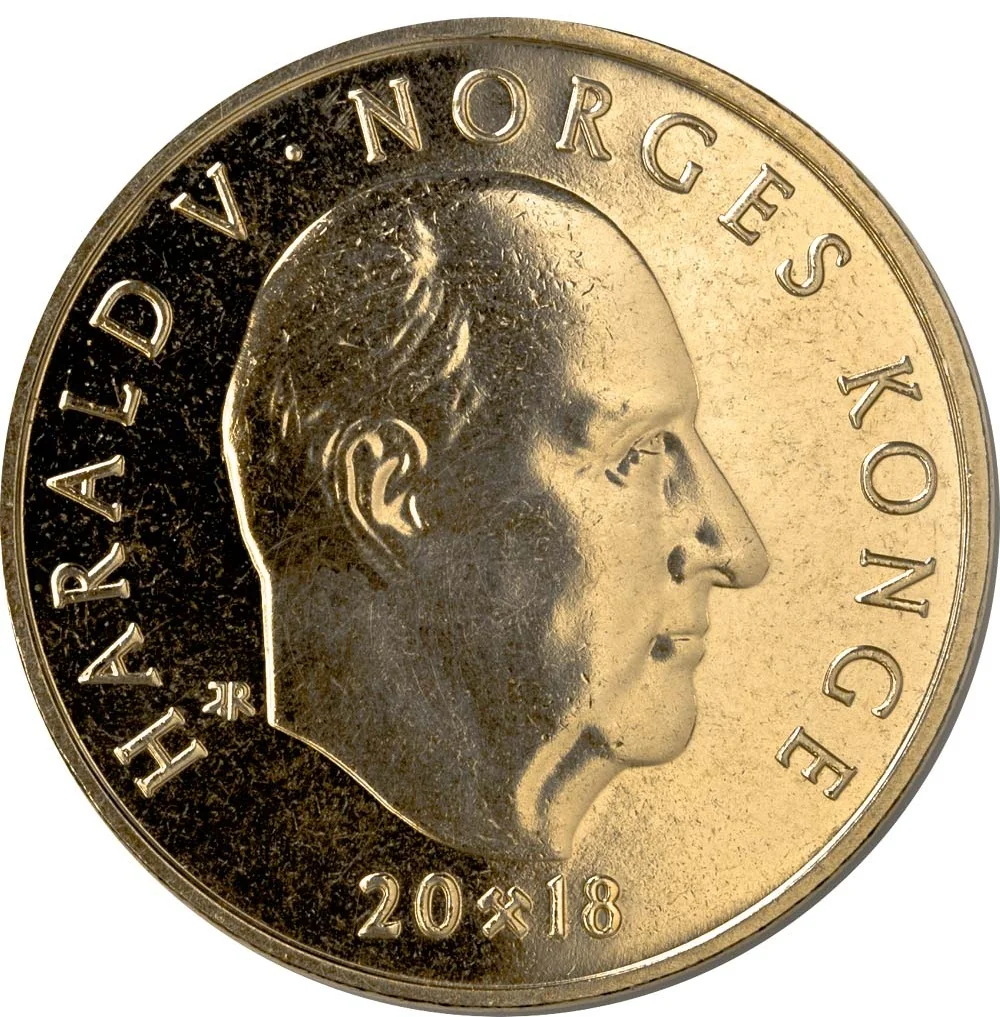
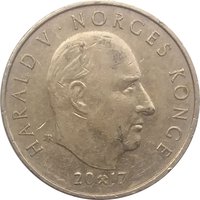
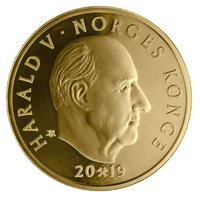
Bust of King Harald V facing right, with engraver's initials behind it. Inscription surrounds the bust, and a mintmark divides the date below. Solid ring on the rim.
Inscription:
HARALD V · NORGES KONGE
IAR
20 ⚒ 18
IAR
20 ⚒ 18
Translation:
Harald V, Norway's King
20th Anniversary of Reign 2018
20th Anniversary of Reign 2018
Script: Latin
Engraver: Ingrid Austlid Rise
Reverse
Description:
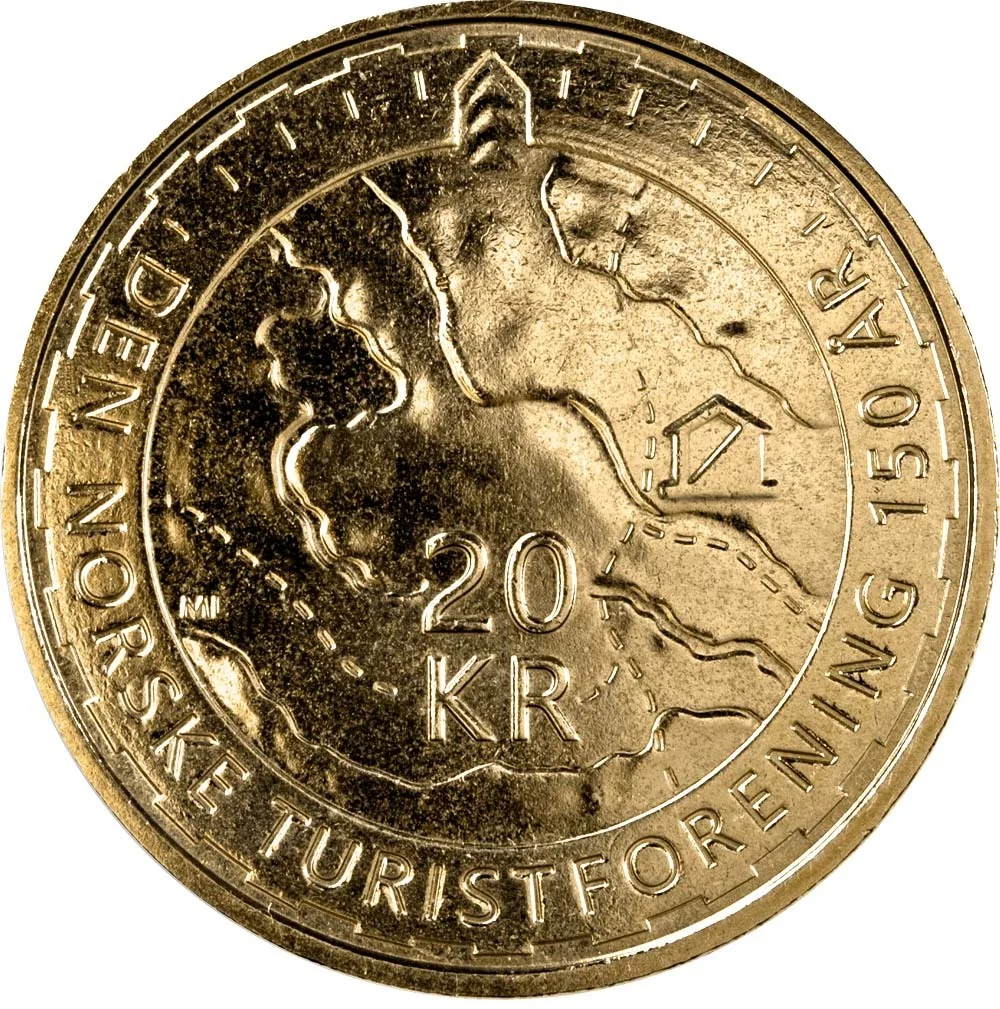
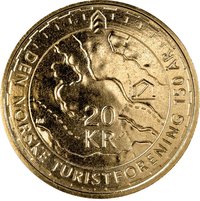
A hiking map with a lake, river, trails, and a cabin symbol inside a compass bezel. The denomination is inscribed vertically near the center, with further text on the bezel and the designer's initials to the left. The coin has a solid raised rim.
Inscription:
DEN NORSKE TURISTFORENING 150 ÅR
ML
20
KR
ML
20
KR
Translation:
The Norwegian Tourist Association 150 Years
20
Kroner
20
Kroner
Script: Latin
Language: Norwegian
Engraver: Martine Linge
Edge
Plain
Mints
| Name | Mark |
|---|---|
| Norwegian Mint | — |
Mintings
| Year | Mint Mark | Mintage | Quality | Collection |
|---|---|---|---|---|
| 2018 | — | 2,018,000 | ||
| 2018 | — | 2,350 | Proof |
Historical background
In 2018, Norway's currency situation was primarily characterized by the performance of the Norwegian krone (NOK), which experienced significant depreciation against major currencies like the US dollar and the euro throughout the year. The krone fell to its weakest level in over 16 years against the euro and a nine-year low against the dollar. This decline was largely driven by two interconnected factors: a cautious and dovish interest rate policy from Norges Bank (the central bank) and volatile, but generally lower, global oil prices. As a petro-currency, the krone is highly sensitive to oil market sentiment, and uncertainty in the market weighed heavily on its value.
Domestically, Norges Bank was navigating a delicate economic balance. While the broader Norwegian economy was strong with low unemployment, inflationary pressures remained subdued and household debt levels were high. This led the central bank to raise its key policy interest rate only once in September 2018—the first hike in seven years—and signal a very gradual tightening path. This measured approach, especially when compared to more aggressive tightening by the US Federal Reserve, reduced the krone's yield appeal for international investors, contributing to its weakness. The weak krone provided a boost to Norway's substantial non-oil export sectors, such as seafood and tourism, but also increased import costs and the price of foreign travel for Norwegians.
Overall, the 2018 currency landscape reflected Norway's ongoing adjustment in the post-2014 oil price shock era. The krone's depreciation was seen by many analysts as a structural recalibration rather than a purely cyclical event, influenced by a persistent risk premium assigned by global markets due to Norway's economic reliance on hydrocarbons. The situation underscored the challenges for monetary policy in an oil-dependent economy, tasked with managing inflation, financial stability, and external competitiveness simultaneously.
Domestically, Norges Bank was navigating a delicate economic balance. While the broader Norwegian economy was strong with low unemployment, inflationary pressures remained subdued and household debt levels were high. This led the central bank to raise its key policy interest rate only once in September 2018—the first hike in seven years—and signal a very gradual tightening path. This measured approach, especially when compared to more aggressive tightening by the US Federal Reserve, reduced the krone's yield appeal for international investors, contributing to its weakness. The weak krone provided a boost to Norway's substantial non-oil export sectors, such as seafood and tourism, but also increased import costs and the price of foreign travel for Norwegians.
Overall, the 2018 currency landscape reflected Norway's ongoing adjustment in the post-2014 oil price shock era. The krone's depreciation was seen by many analysts as a structural recalibration rather than a purely cyclical event, influenced by a persistent risk premium assigned by global markets due to Norway's economic reliance on hydrocarbons. The situation underscored the challenges for monetary policy in an oil-dependent economy, tasked with managing inflation, financial stability, and external competitiveness simultaneously.
🌱 Fairly Common