

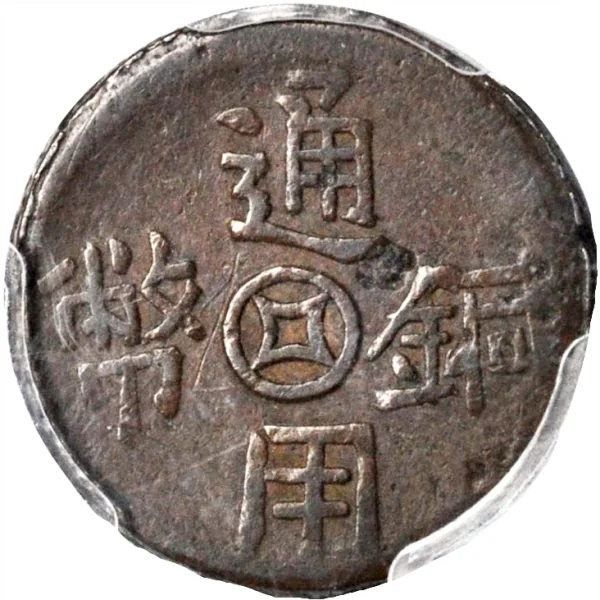
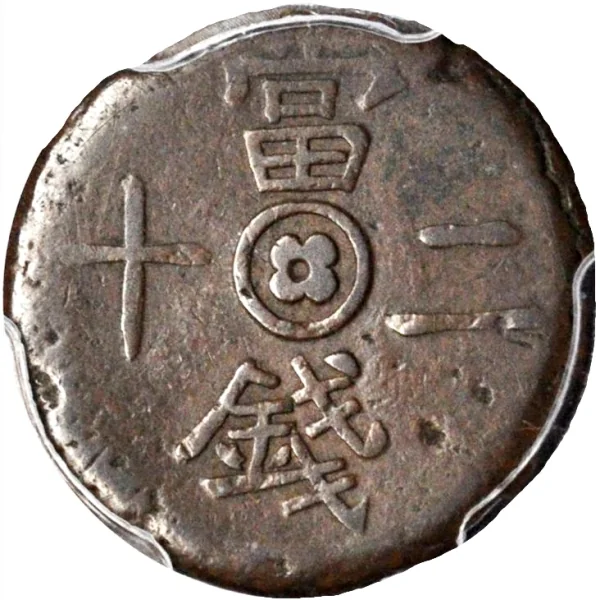
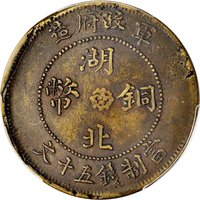
20 Cash – Hupeh Province
China
Context
Year: 1914
Country: China 
Issuer: Hupeh Province
Period:
(1912—1949)
Currency:
(1895—1949)
Demonetized: Yes
Material
References
Y: #Click to copy to clipboardA405
Numista: #277414
Obverse
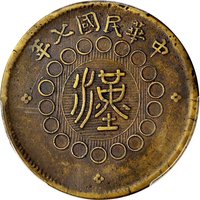
Reverse
Edge
Reeded.
Mintings
| Year | Mint Mark | Mintage | Quality | Collection |
|---|---|---|---|---|
| 1914 | — | — |
Historical background
In 1914, Hupeh (Hubei) Province found itself in a complex and fragmented currency situation, a microcosm of the monetary chaos prevalent in early Republican China. The province, with its major commercial hub at Hankow (Wuhan), was a critical intersection of domestic trade and foreign influence. The monetary system was not unified but operated through a confusing coexistence of several currency types. These included silver sycee (measured in taels), imperial-era copper cash coins, and a growing circulation of foreign silver dollars, particularly the Mexican "Eagle" dollar, which served as a dominant trade currency.
Alongside this, the most significant development was the circulation of banknotes issued by both modern Chinese banks and traditional native banks (qianzhuang). The provincial government itself, through the Hupeh Government Bank, issued notes, as did the newly established Bank of China, which had a branch in Hankow. Crucially, foreign banks, especially the British Hongkong and Shanghai Banking Corporation (HSBC) and the Japanese Yokohama Specie Bank, also issued their own banknotes, which held substantial credibility in international trade. This proliferation of issuers, without a central regulatory authority, led to varying degrees of public trust and exchange rates between different notes and silver.
The fundamental instability stemmed from the lack of a standardized unit of account or convertibility guarantee. Transactions required constant negotiation over whether payment was in "tael" units, silver dollars, or copper cash, and at what discount a banknote might be accepted. This environment created significant transaction costs, hindered commercial efficiency, and fostered speculation. While the newly formed Republican government in Beijing aimed to create a national currency, its authority in Hupeh was limited, and the province in 1914 remained entrenched in a pre-modern, multi-layered monetary system that reflected the political fragmentation and economic transition of the era.
Alongside this, the most significant development was the circulation of banknotes issued by both modern Chinese banks and traditional native banks (qianzhuang). The provincial government itself, through the Hupeh Government Bank, issued notes, as did the newly established Bank of China, which had a branch in Hankow. Crucially, foreign banks, especially the British Hongkong and Shanghai Banking Corporation (HSBC) and the Japanese Yokohama Specie Bank, also issued their own banknotes, which held substantial credibility in international trade. This proliferation of issuers, without a central regulatory authority, led to varying degrees of public trust and exchange rates between different notes and silver.
The fundamental instability stemmed from the lack of a standardized unit of account or convertibility guarantee. Transactions required constant negotiation over whether payment was in "tael" units, silver dollars, or copper cash, and at what discount a banknote might be accepted. This environment created significant transaction costs, hindered commercial efficiency, and fostered speculation. While the newly formed Republican government in Beijing aimed to create a national currency, its authority in Hupeh was limited, and the province in 1914 remained entrenched in a pre-modern, multi-layered monetary system that reflected the political fragmentation and economic transition of the era.
✨ Legendary