

2 Jiao – Hupeh Province
China
Context
Year: 1920
Chinese republican Year: 9
Country: China 
Issuer: Hupeh Province
Period:
(1912—1949)
Currency:
(1895—1949)
Demonetized: Yes
Material
References
Y: #Click to copy to clipboard406
Numista: #276566
Value
Bullion value: $15.57
Obverse
Description:
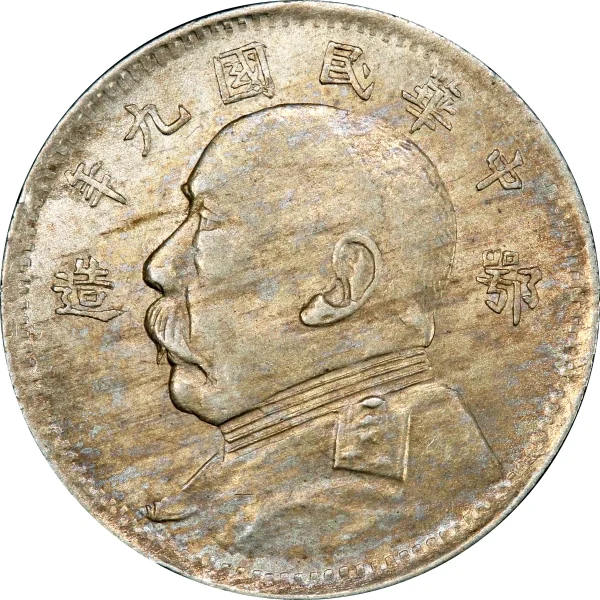
Bust of Yuan Shikai facing left, surrounded by Chinese ideograms.
Inscription:
年九國民華中
造鄂
造鄂
Translation:
Year 9 of the Republic of China
Made in Hubei
Made in Hubei
Script: Chinese
Language: Chinese
Engraver: Luigi Giorgi
Reverse
Description:
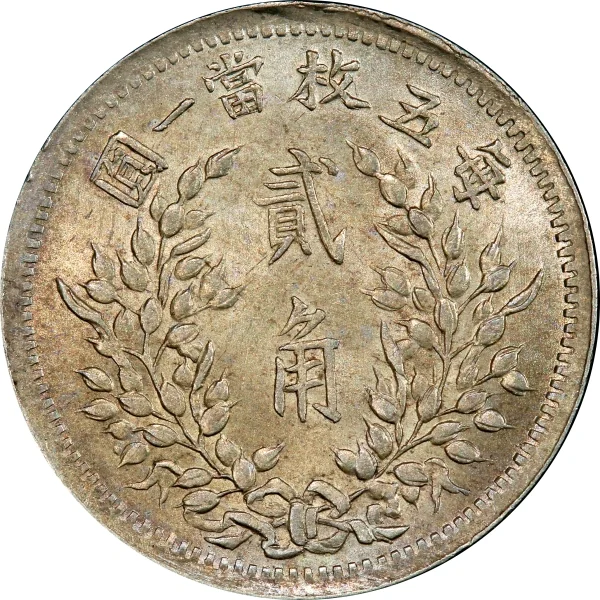
Chinese ideograms in wreath, more above.
Inscription:
圓一當枚五每
貳
角
貳
角
Translation:
One yuan equals five pieces, two jiao each.
Script: Chinese
Language: Chinese
Engraver: Luigi Giorgi
Edge
Reeded.
Categories
| Person> Politician |
| Mustache/Beard |
| Symbol> Wreath |
Mintings
| Year | Mint Mark | Mintage | Quality | Collection |
|---|---|---|---|---|
| 1920 | — | — |
Historical background
In 1920, the currency situation in Hupeh (Hubei) Province was chaotic and inflationary, reflecting the broader fragmentation of China during the Warlord Era. The province, under the control of the Zhili military clique, faced severe financial strain due to constant military requisitions and a lack of unified central fiscal authority. While the silver yuan remained the official national currency, its circulation was limited. Instead, the monetary landscape was dominated by a flood of unbacked paper notes, primarily issued by local banks, provincial authorities, and even military commanders to cover their escalating expenses.
The most notorious instruments were the "Hupeh Government Bank Notes" and various military scrip, which were printed in excessive volumes with inadequate silver reserves. This led to rapid depreciation and widespread loss of public confidence. Merchants and the populace were forced to navigate a complex hierarchy of currencies, where notes from different issuers traded at steep and fluctuating discounts against silver. The situation created a crippling environment for commerce, as transaction risks and uncertainty hampered trade both within the province and with neighboring regions.
This monetary disorder was a direct symptom of political disintegration. The Beijing government's inability to enforce a unified currency system allowed provincial warlords to treat note-issuing as a short-term revenue tool, with little regard for long-term economic stability. Consequently, by 1920, the people of Hupeh were grappling with de facto hyperinflation, a severe erosion of savings, and a deep distrust of paper money, which reinforced their preference for heavy silver coinage in any substantial or reliable transaction.
The most notorious instruments were the "Hupeh Government Bank Notes" and various military scrip, which were printed in excessive volumes with inadequate silver reserves. This led to rapid depreciation and widespread loss of public confidence. Merchants and the populace were forced to navigate a complex hierarchy of currencies, where notes from different issuers traded at steep and fluctuating discounts against silver. The situation created a crippling environment for commerce, as transaction risks and uncertainty hampered trade both within the province and with neighboring regions.
This monetary disorder was a direct symptom of political disintegration. The Beijing government's inability to enforce a unified currency system allowed provincial warlords to treat note-issuing as a short-term revenue tool, with little regard for long-term economic stability. Consequently, by 1920, the people of Hupeh were grappling with de facto hyperinflation, a severe erosion of savings, and a deep distrust of paper money, which reinforced their preference for heavy silver coinage in any substantial or reliable transaction.
✨ Legendary