


Obverse
Description:
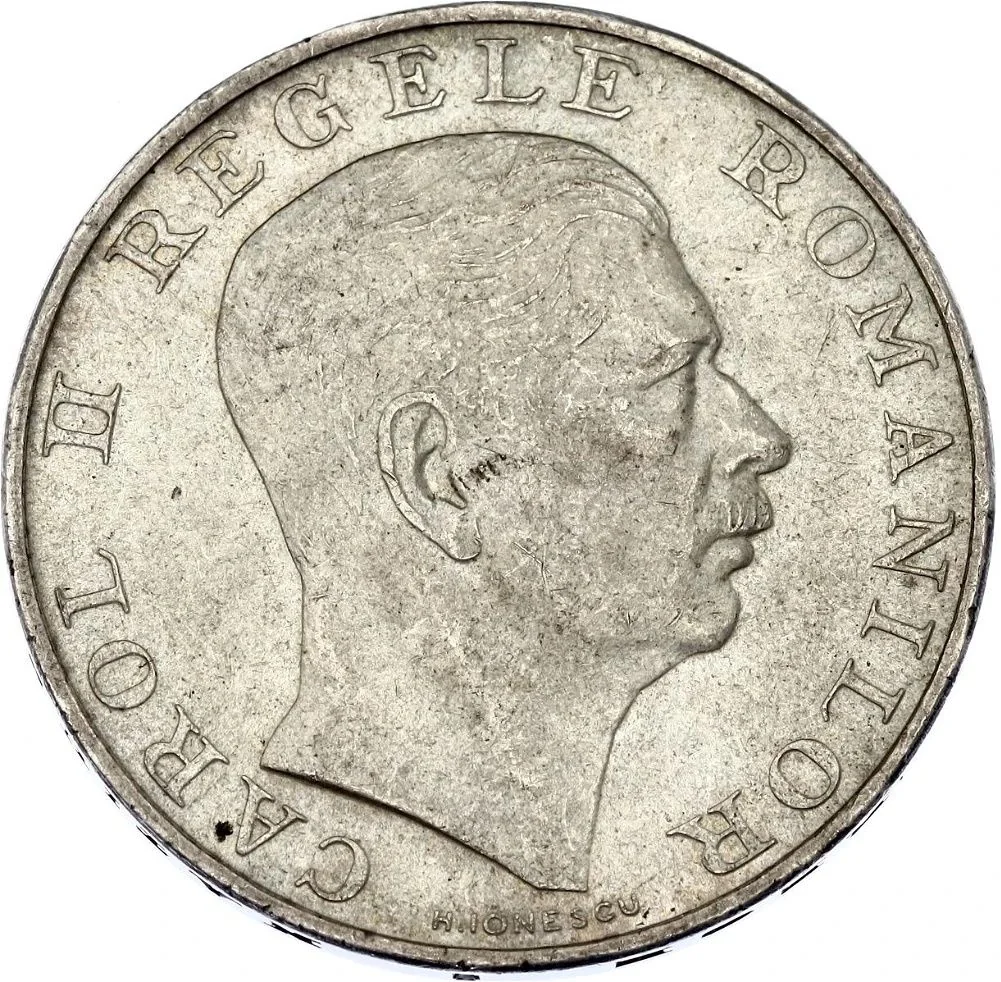
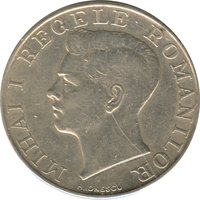
King Carol II, right profile. Circular legend: "CAROL II KING OF THE ROMANS". Engraver's name.
Inscription:
CAROL II REGELE ROMANILOR
H. IONESCU
H. IONESCU
Translation:
Carol II King of the Romanians
H. Ionescu
H. Ionescu
Script: Latin
Language: Romanian
Engraver: Haralambie Ionescu
Reverse
Description:
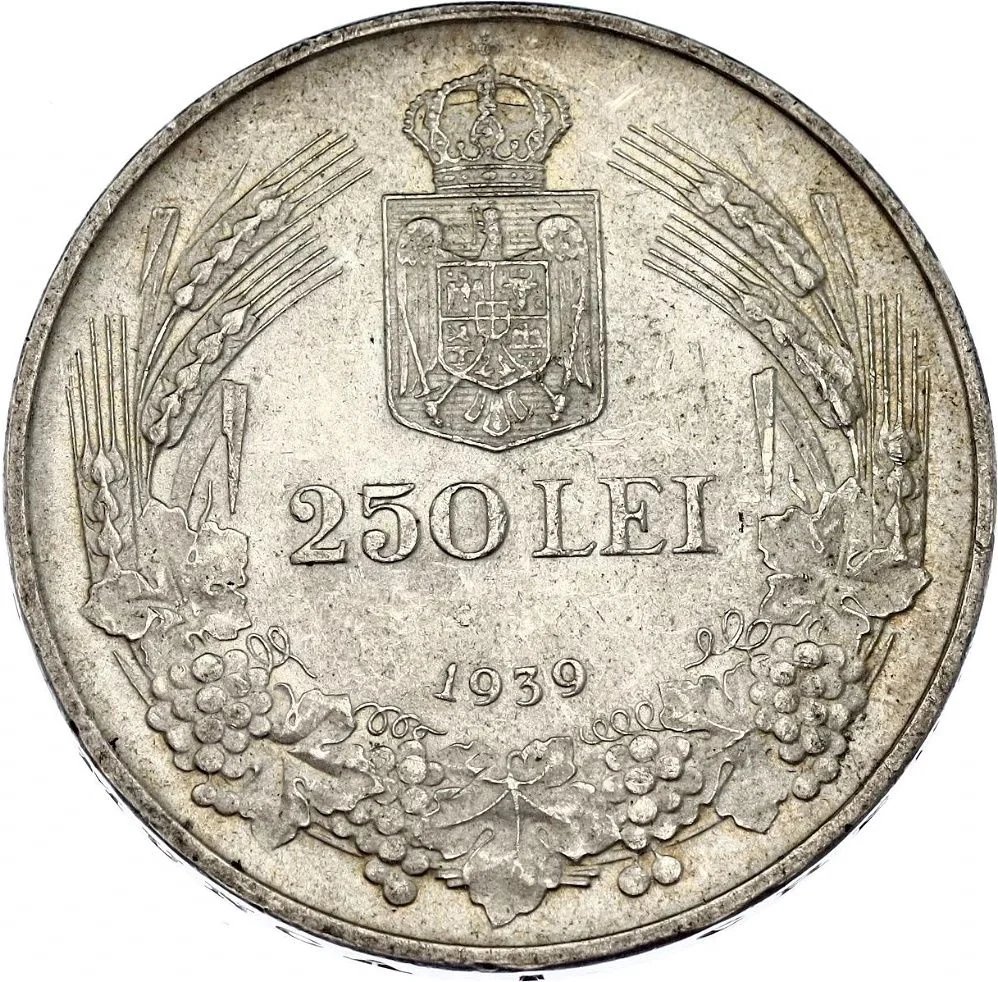
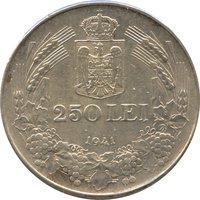
250" LEI emblem with vintage year, encircled by grape and wheat wreath.
Inscription:
250 LEI
1939
1939
Script: Latin
Engraver: Haralambie Ionescu
Edge
Inscripted
Legend:
+ MUNCA + CREDINTA + REGE + NATIUNE
Mints
| Name | Mark |
|---|---|
| State Mint | — |
Mintings
| Year | Mint Mark | Mintage | Quality | Collection |
|---|---|---|---|---|
| 1939 | — | 10,000,000 | ||
| 1940 | — | 8,000,000 |
Historical background
In 1939, Romania's currency, the leu, was under significant strain, reflecting the nation's precarious political and economic position on the eve of World War II. The country was a key supplier of oil and grain to Nazi Germany, creating a complex dependency. This relationship led to the signing of the Economic Treaty of 1939, which tied the Romanian economy to the German war machine and established an unfavorable clearing system. While this provided a guaranteed market for Romanian exports, it also drained resources, distorted prices, and placed the leu under indirect German influence, limiting Romania's monetary sovereignty.
Domestically, the National Bank of Romania struggled with the legacy of the Great Depression and the fiscal policies of King Carol II's authoritarian regime. The government ran substantial deficits, financing extensive rearmament and ambitious public works projects, which increased public debt and inflationary pressures. To manage this, a system of exchange controls and multiple exchange rates was maintained, artificially propping up the leu's official value while a active black market for foreign currency flourished. This created a dual economy where the official exchange rate was largely symbolic for international trade conducted under state direction.
Ultimately, the currency situation in 1939 was one of controlled instability. The leu was not freely convertible, its value was politically managed, and its stability was entirely dependent on the continuance of forced German trade and strict domestic controls. This fragile arrangement left Romania's economy vulnerable to external shocks, a vulnerability that would be fully exposed following the outbreak of war and the subsequent shifting alliances, leading to severe devaluation and hyperinflation in the years immediately following.
Domestically, the National Bank of Romania struggled with the legacy of the Great Depression and the fiscal policies of King Carol II's authoritarian regime. The government ran substantial deficits, financing extensive rearmament and ambitious public works projects, which increased public debt and inflationary pressures. To manage this, a system of exchange controls and multiple exchange rates was maintained, artificially propping up the leu's official value while a active black market for foreign currency flourished. This created a dual economy where the official exchange rate was largely symbolic for international trade conducted under state direction.
Ultimately, the currency situation in 1939 was one of controlled instability. The leu was not freely convertible, its value was politically managed, and its stability was entirely dependent on the continuance of forced German trade and strict domestic controls. This fragile arrangement left Romania's economy vulnerable to external shocks, a vulnerability that would be fully exposed following the outbreak of war and the subsequent shifting alliances, leading to severe devaluation and hyperinflation in the years immediately following.
🌟 Uncommon