

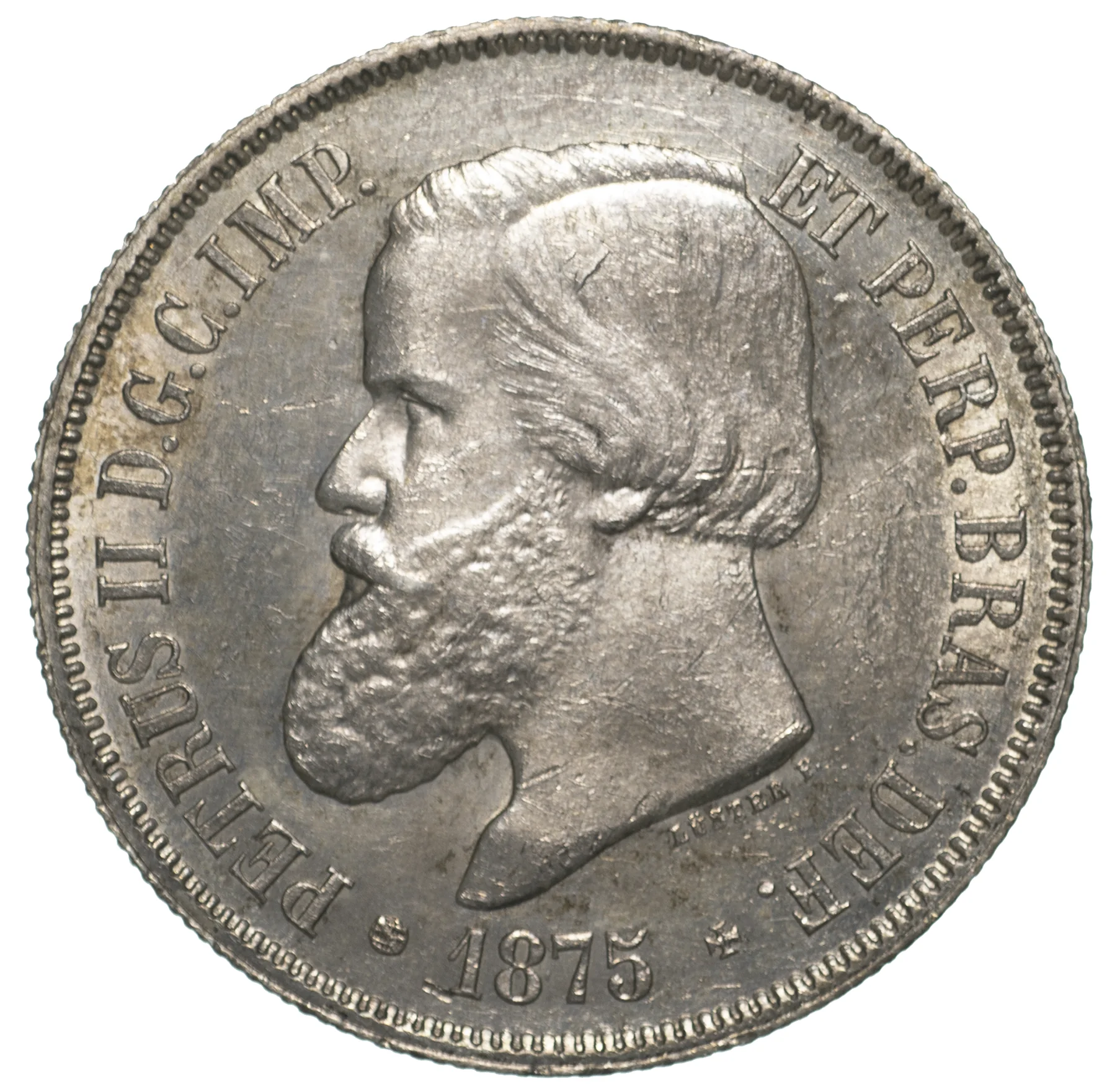
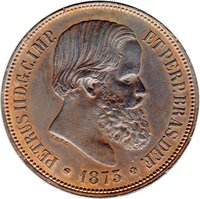
Obverse
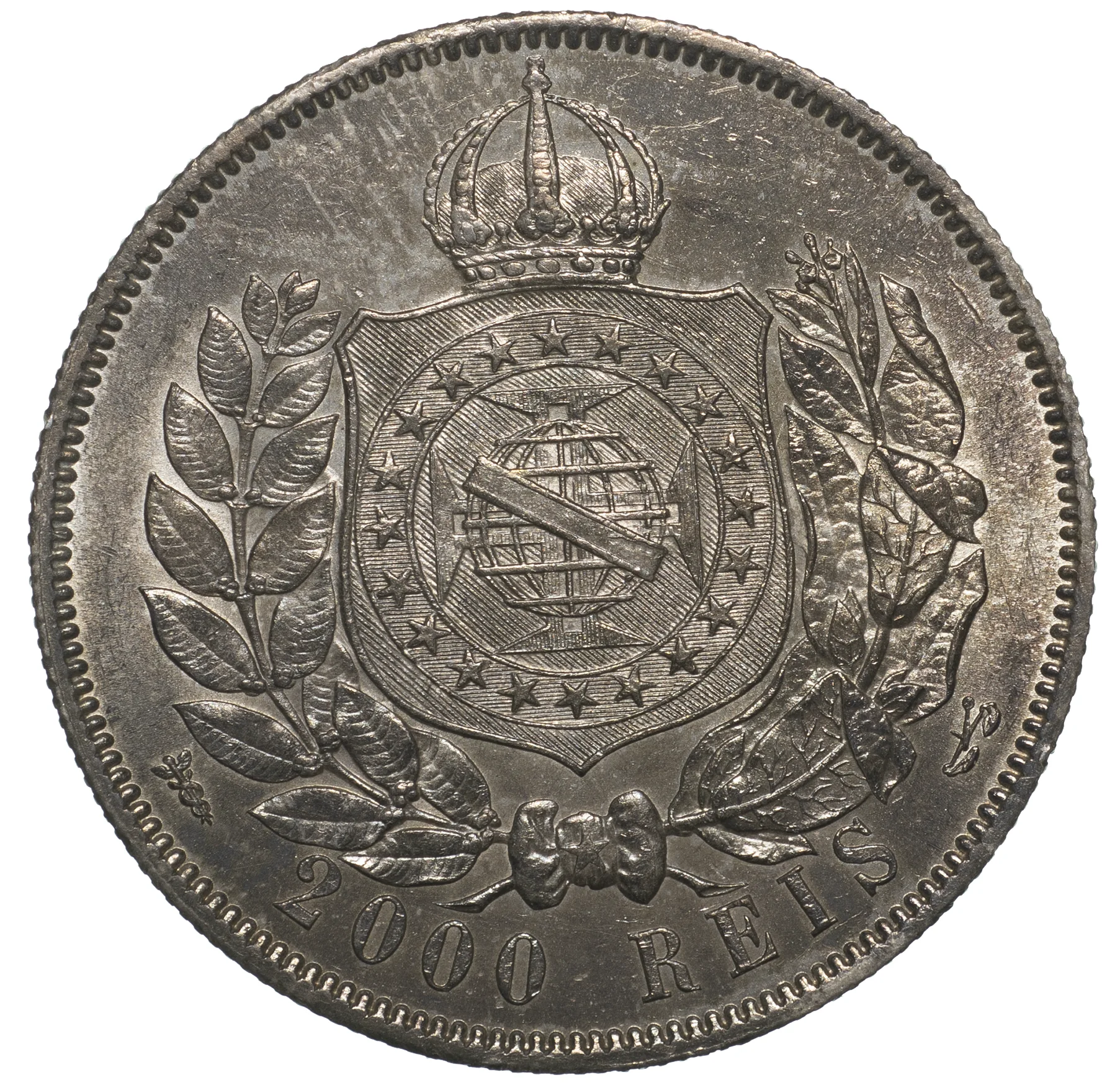
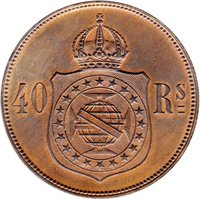
Reverse
Edge
Mints
| Name | Mark |
|---|---|
| Casa da Moeda do Brasil | — |
Mintings
| Year | Mint Mark | Mintage | Quality | Collection |
|---|---|---|---|---|
| 1875 | — | — | ||
| 1876 | — | — |
Historical background
In 1875, Brazil's currency system was characterized by significant complexity and inflationary pressures, rooted in the policies of the preceding decades. The primary unit was the mil-réis, but the circulating medium was a chaotic mix of paper money, copper coins, and gold. Most notably, the government had long relied on the issuance of inconvertible paper currency by the Treasury and private banks to finance deficits, leading to a substantial and growing divergence between the value of this paper mil-réis and the gold-backed mil-réis. This resulted in a persistent premium on gold, a fluctuating exchange rate, and eroding purchasing power.
The situation was a direct legacy of the Law of Impediments (Lei dos Entraves) of 1860, which had sought to stabilize the currency by restricting new banknote issues but had ultimately failed. By 1875, the economy was still recovering from the financial strain of the Paraguayan War (1864-1870), which had been funded almost entirely by the printing press, dramatically increasing the money supply. While the war was over, the inflationary consequences lingered, and the Treasury continued to issue paper to cover ongoing budget shortfalls. The public held little confidence in the paper currency's value, and foreign merchants trading in coffee and other exports insisted on transactions in gold or at rates accounting for the steep discount on paper.
Consequently, Brazil operated with a de facto floating exchange rate for its paper currency against sterling and other gold-backed currencies, with the premium determined by market distrust and the volume of notes in circulation. This environment created uncertainty for both domestic business and international trade, which was the lifeblood of the empire. Discussions about a return to metal-backed convertibility were ongoing among statesmen and economists, but in 1875, no decisive action had been taken, leaving the currency system unstable and awaiting the reforms that would later be attempted, with limited success, in the 1880s.
The situation was a direct legacy of the Law of Impediments (Lei dos Entraves) of 1860, which had sought to stabilize the currency by restricting new banknote issues but had ultimately failed. By 1875, the economy was still recovering from the financial strain of the Paraguayan War (1864-1870), which had been funded almost entirely by the printing press, dramatically increasing the money supply. While the war was over, the inflationary consequences lingered, and the Treasury continued to issue paper to cover ongoing budget shortfalls. The public held little confidence in the paper currency's value, and foreign merchants trading in coffee and other exports insisted on transactions in gold or at rates accounting for the steep discount on paper.
Consequently, Brazil operated with a de facto floating exchange rate for its paper currency against sterling and other gold-backed currencies, with the premium determined by market distrust and the volume of notes in circulation. This environment created uncertainty for both domestic business and international trade, which was the lifeblood of the empire. Discussions about a return to metal-backed convertibility were ongoing among statesmen and economists, but in 1875, no decisive action had been taken, leaving the currency system unstable and awaiting the reforms that would later be attempted, with limited success, in the 1880s.
⭐ Somewhat Rare