

Obverse
Description:
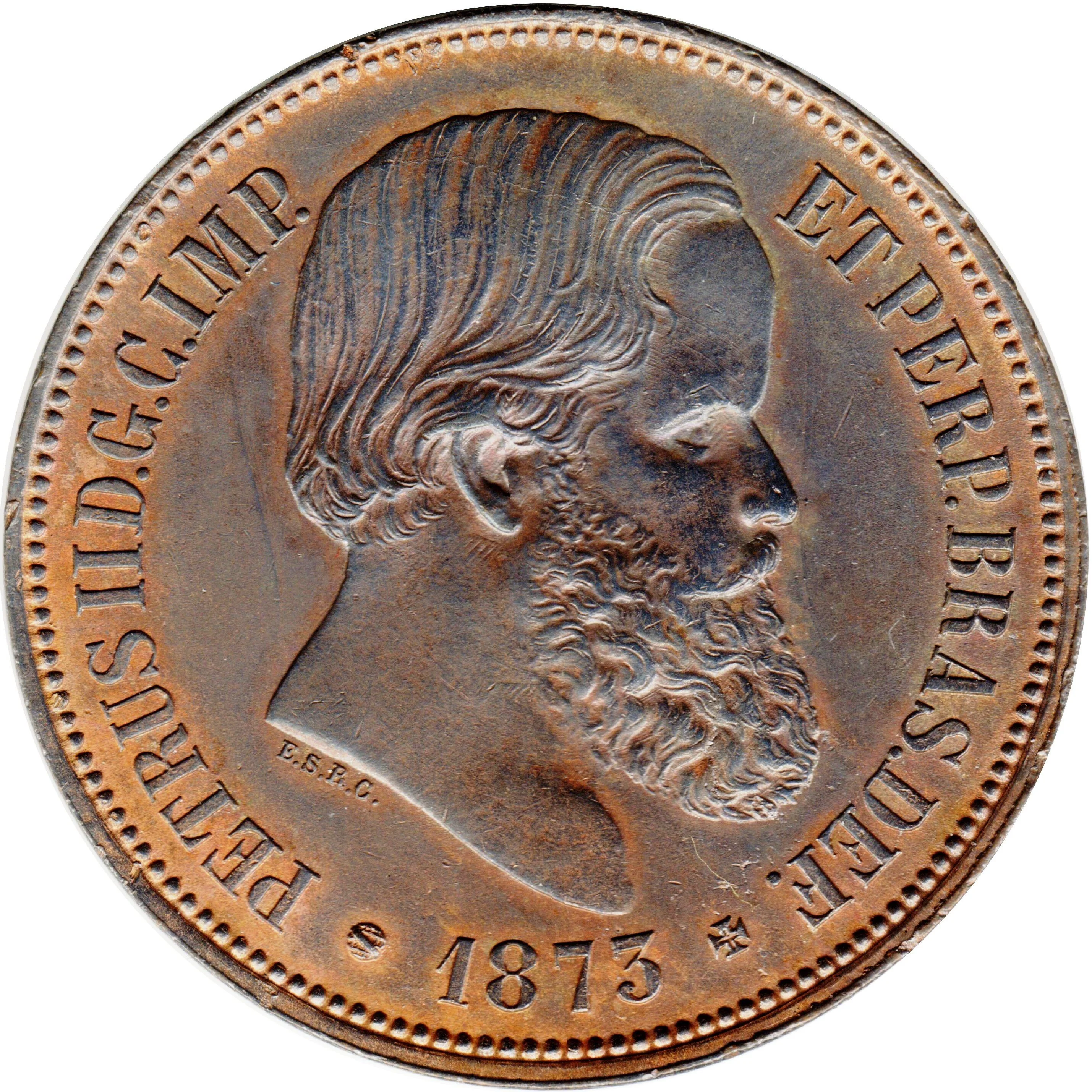
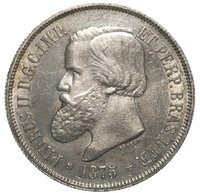
Portrait of Pedro II, Emperor of Brazil (1831–1889).
Inscription:
PETRUS II D.G.C.IMP. ET PERP.BRAS.DEF
ESCR
1880
ESCR
1880
Translation:
Peter II, by the Grace of God, Constitutional Emperor and Perpetual Defender of Brazil
Escudo
1880
Escudo
1880
Script: Latin
Language: Latin
Engraver: Ernesto de Souza Reis Carvalho
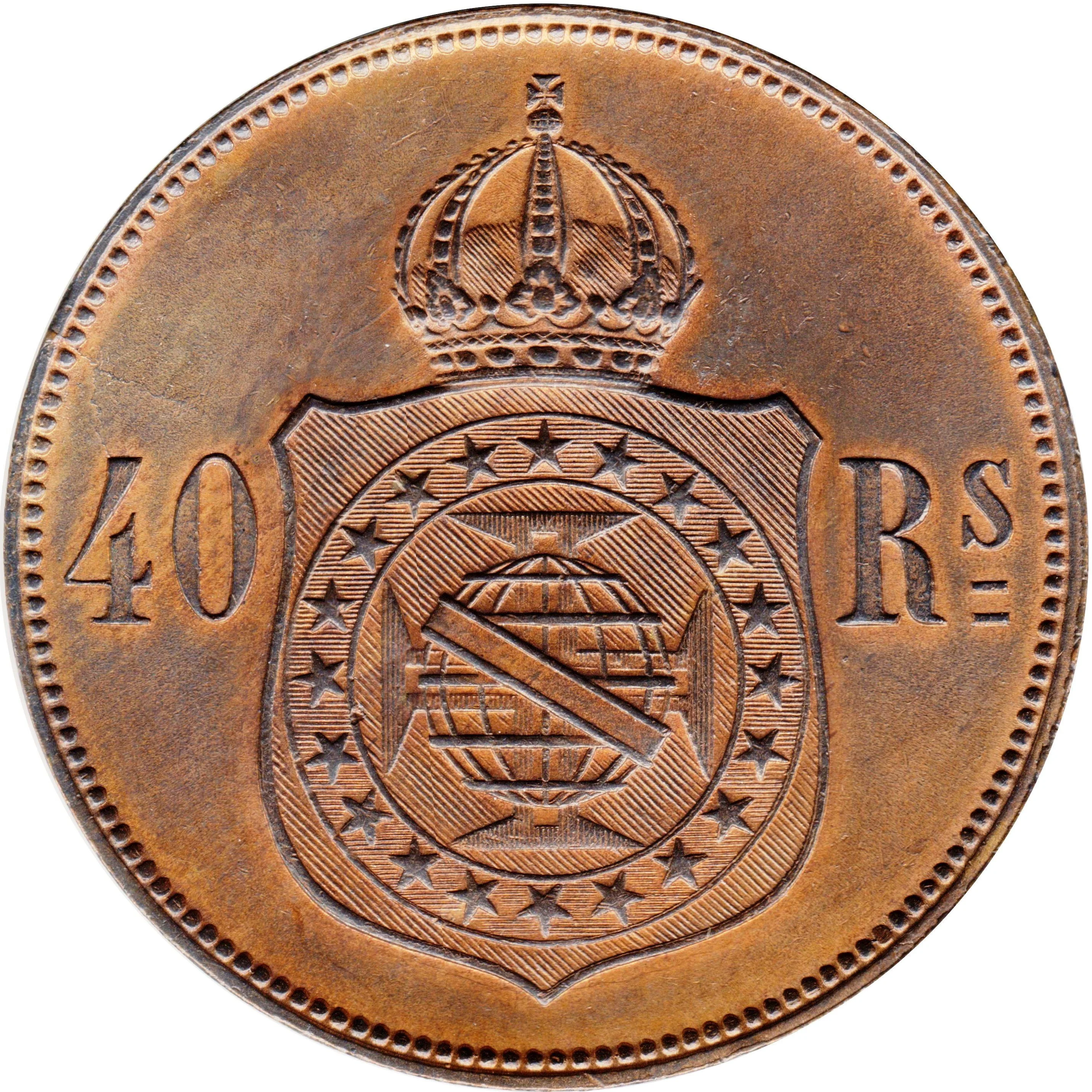
Reverse
Edge
Plain
Mintings
| Year | Mint Mark | Mintage | Quality | Collection |
|---|---|---|---|---|
| 1873 | — | 3,750,000 | ||
| 1874 | — | 890,000 | ||
| 1875 | — | 1,207,800 | ||
| 1876 | — | 548,750 | ||
| 1877 | — | 465,000 | ||
| 1878 | — | 1,222,500 | ||
| 1879 | — | 2,771,250 | ||
| 1880 | — | 1,568,750 |
Historical background
In 1873, Brazil’s currency system was in a state of profound transition and instability, rooted in the policies of the preceding decades. The Empire operated under a bimetallic standard in law, but in practice, the currency was dominated by paper money. A key driver of this was the Law of Impediments (Lei dos Entraves) of 1860, which aimed to curb the expansion of banknote issuance but ultimately failed. Instead, the government itself became the primary source of monetary expansion, issuing vast amounts of Treasury notes (papel-moeda) to cover chronic budget deficits, particularly exacerbated by the costly Paraguayan War (1864-1870). By 1873, the volume of inconvertible paper currency in circulation was high, leading to a significant and fluctuating premium on gold.
The year itself was a point of precarious calm before a gathering storm. The immediate post-war period saw a speculative boom, fueled by easy paper credit and high coffee prices. However, the international Panic of 1873, which began in Vienna and New York, soon impacted Brazil by depressing demand and prices for its primary exports, particularly coffee. This external shock exposed the fragility of the Brazilian monetary system. The falling value of the paper milréis against gold made servicing the substantial foreign debt, contracted in sterling for the war, increasingly expensive, straining public finances further.
Consequently, the core monetary issue of 1873 was the pressing debate over a return to metal convertibility (metallicismo) versus maintaining a flexible, managed paper currency (papelismo). Orthodox economists and foreign creditors advocated for a painful deflationary policy to restore parity with gold, while powerful domestic coffee planters and industrialists, reliant on cheap credit, resisted such measures. The government of the Viscount of Rio Branco, while fiscally conservative, was politically unable to enact drastic contraction. Thus, 1873 stands as a pivotal moment when the structural weaknesses of Brazil’s financial system—fiscal deficits, an inflated money supply, and dependence on a single export—were laid bare by global economic currents, setting the stage for the severe currency crises and inflationary pressures that would mark the later 1870s and 1880s.
The year itself was a point of precarious calm before a gathering storm. The immediate post-war period saw a speculative boom, fueled by easy paper credit and high coffee prices. However, the international Panic of 1873, which began in Vienna and New York, soon impacted Brazil by depressing demand and prices for its primary exports, particularly coffee. This external shock exposed the fragility of the Brazilian monetary system. The falling value of the paper milréis against gold made servicing the substantial foreign debt, contracted in sterling for the war, increasingly expensive, straining public finances further.
Consequently, the core monetary issue of 1873 was the pressing debate over a return to metal convertibility (metallicismo) versus maintaining a flexible, managed paper currency (papelismo). Orthodox economists and foreign creditors advocated for a painful deflationary policy to restore parity with gold, while powerful domestic coffee planters and industrialists, reliant on cheap credit, resisted such measures. The government of the Viscount of Rio Branco, while fiscally conservative, was politically unable to enact drastic contraction. Thus, 1873 stands as a pivotal moment when the structural weaknesses of Brazil’s financial system—fiscal deficits, an inflated money supply, and dependence on a single export—were laid bare by global economic currents, setting the stage for the severe currency crises and inflationary pressures that would mark the later 1870s and 1880s.
🌱 Common