

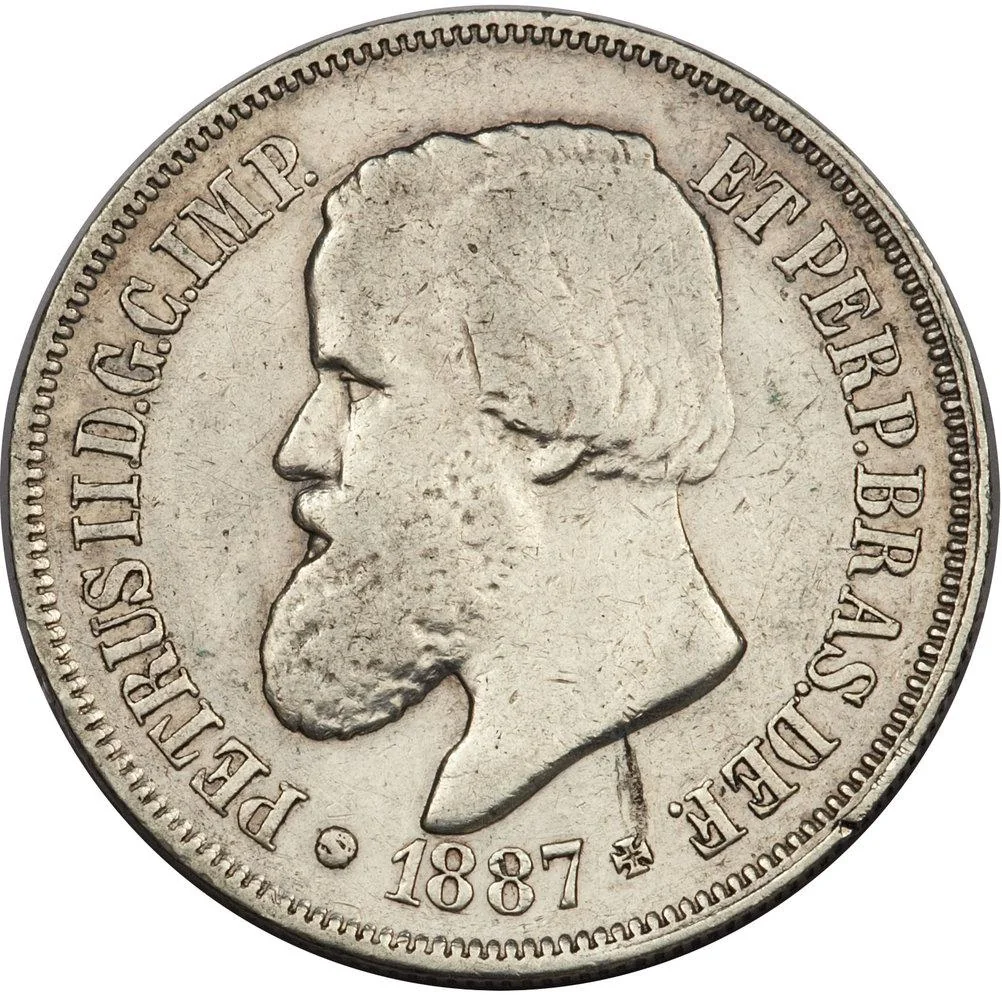
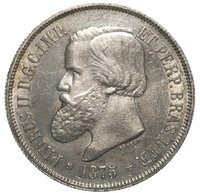
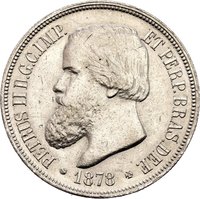
Obverse
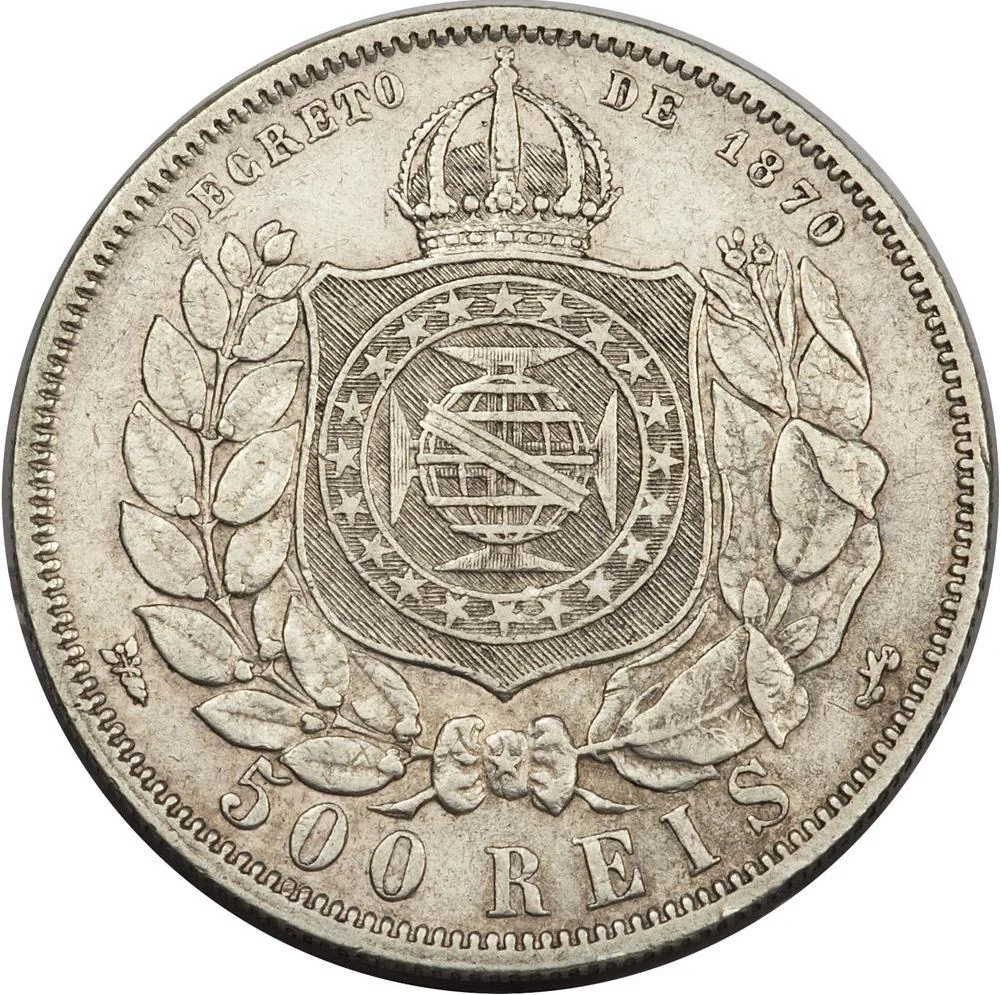
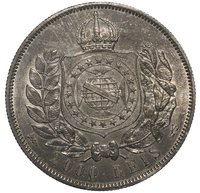
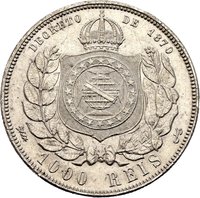
Reverse
Description:
Arms of the Brazilian Empire with the name below.
Inscription:
DECRETO DE 1870
500 RÉIS
500 RÉIS
Translation:
By Decree of 1870
500 Réis
500 Réis
Script: Latin
Language: Portuguese
Edge
Reeded
Mints
| Name | Mark |
|---|---|
| Casa da Moeda do Brasil | — |
Mintings
| Year | Mint Mark | Mintage | Quality | Collection |
|---|---|---|---|---|
| 1876 | — | 76,440 | ||
| 1886 | — | 5,283 | ||
| 1887 | — | 769 | ||
| 1888 | — | 244,603 | ||
| 1889 | — | 277,883 |
Historical background
In 1876, Brazil's currency situation was characterized by the widespread circulation of multiple, often depreciated, forms of money under a de facto bimetallic system. The official standard was the gold milréis, but in practice, silver coins and, most problematically, a flood of low-quality copper and bronze coins issued by provincial governments dominated everyday transactions. This unregulated provincial issuance, intended to address chronic small-change shortages, led to severe inflation of fractional currency and a disconnect between its face value and its metallic worth, creating confusion and hindering commerce.
The imperial government in Rio de Janeiro was engaged in a protracted struggle to assert central control over the monetary system. A key reform in 1875 had demonetized the debased provincial copper coins, but the process of replacing them with new, centrally issued bronze coins was slow and incomplete. Consequently, in 1876, the public still dealt with a messy mix of old and new coins of varying acceptability, while the paper money issued by the Treasury and the Banco do Brasil, though more stable, was primarily used for larger transactions in major commercial centers.
Underlying these circulatory issues was a broader economic context of exchange rate vulnerability. The value of the paper milréis against gold was influenced by Brazil's balance of payments, heavily dependent on coffee exports. While the 1870s were a period of general stability for the paper currency, the system remained exposed to external shocks. Thus, in 1876, the currency situation was one of transition and fragmentation, with the central government attempting to impose uniformity on a historically decentralized and complex monetary landscape, while the economy's dependence on a single commodity created a persistent backdrop of potential instability.
The imperial government in Rio de Janeiro was engaged in a protracted struggle to assert central control over the monetary system. A key reform in 1875 had demonetized the debased provincial copper coins, but the process of replacing them with new, centrally issued bronze coins was slow and incomplete. Consequently, in 1876, the public still dealt with a messy mix of old and new coins of varying acceptability, while the paper money issued by the Treasury and the Banco do Brasil, though more stable, was primarily used for larger transactions in major commercial centers.
Underlying these circulatory issues was a broader economic context of exchange rate vulnerability. The value of the paper milréis against gold was influenced by Brazil's balance of payments, heavily dependent on coffee exports. While the 1870s were a period of general stability for the paper currency, the system remained exposed to external shocks. Thus, in 1876, the currency situation was one of transition and fragmentation, with the central government attempting to impose uniformity on a historically decentralized and complex monetary landscape, while the economy's dependence on a single commodity created a persistent backdrop of potential instability.
🌱 Fairly Common