

1 Fen – Manchurian Provinces
China
Context
Year: 1929
Chinese republican Year: 18
Country: China 
Issuer: Manchurian Provinces
Period:
(1912—1949)
Currency:
(1907—1931)
Demonetized: Yes
Material
References
Y: #Click to copy to clipboard434
Numista: #42343
Obverse
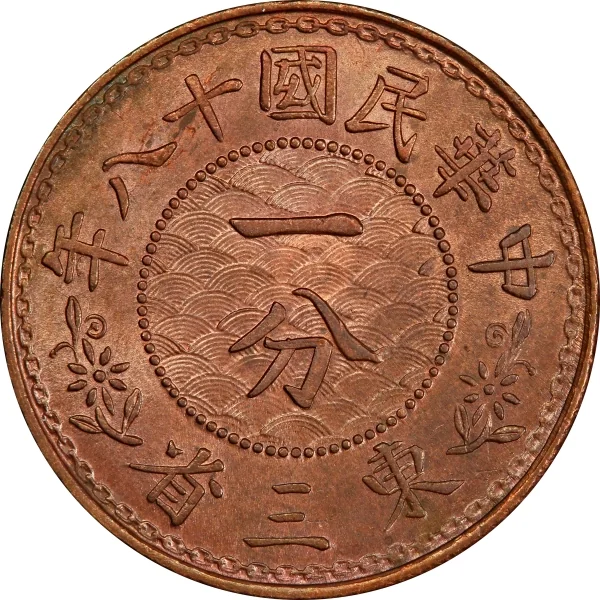
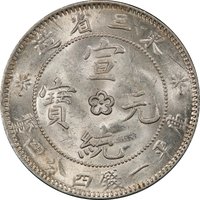
Description:
Two Chinese characters amid others, with two flowers.
Inscription:
年八十國民華中
一
分
省三東
一
分
省三東
Translation:
Eighty years of the Republic of China
One
Cent
Shantung Province
One
Cent
Shantung Province
Language: Chinese
Reverse
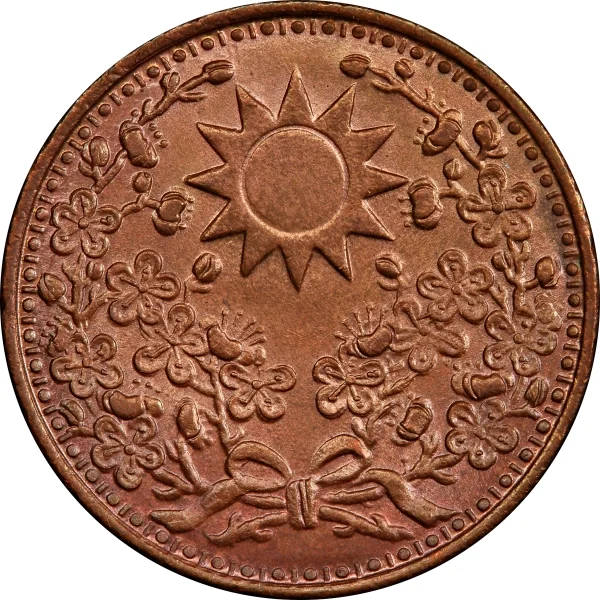
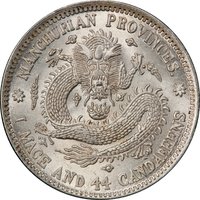
Description:
Sun over a floral wreath.
Edge
Plain
Mintings
| Year | Mint Mark | Mintage | Quality | Collection |
|---|---|---|---|---|
| 1929 | — | — |
Historical background
In 1929, the currency situation in China's northeastern provinces, commonly referred to as Manchuria, was characterized by profound instability and fragmentation, a direct legacy of the region's recent political history. Following the fall of the Qing Dynasty, the area had been dominated by the Fengtian warlord clique, which issued its own banknotes, primarily the Fengtian yuan/ dollar. However, after the assassination of warlord Zhang Zuolin in 1928, his son Zhang Xueliang pledged nominal allegiance to the Nationalist Government (KMT) in Nanjing. This political shift created a currency limbo: while the region was now ostensibly under the Chinese Republic, the Nanjing government's unified currency reforms had not yet been effectively implemented in the northeast, leaving local notes dominant but their authority weakened.
The monetary landscape was further complicated by the pervasive circulation of multiple, competing forms of money. Alongside the official Fengtian notes, a plethora of older provincial banknotes, local scrip issued by merchants and municipalities, and even notes from the previous era of the Russian-owned Chinese Eastern Railway circulated with varying degrees of acceptance. Most significantly, the Japanese yen and notes from the Bank of Chosen (Korea) and the Bank of Taiwan held substantial influence, particularly in the Japanese-controlled Kwantung Leased Territory and the South Manchuria Railway Zone. This created a multi-tiered system where Japanese currency was often preferred for major transactions and foreign trade, undermining Chinese monetary sovereignty.
This chaotic environment led to severe practical problems, including widespread counterfeiting, volatile exchange rates between the different note issues, and frequent bank runs as public confidence wavered. The instability hampered commercial activity and regional development. Ultimately, the currency disorder of 1929 was a microcosm of the broader contest for control of resource-rich Manchuria, reflecting the weak central authority of the Nanjing government, the lingering autonomy of local authorities, and the deepening economic encroachment of Japan, which would culminate in the military occupation of the region just two years later in 1931.
The monetary landscape was further complicated by the pervasive circulation of multiple, competing forms of money. Alongside the official Fengtian notes, a plethora of older provincial banknotes, local scrip issued by merchants and municipalities, and even notes from the previous era of the Russian-owned Chinese Eastern Railway circulated with varying degrees of acceptance. Most significantly, the Japanese yen and notes from the Bank of Chosen (Korea) and the Bank of Taiwan held substantial influence, particularly in the Japanese-controlled Kwantung Leased Territory and the South Manchuria Railway Zone. This created a multi-tiered system where Japanese currency was often preferred for major transactions and foreign trade, undermining Chinese monetary sovereignty.
This chaotic environment led to severe practical problems, including widespread counterfeiting, volatile exchange rates between the different note issues, and frequent bank runs as public confidence wavered. The instability hampered commercial activity and regional development. Ultimately, the currency disorder of 1929 was a microcosm of the broader contest for control of resource-rich Manchuria, reflecting the weak central authority of the Nanjing government, the lingering autonomy of local authorities, and the deepening economic encroachment of Japan, which would culminate in the military occupation of the region just two years later in 1931.

⭐ Somewhat Rare