

20 fen – Manchurian Provinces
Add to wishlist
China
Context
Years: 1909–1910
Chinese - Xuantong era Year:: 1
Country: China
Issuer: Manchurian Provinces
Ruler: Xuantong
Currency:
(1907—1931)
Demonetized: Yes
Material
References
Y: #
Numista: #22476
Value
Bullion value: $11.78
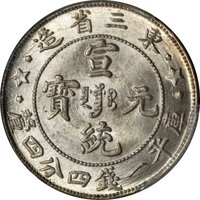
Obverse
Description:
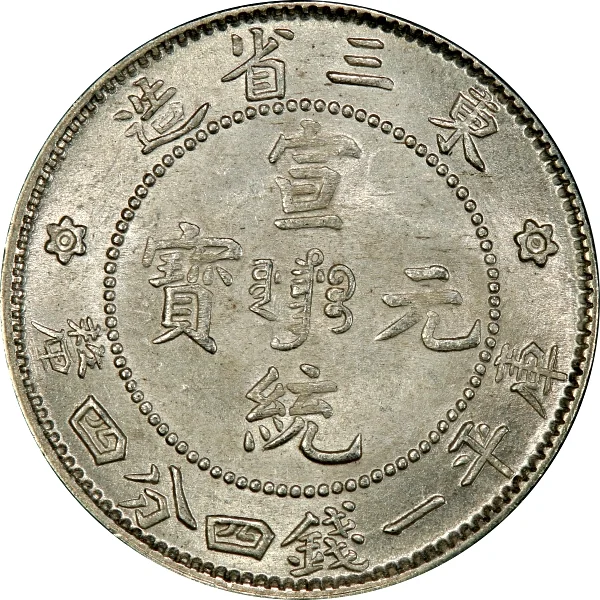
Chinese ideograms read vertically, right to left, with Manchu text in the center, all encircled by more Chinese characters.
Inscription:
造省三東
宣
寶 ᠶᡠᠸᠠᠨ ᡩᠠᡳᠴᡳᠩ ᠪᠣᠣ 元
統
釐四分四錢一平庫
宣
寶 ᠶᡠᠸᠠᠨ ᡩᠠᡳᠴᡳᠩ ᠪᠣᠣ 元
統
釐四分四錢一平庫
Translation:
Made in the Eastern Provinces
Xuan
Yuan Bao (Silver Coin) of the Great Qing Dynasty
Tong
One Ping Ku (Treasury) Tael, One Mace, Four Candareens, and Four Cent
Xuan
Yuan Bao (Silver Coin) of the Great Qing Dynasty
Tong
One Ping Ku (Treasury) Tael, One Mace, Four Candareens, and Four Cent
Scripts: Chinese, Mongolian / Manchu
Languages: Manchu, Classical Chinese
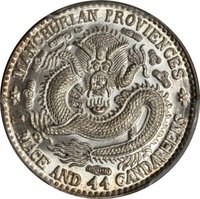
Reverse
Description:
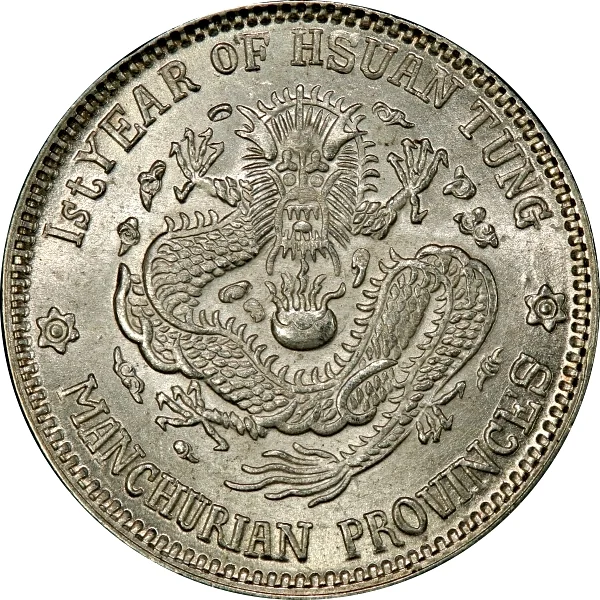
Dragon encircling a pearl, surrounded by English text.
Inscription:
1st YEAR OF HSUAN TUNG
MANCHURIAN PROVINCES
MANCHURIAN PROVINCES
Script: Latin
Edge
Reeded.
Categories
| Mythology> Fantastic animal |
Mintings
| Year | Mint Mark | Mintage | Quality | Collection |
|---|---|---|---|---|
| 1909 | — | — | ||
| 1910 | — | — |
Historical background
In 1909, the currency situation in China's Manchurian provinces (Fengtian, Jilin, and Heilongjiang) was a complex and unstable monetary landscape, characterized by competing currencies and severe inflation. The primary circulating medium was the Fengtian tiao or guandie, a silver-denominated banknote issued by the provincial government banks, notably the Official Bank of the Three Eastern Provinces established in 1905. However, these notes were not fully convertible to silver, and their value fluctuated wildly between major commercial centers like Fengtian (Shenyang) and Harbin, leading to chaotic exchange rates and widespread merchant speculation.
This instability was exacerbated by the intense foreign influence in the region following the Russo-Japanese War (1904-1905). Japanese yen notes, issued by the Bank of Chosen and the Yokohama Specie Bank, circulated widely, especially in the southern railway zone. Simultaneously, Russian rubles (known as chiao or guangpiao) remained strong in northern Manchuria, particularly along the Chinese Eastern Railway. Furthermore, a vast quantity of small, privately issued jiaozi notes from local Chinese shops and money changers flooded the market, often becoming worthless. This created a multi-currency system where trust was low, and transactions required constant discounting and verification.
The Qing government recognized the crisis, as monetary disorder hampered administration and revenue collection. Efforts were made to centralize control, with the Imperial Bank of China (Da Qing Bank) establishing branches and promoting its own notes. The core goal was to unify the currency on a standard silver yuan basis and suppress the volatile tiao notes. However, in 1909, these efforts were still in their infancy and largely ineffective against entrenched local interests and foreign financial power. Consequently, the monetary chaos persisted, reflecting the weakening sovereignty of the Qing dynasty and setting the stage for further foreign economic dominance in the years to follow.
This instability was exacerbated by the intense foreign influence in the region following the Russo-Japanese War (1904-1905). Japanese yen notes, issued by the Bank of Chosen and the Yokohama Specie Bank, circulated widely, especially in the southern railway zone. Simultaneously, Russian rubles (known as chiao or guangpiao) remained strong in northern Manchuria, particularly along the Chinese Eastern Railway. Furthermore, a vast quantity of small, privately issued jiaozi notes from local Chinese shops and money changers flooded the market, often becoming worthless. This created a multi-currency system where trust was low, and transactions required constant discounting and verification.
The Qing government recognized the crisis, as monetary disorder hampered administration and revenue collection. Efforts were made to centralize control, with the Imperial Bank of China (Da Qing Bank) establishing branches and promoting its own notes. The core goal was to unify the currency on a standard silver yuan basis and suppress the volatile tiao notes. However, in 1909, these efforts were still in their infancy and largely ineffective against entrenched local interests and foreign financial power. Consequently, the monetary chaos persisted, reflecting the weakening sovereignty of the Qing dynasty and setting the stage for further foreign economic dominance in the years to follow.
⭐ Somewhat Rare