

20 Centimes – Belgium
Belgium

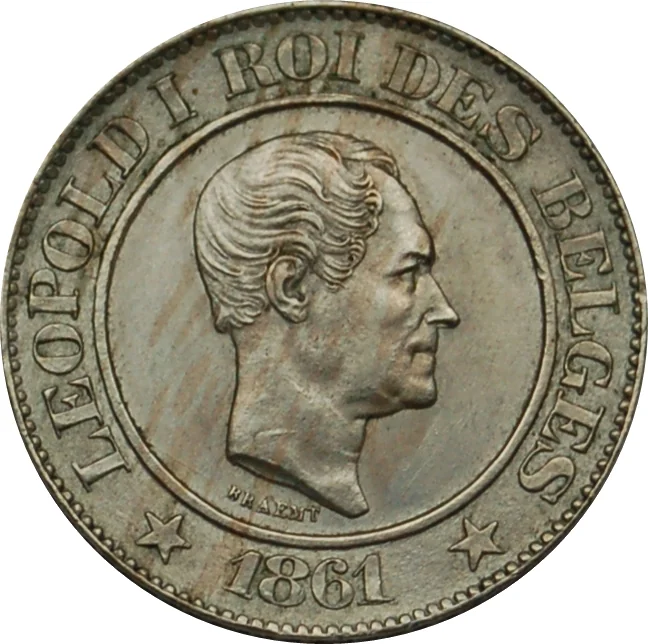
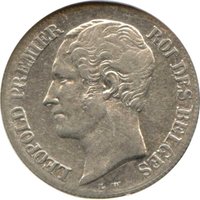
Obverse
Description:
Leopold I faces right within a circle, surrounded by a French legend. The date, between two stars, and the designer's name are below.
Inscription:
LEOPOLD I ROI DES BELGES
★ 1861 ★
BRAEMT
★ 1861 ★
BRAEMT
Translation:
Leopold I King of the Belgians
★ 1861 ★
Braemt
★ 1861 ★
Braemt
Script: Latin
Language: French
Engraver: Joseph-Pierre Braemt
Reverse
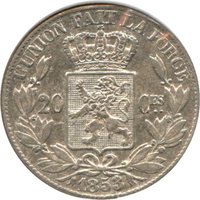
Description:
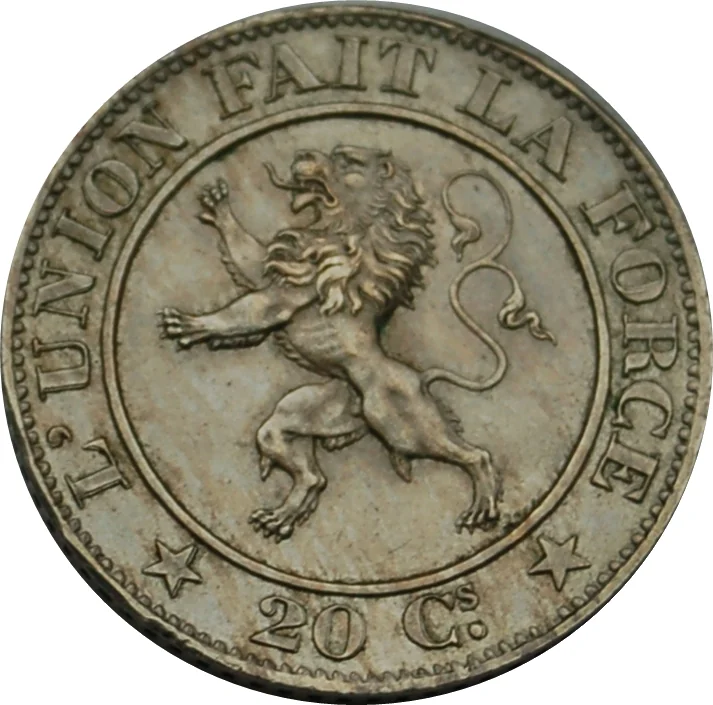
Left-facing rampant lion in circle, surrounded by motto. Value between stars below.
Inscription:
L'UNION FAIT LA FORCE
★ 20 Cs. ★
★ 20 Cs. ★
Translation:
Union Makes Strength
★ 20 Cs. ★
★ 20 Cs. ★
Script: Latin
Language: French
Engraver: Joseph-Pierre Braemt
Edge
Security edge
Mints
| Name | Mark |
|---|---|
| Royal Mint of Belgium | — |
Mintings
| Year | Mint Mark | Mintage | Quality | Collection |
|---|---|---|---|---|
| 1860 | — | — | ||
| 1861 | — | 1,803,670 |
Historical background
In 1860, Belgium operated under a bimetallic monetary system, as established by the laws of 1832. This system legally fixed the values of both gold and silver coins relative to the Belgian franc, with a mint ratio of 15.5 to 1. While theoretically stable, the system was under growing international strain. Major economic powers like the United Kingdom had already adopted a de facto gold standard, and large discoveries of silver in the Americas were beginning to depress its global market value, threatening to disrupt the fixed legal ratio.
Domestically, Belgium's economy was in a period of vigorous industrial expansion, particularly in coal, iron, steel, and textiles. This growth demanded a reliable and uniform currency for both domestic commerce and international trade, much of which was conducted with gold-standard nations like Britain and France. The coexistence of two legal tender metals created practical complexities, and the risk that one metal would disappear from circulation (driven by its market value versus its mint value) was a constant concern for bankers and the government.
Consequently, the 1860s marked a pivotal decade of transition. The Belgian government and the National Bank of Belgium were increasingly inclined to follow the lead of its major trading partners and move toward a gold standard. This shift would culminate in the monetary law of 1873, which formally demonetized silver and placed Belgium firmly on the gold standard, but the economic pressures and policy debates that made this inevitable were already clearly at play by 1860.
Domestically, Belgium's economy was in a period of vigorous industrial expansion, particularly in coal, iron, steel, and textiles. This growth demanded a reliable and uniform currency for both domestic commerce and international trade, much of which was conducted with gold-standard nations like Britain and France. The coexistence of two legal tender metals created practical complexities, and the risk that one metal would disappear from circulation (driven by its market value versus its mint value) was a constant concern for bankers and the government.
Consequently, the 1860s marked a pivotal decade of transition. The Belgian government and the National Bank of Belgium were increasingly inclined to follow the lead of its major trading partners and move toward a gold standard. This shift would culminate in the monetary law of 1873, which formally demonetized silver and placed Belgium firmly on the gold standard, but the economic pressures and policy debates that made this inevitable were already clearly at play by 1860.
🌱 Common