

20 Centimes – Belgium
Belgium
Context

Material
References
KM: #Click to copy to clipboard19
Numista: #266
Value
Exchange value: 0.20 BEF
Bullion value: $2.56
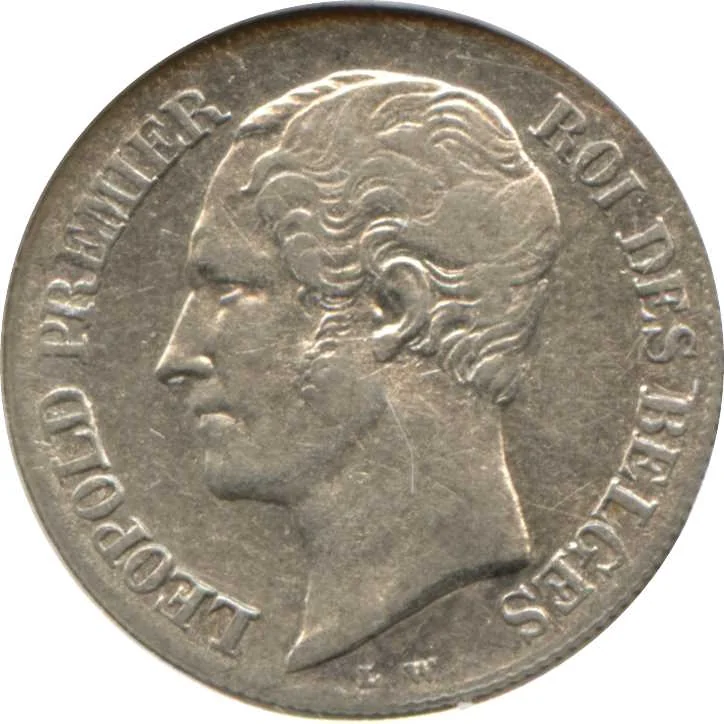
Obverse
Description:
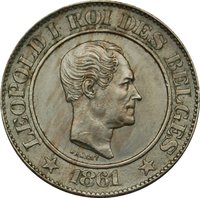
Leopold I of Belgium in left profile, encircled by a French legend. Designer initials below.
Inscription:
LEOPOLD PREMIER ROI DES BELGES
L.W.
L.W.
Translation:
Leopold the First King of the Belgians
L.W.
L.W.
Script: Latin
Language: French
Engraver: Léopold Wiener
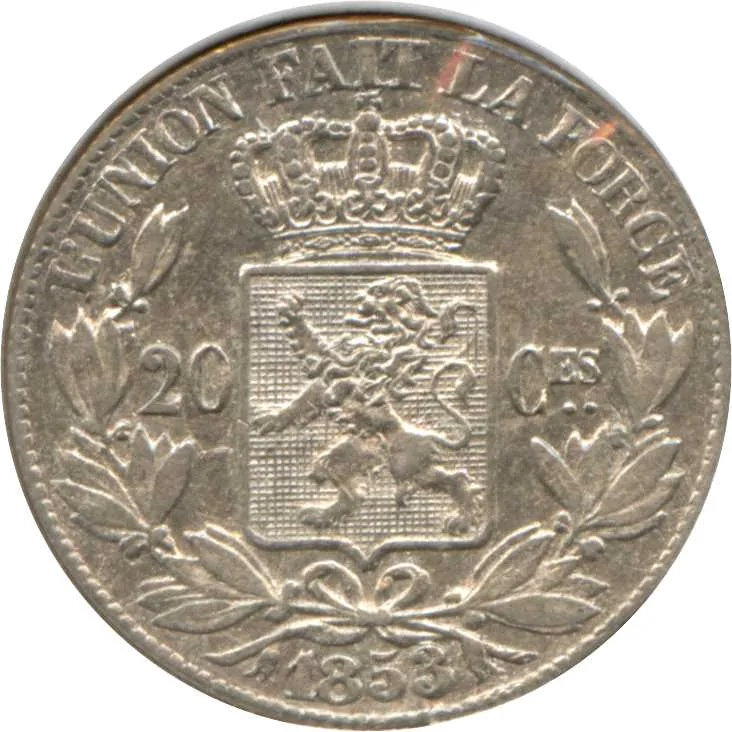
Reverse
Description:
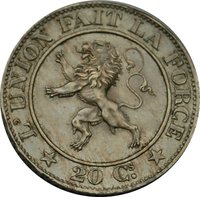
Belgian coat of arms with face value between olive twigs, surrounded by French motto. Date below.
Inscription:
L'UNION FAIT LA FORCE
20 Ces.
1853
20 Ces.
1853
Translation:
Union makes strength
20 Cents.
1853
20 Cents.
1853
Script: Latin
Language: French
Engraver: Léopold Wiener
Edge
Reeded
Mints
| Name | Mark |
|---|---|
| Royal Mint of Belgium | — |
Mintings
| Year | Mint Mark | Mintage | Quality | Collection |
|---|---|---|---|---|
| 1852 | — | 300,640 | ||
| 1853 | — | 1,965,054 | ||
| 1858 | — | 865,252 |
Historical background
In 1852, Belgium's currency situation was characterized by a period of transition and consolidation following the nation's independence in 1830. The new kingdom inherited a complex monetary landscape with French, Dutch, and older Austrian coins still circulating alongside various banknotes. To establish economic sovereignty and stability, the government had passed a monetary law in 1832, officially adopting a bimetallic system based on both gold and silver francs, aligning Belgium closely with the French Latin Monetary Union in practice, though the formal Union would not be established until 1865. The Belgian franc was defined, mirroring the French franc, with a fixed ratio between gold and silver.
Despite this legal framework, the 1840s and early 1850s presented significant challenges. A major practical problem was a chronic shortage of small-denomination coinage for everyday transactions, which hampered commerce and led to the circulation of private tokens and foreign coins. Furthermore, the global fluctuation in the market values of gold and silver versus their fixed legal ratio created arbitrage opportunities, leading to the disappearance of full-value silver coins from circulation as they were hoarded or exported. This left the public with worn, underweight silver and an unreliable mix of token money.
Consequently, by 1852, authorities were actively seeking solutions to these persistent issues. The focus was on reforming the subsidiary coinage (low-value coins) to prevent its export and to ensure a stable supply for the domestic economy. This period of adjustment was a crucial prelude to Belgium's full and formal entry into the Latin Monetary Union a decade later, which would finally provide a standardized, multinational framework for currency stability across much of continental Europe.
Despite this legal framework, the 1840s and early 1850s presented significant challenges. A major practical problem was a chronic shortage of small-denomination coinage for everyday transactions, which hampered commerce and led to the circulation of private tokens and foreign coins. Furthermore, the global fluctuation in the market values of gold and silver versus their fixed legal ratio created arbitrage opportunities, leading to the disappearance of full-value silver coins from circulation as they were hoarded or exported. This left the public with worn, underweight silver and an unreliable mix of token money.
Consequently, by 1852, authorities were actively seeking solutions to these persistent issues. The focus was on reforming the subsidiary coinage (low-value coins) to prevent its export and to ensure a stable supply for the domestic economy. This period of adjustment was a crucial prelude to Belgium's full and formal entry into the Latin Monetary Union a decade later, which would finally provide a standardized, multinational framework for currency stability across much of continental Europe.
🌱 Fairly Common