

50 Pfennigs – Germany
Germany

Obverse
Description:
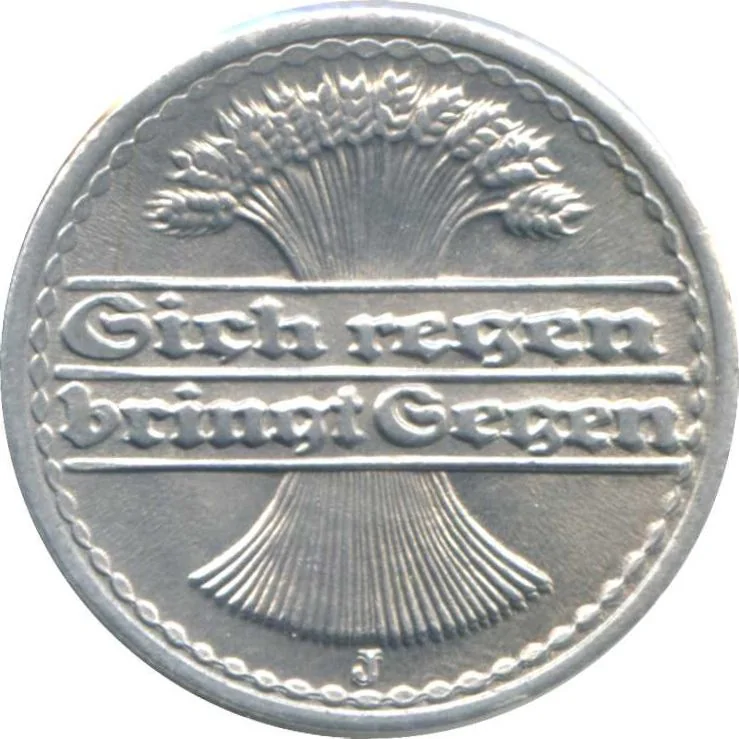
"Hard work pays off" on a wheatsheaf.
Inscription:
Sich regen bringt Segen
A
A
Translation:
To be active brings blessings.
Scripts: Latin, Latin (Fraktur blackletter)
Language: German
Engravers: Louis Oppenheim, Reinhard Kullrich
Reverse
Description:
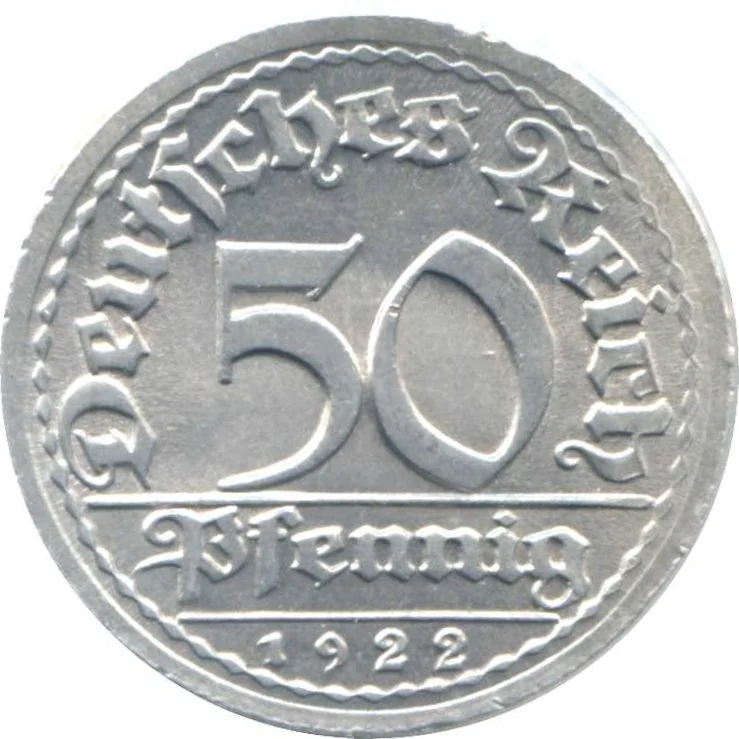
Value, date below.
Inscription:
Deutſches Reich
50 Pfennig
1921
50 Pfennig
1921
Translation:
German Empire
50 Pfennig
1921
50 Pfennig
1921
Script: Latin (Fraktur blackletter)
Language: German
Engravers: Louis Oppenheim, Reinhard Kullrich
Edge
Reeded
Mints
| Name | Mark |
|---|---|
| Berlin | A |
| Munich | D |
| Muldenhütten | E |
| Staatliche Münze Baden-Württemberg | F |
| Staatliche Münze Baden-Württemberg | G |
| Hamburgische Münze | J |
Mintings
| Year | Mint Mark | Mintage | Quality | Collection |
|---|---|---|---|---|
| 1919 | A | 7,172,760 | ||
| 1919 | D | 791,330 | ||
| 1919 | E | 930,000 | ||
| 1919 | E | 35 | Proof | |
| 1919 | G | 660,000 | ||
| 1919 | J | 800,000 | ||
| 1919 | F | 160,000 | ||
| 1920 | A | 119,793,426 | ||
| 1920 | D | 28,305,806 | ||
| 1920 | E | 14,400,000 | ||
| 1920 | E | 226 | Proof | |
| 1920 | F | 10,931,515 | ||
| 1920 | G | 5,040,000 | ||
| 1920 | J | 15,423,292 | ||
| 1921 | E | 31,210,000 | ||
| 1921 | A | 184,468,127 | ||
| 1921 | D | 48,728,529 | ||
| 1921 | E | 332 | Proof | |
| 1921 | F | 46,950,000 | ||
| 1921 | G | 19,106,787 | ||
| 1921 | J | 28,012,859 | ||
| 1922 | G | 36,744,646 | ||
| 1922 | J | 36,202,220 | ||
| 1922 | D | 62,658,564 | ||
| 1922 | E | 33,930,000 | ||
| 1922 | E | 333 | Proof | |
| 1922 | F | 33,000,000 | ||
| 1922 | A | 145,215,291 |
Historical background
The currency situation in Germany in 1919 was one of profound instability, directly rooted in the financial burdens of the First World War. To fund the conflict, the Imperial government had largely abandoned the gold standard and relied heavily on borrowing and printing money, avoiding major tax increases. This deliberate inflation during the war devalued the Mark significantly, though price controls and rationing masked the full effect. By the armistice in November 1918, the paper Mark had already lost over half of its pre-war value against the US dollar, and the new Weimar Republic inherited a massive public debt and a money supply that had quadrupled.
The financial crisis deepened dramatically in 1919 due to the political and economic terms of the Treaty of Versailles, signed in June. The treaty imposed colossal reparations payments on Germany, the final sum of which would be staggering. This created a crushing expectation of future debt, destroying international confidence in the Mark's ability to retain value. The government, facing immense social unrest and reconstruction costs, continued to run massive budget deficits, which it financed almost exclusively by printing new currency. This practice moved the economy from controlled wartime inflation to the beginning of a vicious cycle of hyperinflation.
Consequently, the Mark's value began its infamous collapse on foreign exchange markets. The dollar exchange rate, a key indicator, spiraled from about 8 Marks per dollar in 1914 to 48 Marks by the end of 1919. Domestic prices rose rapidly, eroding savings and wages, though the catastrophic hyperinflation of the early 1920s was still to come. In 1919, the stage was set: the currency was no longer a stable store of value but had become a tool for the state to meet impossible obligations, creating a pervasive sense of economic insecurity that would destabilize the young republic.
The financial crisis deepened dramatically in 1919 due to the political and economic terms of the Treaty of Versailles, signed in June. The treaty imposed colossal reparations payments on Germany, the final sum of which would be staggering. This created a crushing expectation of future debt, destroying international confidence in the Mark's ability to retain value. The government, facing immense social unrest and reconstruction costs, continued to run massive budget deficits, which it financed almost exclusively by printing new currency. This practice moved the economy from controlled wartime inflation to the beginning of a vicious cycle of hyperinflation.
Consequently, the Mark's value began its infamous collapse on foreign exchange markets. The dollar exchange rate, a key indicator, spiraled from about 8 Marks per dollar in 1914 to 48 Marks by the end of 1919. Domestic prices rose rapidly, eroding savings and wages, though the catastrophic hyperinflation of the early 1920s was still to come. In 1919, the stage was set: the currency was no longer a stable store of value but had become a tool for the state to meet impossible obligations, creating a pervasive sense of economic insecurity that would destabilize the young republic.
🌱 Very Common