

10 Pfennigs – Germany
Germany
Context
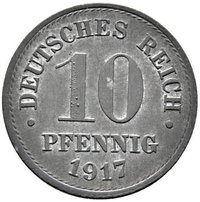
Years: 1917–1922
Issuer: Germany 
Ruler: William II
Currency:
(1873—1923)
Demonetization: 11 October 1924
Total mintage: 1,250,548,767
Material
References
KM: #Click to copy to clipboard26
Numista: #1954
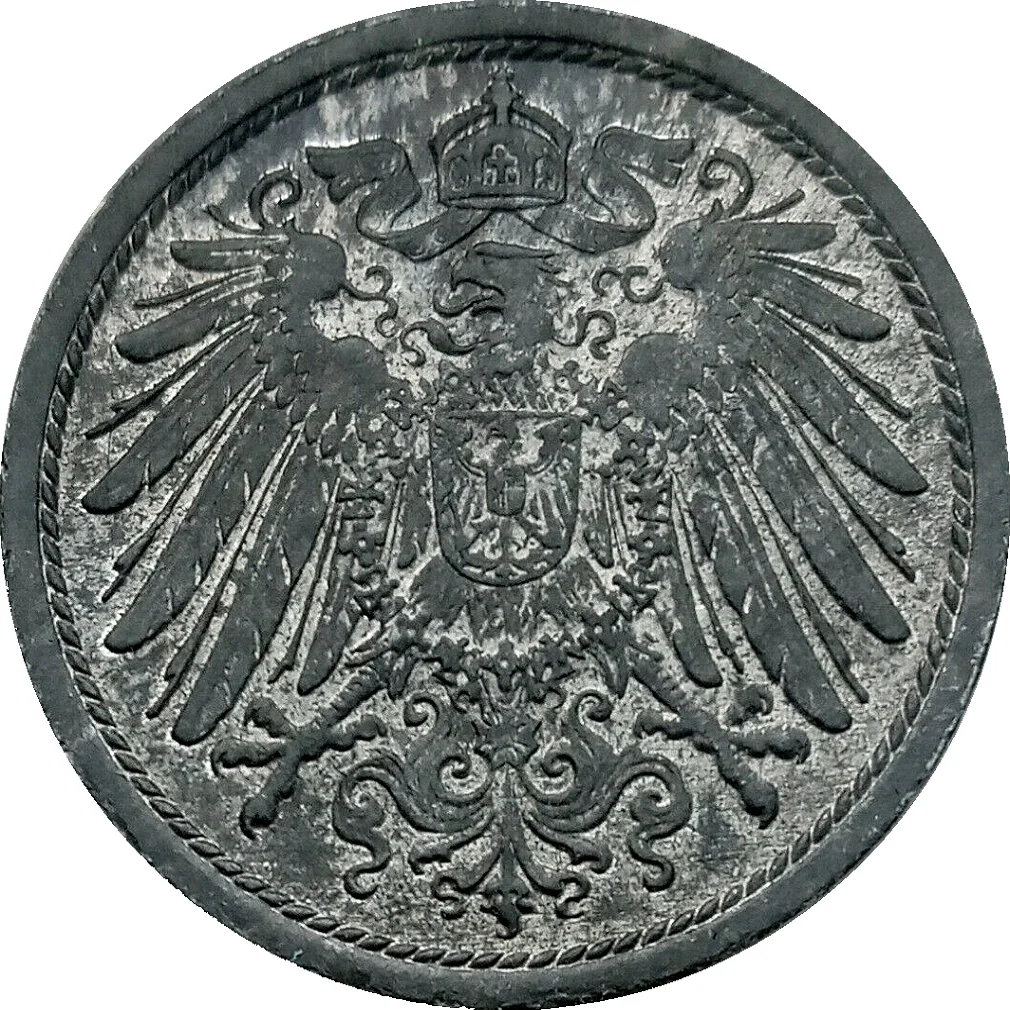
Obverse
Description:
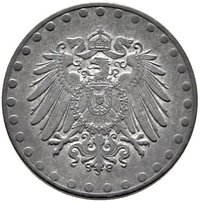
Imperial eagle with shield; border of about 100 tiny dots.
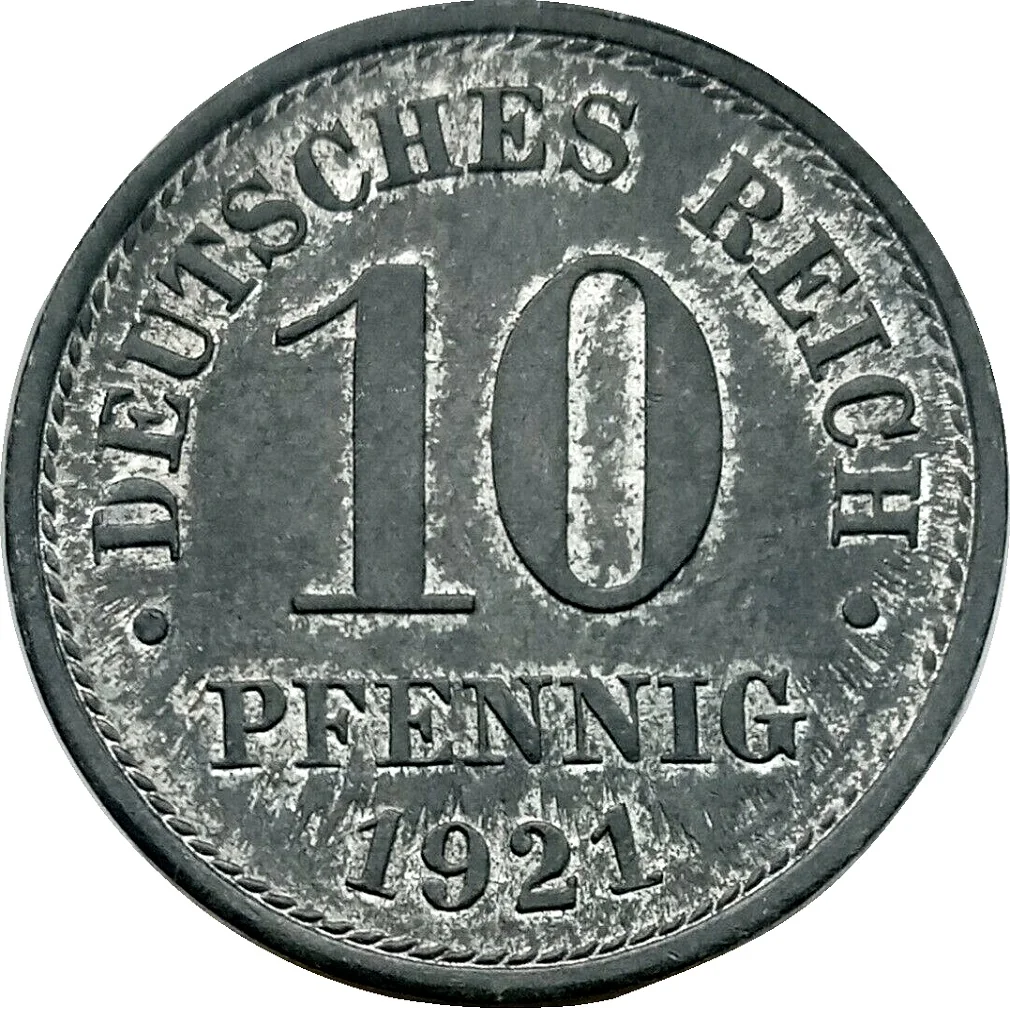
Reverse
Edge
Plain
Mintings
| Year | Mint Mark | Mintage | Quality | Collection |
|---|---|---|---|---|
| 1917 | — | 75,073,243 | ||
| 1918 | — | 202,008,329 | ||
| 1918 | — | 28 | Proof | |
| 1919 | — | 147,799,629 | ||
| 1919 | — | 50 | Proof | |
| 1920 | — | 40 | Proof | |
| 1920 | — | 223,018,653 | ||
| 1921 | — | 319,333,998 | ||
| 1921 | — | 24 | Proof | |
| 1922 | — | 283,314,761 | ||
| 1922 | — | 12 | Proof |
Historical background
By 1917, Germany's wartime currency situation was one of severe and accelerating strain, fundamentally underpinned by the financial strategy chosen to fund the war. Rejecting major tax increases that might dampen public morale, the Imperial government opted to finance the conflict primarily through war bonds and, crucially, by borrowing directly from the Reichsbank. This process, known as "monetizing the debt," meant the central bank printed new banknotes to purchase government debt, injecting vast amounts of money into the economy without corresponding economic growth or gold reserves.
The direct consequences were rampant inflation and a growing disconnect between the paper Mark and its pre-war value. The money supply increased exponentially to pay for military expenses and raw material imports, while the Allied naval blockade drastically reduced available goods for civilians. This created a classic imbalance of too much money chasing too few goods, leading to sharp price increases. The value of the gold Mark held by the Reichsbank to back the currency fell to cover less than half of the circulating paper money, shattering confidence. Prices for basic necessities had already doubled or tripled since 1914, eroding savings and wages, particularly for those on fixed incomes.
This inflationary environment in 1917 was a critical turning point, setting the stage for the hyperinflation of the early 1920s. While not yet catastrophic, the mechanisms for disaster were firmly in place. The government and industries became dependent on the continuous creation of new money, and the public began to lose faith in the stability of the currency. The situation was a hidden economic crisis, undermining the home front's endurance and creating a financial time bomb that would detonate with devastating force after the war's end and the burden of reparations were imposed.
The direct consequences were rampant inflation and a growing disconnect between the paper Mark and its pre-war value. The money supply increased exponentially to pay for military expenses and raw material imports, while the Allied naval blockade drastically reduced available goods for civilians. This created a classic imbalance of too much money chasing too few goods, leading to sharp price increases. The value of the gold Mark held by the Reichsbank to back the currency fell to cover less than half of the circulating paper money, shattering confidence. Prices for basic necessities had already doubled or tripled since 1914, eroding savings and wages, particularly for those on fixed incomes.
This inflationary environment in 1917 was a critical turning point, setting the stage for the hyperinflation of the early 1920s. While not yet catastrophic, the mechanisms for disaster were firmly in place. The government and industries became dependent on the continuous creation of new money, and the public began to lose faith in the stability of the currency. The situation was a hidden economic crisis, undermining the home front's endurance and creating a financial time bomb that would detonate with devastating force after the war's end and the burden of reparations were imposed.
🌱 Very Common