

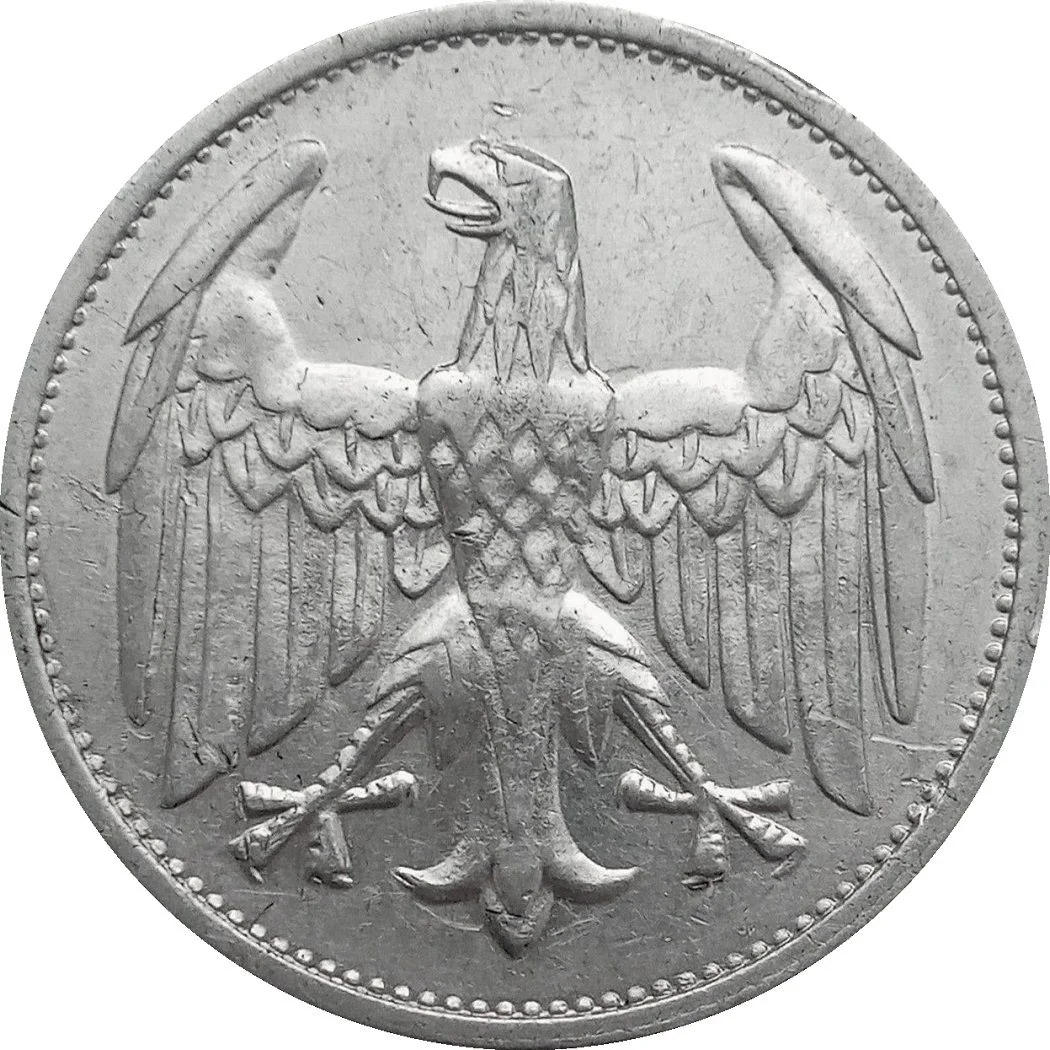

Obverse
Description:
Eagle: A powerful bird of prey.
Engraver: Josef Wackerle
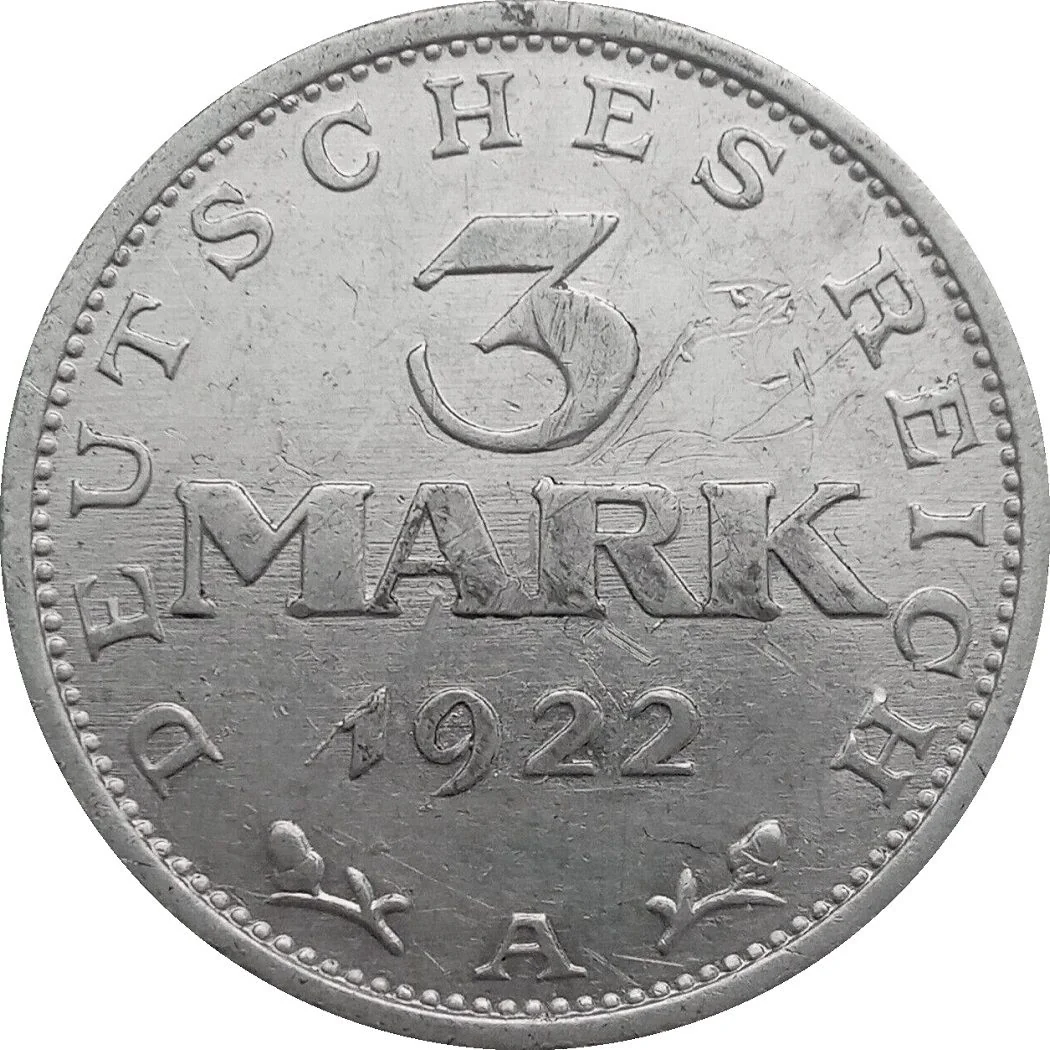
Reverse
Description:
G series
Inscription:
DEUTSCHES REICH
3
MARK
1922
A
3
MARK
1922
A
Translation:
German Empire
3
Mark
1922
A
3
Mark
1922
A
Script: Latin
Language: German
Engraver: Reinhard Kullrich
Edge
Reeded
Mintings
| Year | Mint Mark | Mintage | Quality | Collection |
|---|---|---|---|---|
| 1922 | A | 15,496,695 | ||
| 1922 | E | 2,000 | ||
| 1922 | F | — | ||
| 1922 | A | — | Proof | |
| 1922 | E | 1,000 | Proof |
Historical background
By 1922, the Weimar Republic's currency crisis had escalated from a serious economic concern into a full-blown hyperinflationary disaster. The root cause lay in the staggering reparations payments demanded by the Treaty of Versailles, which crippled the German budget. Rather than raising taxes, the government, with the acquiescence of the Reichsbank, financed its deficits—including reparations, social programs, and subsidies to struggling industries—by printing vast quantities of paper marks. This flood of currency rapidly eroded its value, but the policy was deliberately continued in a misguided attempt to prove to the Allies that the reparations burden was unsustainable and to cheapen German exports.
The year 1922 marked the decisive turning point where inflation became unmanageable. The situation dramatically worsened after the assassination of Foreign Minister Walther Rathenau in June, which triggered a collapse of international confidence and a massive flight from the mark. As foreigners and Germans alike rushed to exchange paper currency for tangible assets, the mark's value on foreign exchanges plummeted. By the end of the year, the exchange rate had fallen from approximately 190 marks to the US dollar in January to an astonishing 7,600 marks to the dollar. Prices within Germany began to rise at an accelerating, dizzying pace, eroding savings and wages on a daily basis.
Consequently, daily life for ordinary Germans descended into a surreal struggle. Workers were paid multiple times a day, and families rushed to spend money immediately before it lost further value, often buying anything tangible as a store of worth. Bartering for goods and services became common as faith in the currency evaporated. This social and economic chaos undermined the legitimacy of the young republic, fueled political extremism from both the left and right, and set the stage for the even more catastrophic hyperinflation of 1923, when the currency would ultimately become utterly worthless.
The year 1922 marked the decisive turning point where inflation became unmanageable. The situation dramatically worsened after the assassination of Foreign Minister Walther Rathenau in June, which triggered a collapse of international confidence and a massive flight from the mark. As foreigners and Germans alike rushed to exchange paper currency for tangible assets, the mark's value on foreign exchanges plummeted. By the end of the year, the exchange rate had fallen from approximately 190 marks to the US dollar in January to an astonishing 7,600 marks to the dollar. Prices within Germany began to rise at an accelerating, dizzying pace, eroding savings and wages on a daily basis.
Consequently, daily life for ordinary Germans descended into a surreal struggle. Workers were paid multiple times a day, and families rushed to spend money immediately before it lost further value, often buying anything tangible as a store of worth. Bartering for goods and services became common as faith in the currency evaporated. This social and economic chaos undermined the legitimacy of the young republic, fueled political extremism from both the left and right, and set the stage for the even more catastrophic hyperinflation of 1923, when the currency would ultimately become utterly worthless.
🌱 Common