

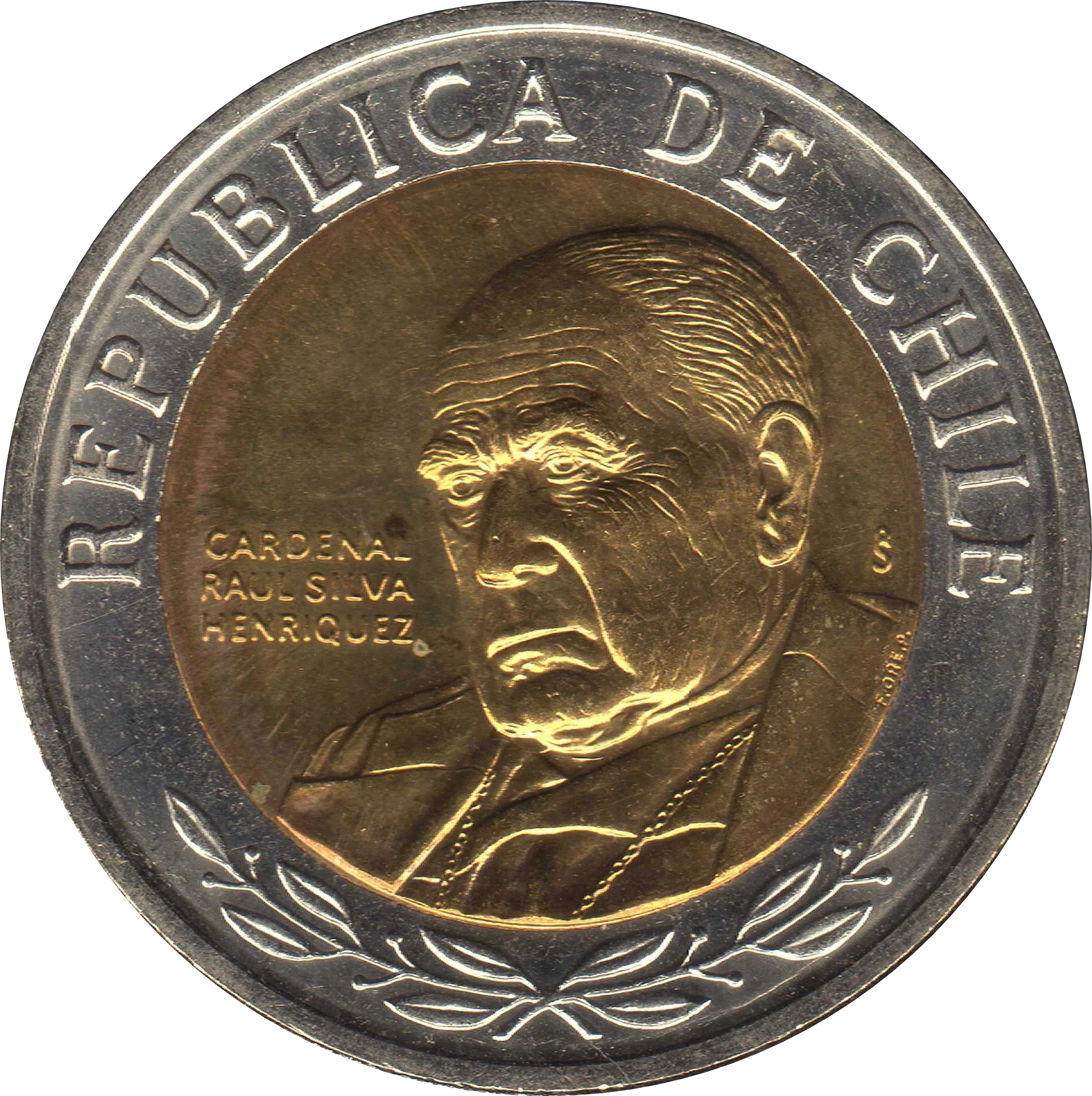
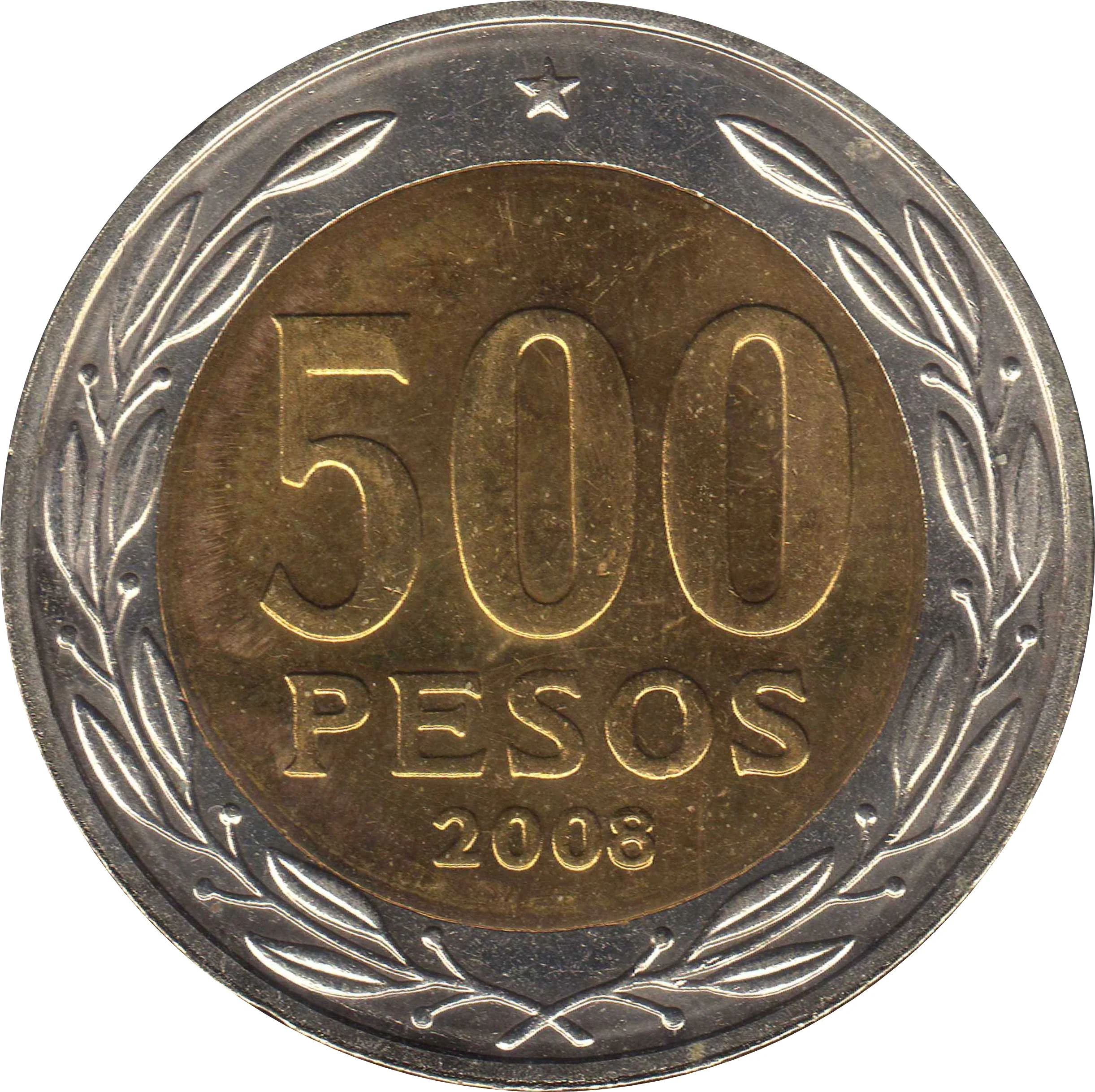
500 Pesos – Chile
Chile

Obverse
Description:
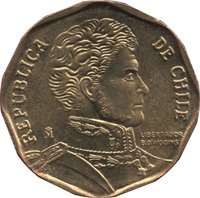
Portrait of Cardinal Raúl Silva Henríquez. Mintmark to head's right; engraver's signature, if present, on bust's right side.
Inscription:
REPUBLICA DE CHILE
So
CARDENAL
RAUL SILVA
HENRIQUEZ
F.ORE.P.
So
CARDENAL
RAUL SILVA
HENRIQUEZ
F.ORE.P.
Translation:
REPUBLIC OF CHILE
5
CARDINAL
RAUL SILVA
HENRIQUEZ
F.ORE.P.
5
CARDINAL
RAUL SILVA
HENRIQUEZ
F.ORE.P.
Script: Latin
Language: Spanish
Engraver: Francisco Orellana P.
Reverse
Edge
Categories
| Person> Religious figure |
| Symbol> Wreath |
Mints
| Name | Mark |
|---|---|
| Casa de Moneda de Chile | (So) |
Mintings
| Year | Mint Mark | Mintage | Quality | Collection |
|---|---|---|---|---|
| 2000 | So | 20,000,000 | ||
| 2001 | So | 30,000,000 | ||
| 2002 | So | 39,800,000 | ||
| 2003 | So | 35,000,000 | ||
| 2008 | So | 38,000,000 | ||
| 2010 | So | 3,000,000 | ||
| 2011 | So | 20,000,000 | ||
| 2012 | So | 25,000,000 | ||
| 2013 | So | 32,000,000 | ||
| 2014 | So | 21,000,000 | ||
| 2015 | So | 68,000,000 | ||
| 2016 | So | 28,000,000 | ||
| 2017 | So | 77,000,000 | ||
| 2018 | So | 22,000,000 | ||
| 2019 | So | 20,000,000 | ||
| 2021 | So | 25,000,000 | ||
| 2022 | So | 32,000,000 | ||
| 2023 | So | — |
Historical background
In the year 2000, Chile's currency situation was characterized by a managed exchange rate regime and a context of economic recovery following the turbulence of the late 1990s. The Chilean peso (CLP) operated under a crawling band system, where the central bank (Banco Central de Chile) allowed the currency to fluctuate within a predetermined range against the US dollar, with the band's reference point adjusted daily according to a pre-announced schedule. This policy, in place since the mid-1980s, aimed to provide stability for trade and investment while allowing gradual adjustment to external shocks, such as the 1997-98 Asian financial crisis which had significantly impacted emerging markets like Chile.
The period around 2000 saw a deliberate shift towards greater exchange rate flexibility. In the wake of the emerging market crises, the central bank had progressively widened the fluctuation band throughout 1999, effectively moving towards a free-floating regime. By the end of 1999, the band was so wide it became virtually irrelevant, and in September 1999, the central bank had officially announced the suspension of the band's defense. Consequently, by 2000, the peso was largely floating, with the central bank intervening only in exceptional circumstances to curb excessive volatility. This transition was part of a broader move towards a full-fledged inflation targeting framework, which was formally adopted in 1999.
Economically, the year 2000 marked a rebound from the 1999 recession, with GDP growth recovering to 4.5%. This recovery, coupled with rising copper prices (a key export), provided underlying support for the peso. However, the currency still faced pressures from global financial uncertainty and the lingering effects of the recent crises. The move to a floating regime in this context was a strategic decision to enhance the economy's ability to absorb external shocks autonomously through exchange rate movements, while the central bank focused its monetary policy squarely on achieving its inflation targets, setting the stage for Chile's modern macroeconomic framework.
The period around 2000 saw a deliberate shift towards greater exchange rate flexibility. In the wake of the emerging market crises, the central bank had progressively widened the fluctuation band throughout 1999, effectively moving towards a free-floating regime. By the end of 1999, the band was so wide it became virtually irrelevant, and in September 1999, the central bank had officially announced the suspension of the band's defense. Consequently, by 2000, the peso was largely floating, with the central bank intervening only in exceptional circumstances to curb excessive volatility. This transition was part of a broader move towards a full-fledged inflation targeting framework, which was formally adopted in 1999.
Economically, the year 2000 marked a rebound from the 1999 recession, with GDP growth recovering to 4.5%. This recovery, coupled with rising copper prices (a key export), provided underlying support for the peso. However, the currency still faced pressures from global financial uncertainty and the lingering effects of the recent crises. The move to a floating regime in this context was a strategic decision to enhance the economy's ability to absorb external shocks autonomously through exchange rate movements, while the central bank focused its monetary policy squarely on achieving its inflation targets, setting the stage for Chile's modern macroeconomic framework.
🌱 Very Common