

Obverse
Description:
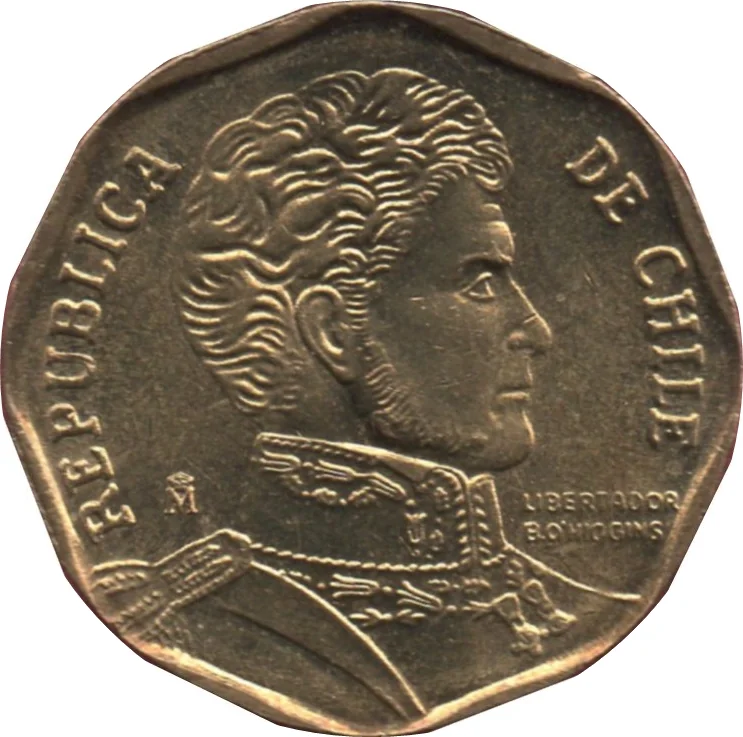
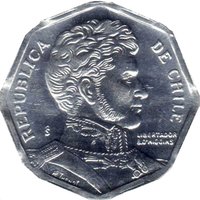
Bernardo O'Higgins portrait right, mint mark left.
Inscription:
REPUBLICA DE CHILE
So
LIBERTADOR
B O'HIGGINS
R.THENOT
So
LIBERTADOR
B O'HIGGINS
R.THENOT
Translation:
REPUBLIC OF CHILE
So
LIBERATOR
B O'HIGGINS
R.THENOT
So
LIBERATOR
B O'HIGGINS
R.THENOT
Script: Latin
Language: Spanish
Engraver: Francois Maurice Thénot
Reverse
Edge
Plain
Categories
| Person> Politician |
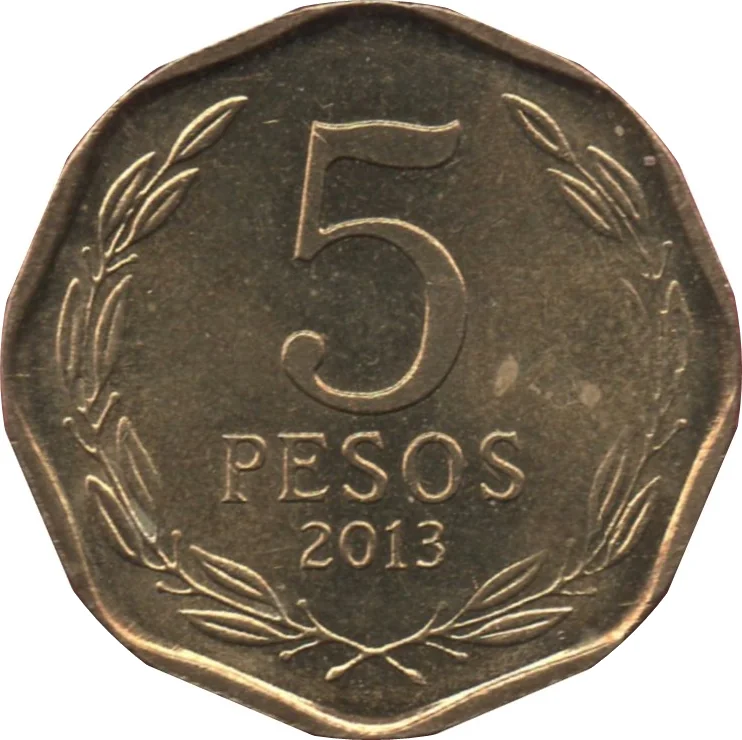
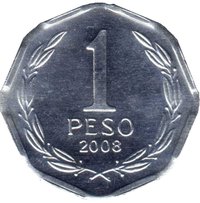
| Symbol> Wreath |
Mints
| Name | Mark |
|---|---|
| Royal Dutch Mint | (Caduceus) |
| Royal Mint of Madrid | (Crowned M) |
| South African Mint | SA |
| Casa de Moneda de Chile | (So) |
Mintings
| Year | Mint Mark | Mintage | Quality | Collection |
|---|---|---|---|---|
| 1992 | So | 76,000,000 | ||
| 1993 | So | 40,300,000 | ||
| 1994 | So | 85,400,000 | ||
| 1995 | So | 85,400,000 | ||
| 1996 | So | 85,300,000 | ||
| 1997 | So | 82,600,000 | ||
| 1998 | So | 106,000,000 | ||
| 1999 | So | 40,800,000 | ||
| 2000 | So | 154,900,000 | ||
| 2001 | SA | 29,100,000 | ||
| 2001 | So | 37,900,000 | ||
| 2002 | A | — | ||
| 2002 | So | 62,000,000 | ||
| 2003 | So | 69,000,000 | ||
| 2004 | So | 107,000,000 | ||
| 2005 | So | 85,000,000 | ||
| 2006 | So | 88,000,000 | ||
| 2007 | So | 139,500,000 | ||
| 2008 | So | 106,000,000 | ||
| 2009 | So | 93,200,000 | ||
| 2010 | So | 50,000,000 | ||
| 2011 | So | 103,000,000 | ||
| 2012 | M | 150,000,000 | ||
| 2013 | M | 127,000,000 | ||
| 2014 | — | 10,000,000 | ||
| 2015 | — | 76,800,000 |
Historical background
In 1992, Chile's currency situation was characterized by a managed exchange rate system and a period of remarkable macroeconomic stability, serving as a cornerstone for the nation's sustained economic growth. Following a severe crisis in the early 1980s, Chilean authorities had implemented profound structural reforms and pursued disciplined fiscal and monetary policies. By 1992, the central bank operated a "crawling peg" exchange rate regime, where the Chilean peso was allowed to depreciate against the US dollar within a pre-announced band (or "banda cambiaria"). This system aimed to provide a nominal anchor to control inflation—which had been successfully tamed from triple digits to around 12-15% annually—while maintaining export competitiveness through gradual, predictable devaluations.
This stability was underpinned by strong capital inflows, driven by foreign investment in Chile's booming export sectors (notably copper, forestry, and fruit), and a consensus on sound economic management. The currency band successfully reduced exchange rate volatility, providing businesses with greater certainty for planning and investment. However, it also required consistent central bank intervention to defend the band's limits, tying up international reserves and limiting the autonomy of monetary policy. The peso's value was thus not freely set by the market but carefully managed as a key tool for economic stabilization.
The context of 1992 was one of cautious optimism, as the system appeared to be delivering its intended results: controlled inflation, robust growth, and increasing integration into the global economy. Nonetheless, the managed regime contained inherent tensions. The large inflows of foreign capital, attracted by Chile's success, began to exert upward pressure on the peso, threatening export competitiveness and complicating the central bank's task. These pressures would intensify in the coming years, ultimately leading to a series of widening of the exchange rate band and a move towards greater flexibility, setting the stage for a fully floating currency by the end of the decade.
This stability was underpinned by strong capital inflows, driven by foreign investment in Chile's booming export sectors (notably copper, forestry, and fruit), and a consensus on sound economic management. The currency band successfully reduced exchange rate volatility, providing businesses with greater certainty for planning and investment. However, it also required consistent central bank intervention to defend the band's limits, tying up international reserves and limiting the autonomy of monetary policy. The peso's value was thus not freely set by the market but carefully managed as a key tool for economic stabilization.
The context of 1992 was one of cautious optimism, as the system appeared to be delivering its intended results: controlled inflation, robust growth, and increasing integration into the global economy. Nonetheless, the managed regime contained inherent tensions. The large inflows of foreign capital, attracted by Chile's success, began to exert upward pressure on the peso, threatening export competitiveness and complicating the central bank's task. These pressures would intensify in the coming years, ultimately leading to a series of widening of the exchange rate band and a move towards greater flexibility, setting the stage for a fully floating currency by the end of the decade.
🌱 Very Common