

10 Centimes – Belgium
Belgium
Context
Years: 1902–1903
Issuer: Belgium 
Ruler: Leopold II
Currency:
(1832—2001)
Demonetized: Yes
Total mintage: 7,218,344
Material
Diameter: 22 mm
Weight: 4 g
Thickness: 1.31 mm
Shape: Round with a round hole
Technique: Milled
Alignment: Coin alignment
flip
References
KM: #Click to copy to clipboard49
Numista: #2674
Value
Exchange value: 0.10 BEF
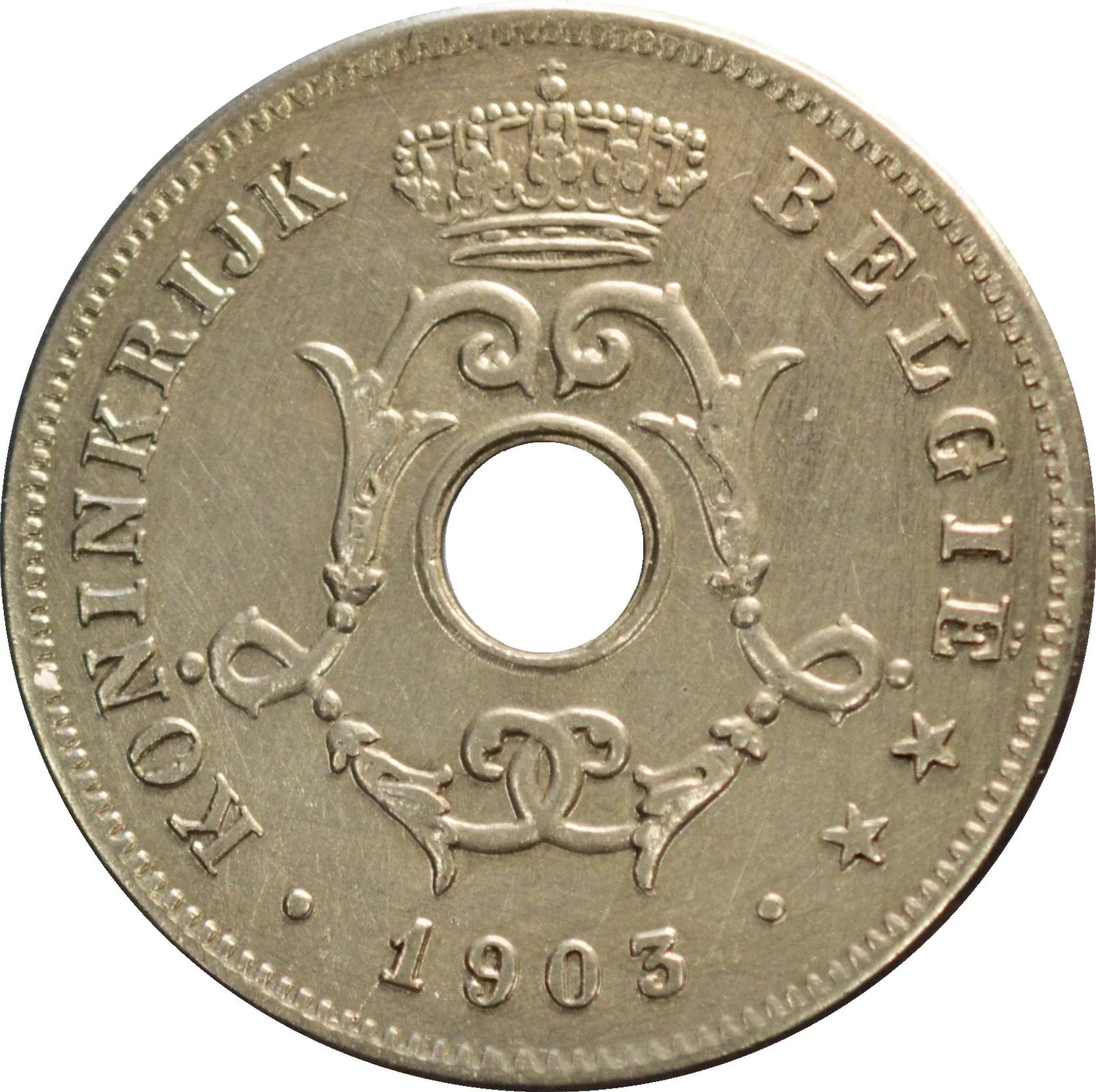
Obverse
Description:
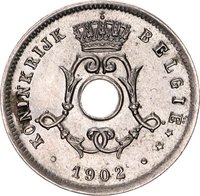
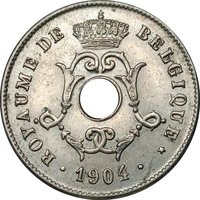
King Léopold II's monogram encircled by Dutch text. Date beneath central hole.
Inscription:
KONINKRIJK BELGIË ★★
• 1903 •
• 1903 •
Translation:
Kingdom of Belgium ★★
• 1903 •
• 1903 •
Script: Latin
Engraver: Alphonse Michaux
Reverse
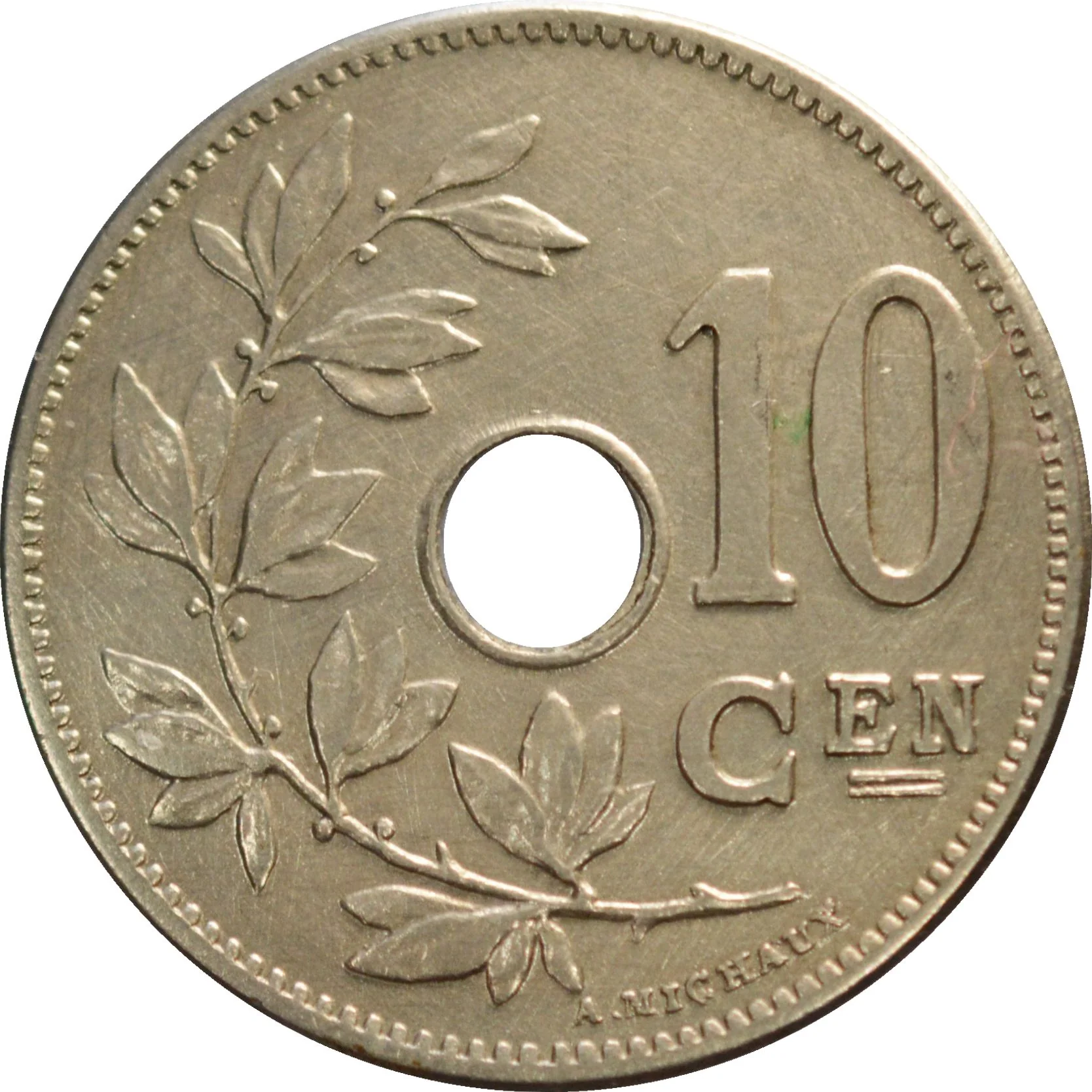
Description:
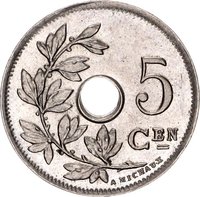
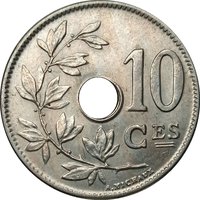
Center hole flanked by olive sprig and value; designer below.
Inscription:
10
CEN
A.MICHAUX
CEN
A.MICHAUX
Script: Latin
Engraver: Alphonse Michaux
Edge
Plain
Mints
| Name | Mark |
|---|---|
| Royal Mint of Belgium | — |
Mintings
| Year | Mint Mark | Mintage | Quality | Collection |
|---|---|---|---|---|
| 1902 | — | 1,560,041 | ||
| 1903 | — | 5,658,303 |
Historical background
In 1902, Belgium operated under a stable and well-established monetary system centered on the Belgian Franc, which was part of the Latin Monetary Union (LMU). This multinational treaty, formed in 1865 with France, Italy, Switzerland, and later Greece, created a bimetallic standard where gold and silver coins circulated freely across member nations at fixed values. Belgian 20-franc gold coins (Napoleons) and 5-franc silver coins were legal tender not just domestically but throughout the Union, facilitating trade and travel. The system was managed by the National Bank of Belgium, founded in 1850, which held substantial gold reserves to back the currency and ensure confidence.
However, the LMU was under significant strain by the turn of the century, and Belgium felt these pressures. A global decline in the value of silver had led to arbitrage, where cheaper silver coins from member states flooded countries with stronger economies, threatening their gold reserves. To protect itself, Belgium, like France, had suspended the free minting of silver coins in 1876, effectively moving to a "limping gold standard" where silver coins remained legal tender but were limited in quantity. By 1902, the Union was largely a facade, with each nation managing its own specie. Domestically, Belgium's rapid industrialization and economic growth required a reliable and abundant currency, leading to an increased reliance on banknotes and token coinage for everyday transactions, though the gold standard remained the official anchor.
Overall, the currency situation in 1902 was one of formal stability but underlying transition. The Belgian Franc was strong and trusted, underpinned by gold and a prudent central bank. Yet, the international framework it relied upon, the Latin Monetary Union, was crumbling, foreshadowing its eventual dissolution after World War I. Belgium's monetary policy was thus cautiously navigating between its international treaty obligations and the practical need to safeguard its national economy from the vulnerabilities of a mismanaged bimetallic system.
However, the LMU was under significant strain by the turn of the century, and Belgium felt these pressures. A global decline in the value of silver had led to arbitrage, where cheaper silver coins from member states flooded countries with stronger economies, threatening their gold reserves. To protect itself, Belgium, like France, had suspended the free minting of silver coins in 1876, effectively moving to a "limping gold standard" where silver coins remained legal tender but were limited in quantity. By 1902, the Union was largely a facade, with each nation managing its own specie. Domestically, Belgium's rapid industrialization and economic growth required a reliable and abundant currency, leading to an increased reliance on banknotes and token coinage for everyday transactions, though the gold standard remained the official anchor.
Overall, the currency situation in 1902 was one of formal stability but underlying transition. The Belgian Franc was strong and trusted, underpinned by gold and a prudent central bank. Yet, the international framework it relied upon, the Latin Monetary Union, was crumbling, foreshadowing its eventual dissolution after World War I. Belgium's monetary policy was thus cautiously navigating between its international treaty obligations and the practical need to safeguard its national economy from the vulnerabilities of a mismanaged bimetallic system.
Series: 1902 Belgium circulation coins
🌱 Very Common