

10 Centimes – Belgium
Belgium
Context
Years: 1903–1906
Issuer: Belgium 
Ruler: Leopold II
Currency:
(1832—2001)
Demonetized: Yes
Total mintage: 32,992,756
Material
Diameter: 22 mm
Weight: 4 g
Thickness: 1.4 mm
Shape: Round with a round hole
Technique: Milled
Alignment: Coin alignment
flip
References
KM: #Click to copy to clipboard52
Numista: #747
Value
Exchange value: 0.10 BEF
Obverse
Description:
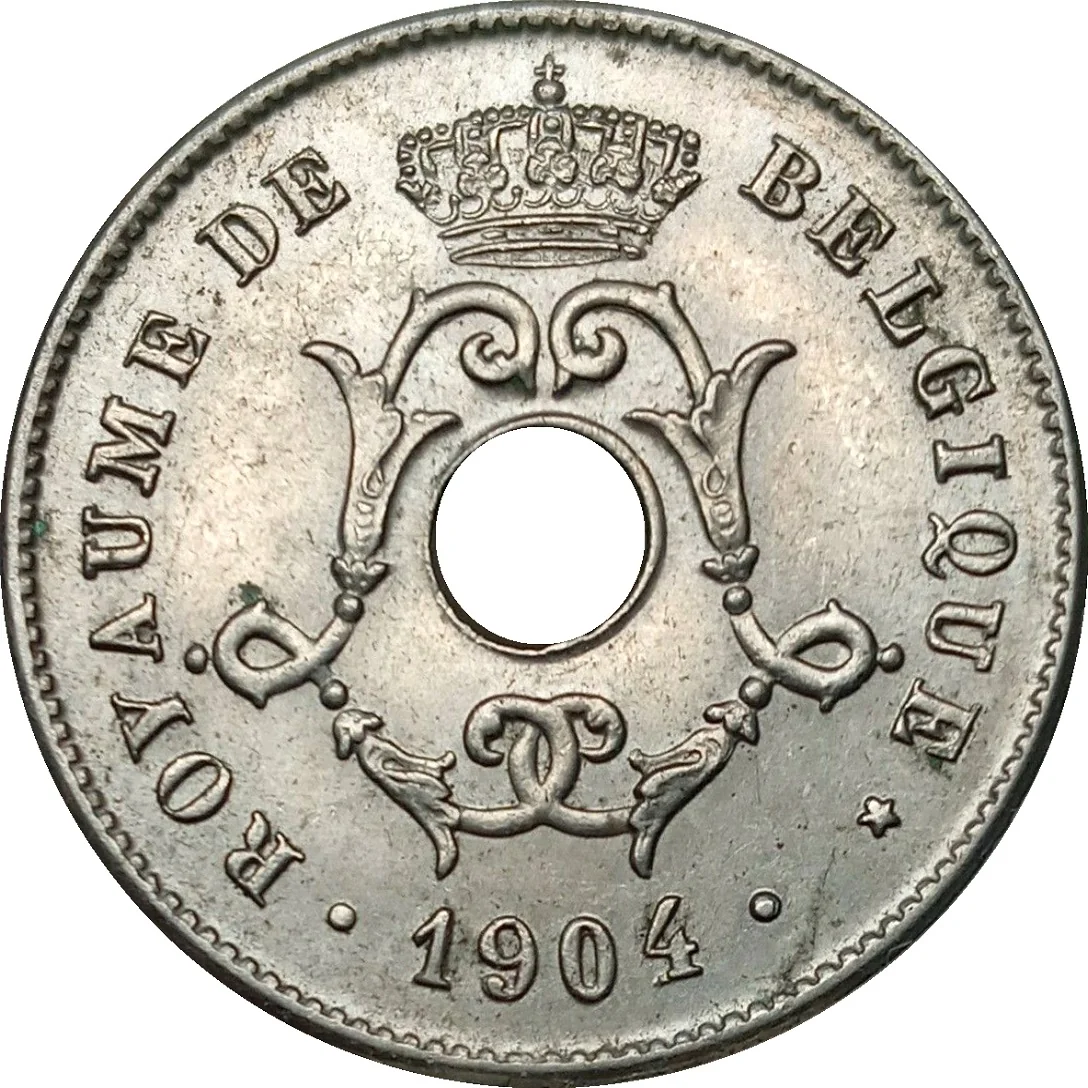
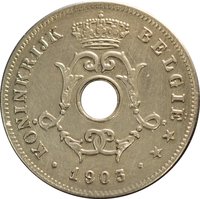
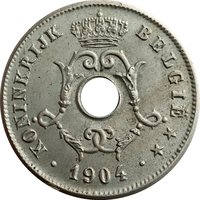
King Léopold II's monogram, French lettering, date below.
Inscription:
ROYAUME DE BELGIQUE ★
· 1904 ·
· 1904 ·
Translation:
Kingdom of Belgium ★
· 1904 ·
· 1904 ·
Script: Latin
Language: French
Engraver: Alphonse Michaux
Reverse
Description:
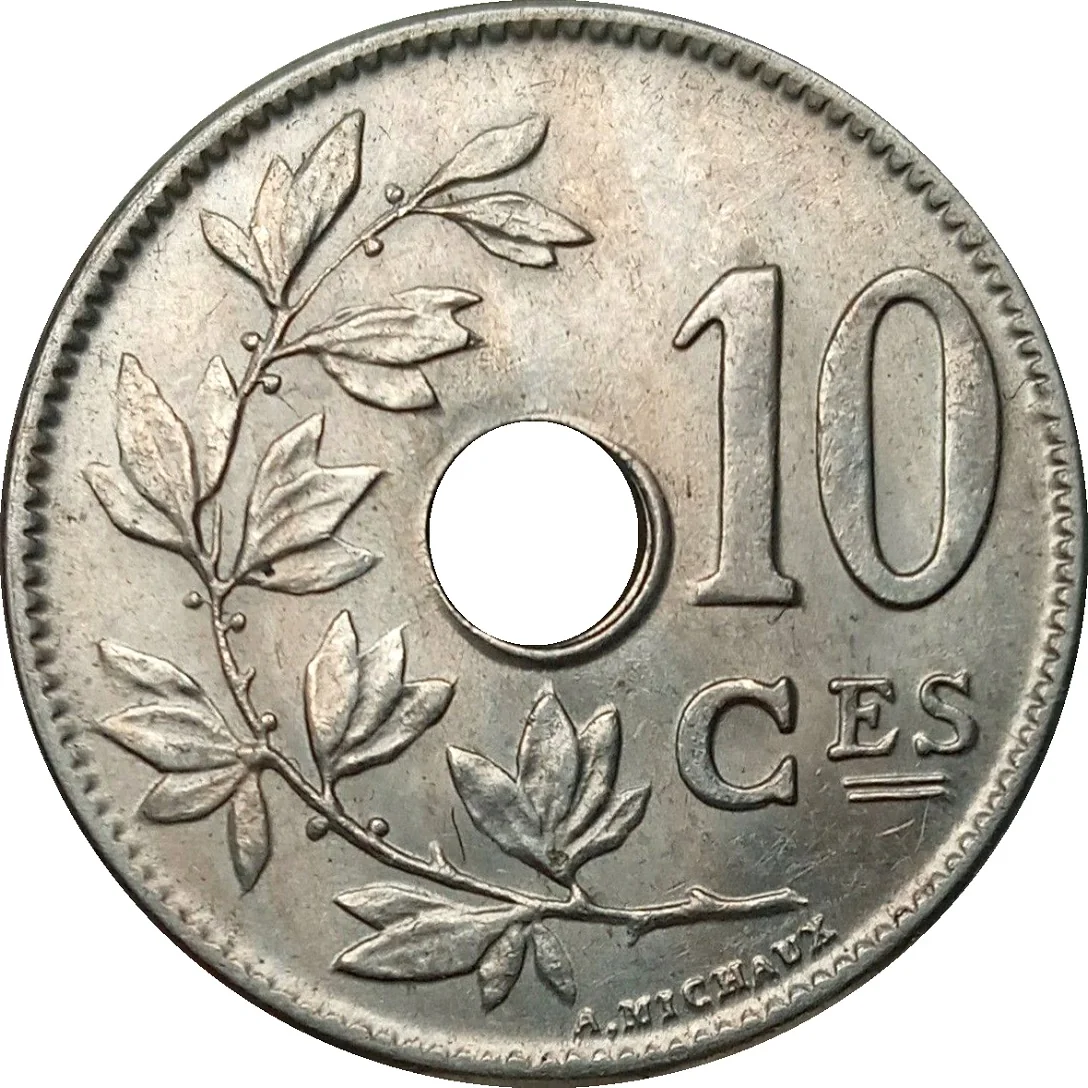
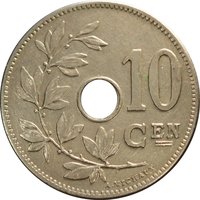
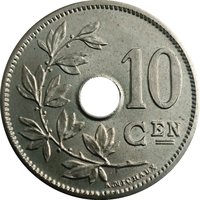
The center hole is flanked by an olive sprig on the left and the value on the right.
Inscription:
10
CES
A.MICHAUX
CES
A.MICHAUX
Script: Latin
Engraver: Alphonse Michaux
Edge
Plain
Mints
| Name | Mark |
|---|---|
| Royal Mint of Belgium | — |
Mintings
| Year | Mint Mark | Mintage | Quality | Collection |
|---|---|---|---|---|
| 1903 | — | 763,387 | ||
| 1904 | — | 16,354,035 | ||
| 1905 | — | 14,392,452 | ||
| 1906 | — | 1,482,882 |
Historical background
In 1903, Belgium's currency was firmly embedded within the Latin Monetary Union (LMU), a multinational agreement established in 1865 to standardize coinage across member nations, including France, Italy, Switzerland, and Greece. The system was bimetallic, based on fixed exchange rates between silver and gold, with the Belgian franc defined as equal to the French franc. Belgian coins minted to LMU standards (like the 20-franc gold "Napoleon") were legally acceptable across the union, facilitating trade and travel. However, by the turn of the century, the LMU was under severe strain due to the fluctuating market values of precious metals, which led to arbitrage and the hoarding of gold coins, draining them from circulation in Belgium and elsewhere.
Domestically, this period was characterized by a practical reliance on banknotes and token silver coins for everyday transactions. The National Bank of Belgium, which held the monopoly on note issuance, saw its paper currency gain public trust and widespread use, though legally it was still convertible into gold. The scarcity of gold in daily life meant that the Belgian economy operated on a de facto gold exchange standard, where banknotes represented gold held in reserve. This system provided stability but was dependent on the broader health of the LMU, which was increasingly fragile.
The situation in 1903 was one of quiet transition and underlying tension. While the currency was stable on the surface and integrated with key European partners, the structural flaws of the LMU were becoming apparent. International conferences to reform the union had failed, and member states were effectively suspending aspects of the treaty to protect their own gold reserves. Belgium, as a small, trade-dependent nation, was particularly vulnerable to these international monetary shifts, setting the stage for the eventual dissolution of the LMU after World War I and Belgium's later move towards a managed national currency fully backed by its central bank.
Domestically, this period was characterized by a practical reliance on banknotes and token silver coins for everyday transactions. The National Bank of Belgium, which held the monopoly on note issuance, saw its paper currency gain public trust and widespread use, though legally it was still convertible into gold. The scarcity of gold in daily life meant that the Belgian economy operated on a de facto gold exchange standard, where banknotes represented gold held in reserve. This system provided stability but was dependent on the broader health of the LMU, which was increasingly fragile.
The situation in 1903 was one of quiet transition and underlying tension. While the currency was stable on the surface and integrated with key European partners, the structural flaws of the LMU were becoming apparent. International conferences to reform the union had failed, and member states were effectively suspending aspects of the treaty to protect their own gold reserves. Belgium, as a small, trade-dependent nation, was particularly vulnerable to these international monetary shifts, setting the stage for the eventual dissolution of the LMU after World War I and Belgium's later move towards a managed national currency fully backed by its central bank.
🌱 Very Common