

1 pistole – Brunswick-Lüneburg-Calenberg-Hannover
Add to wishlist
Germany
Context
Material
References
KM: #
Numista: #266276
Value
Bullion value: $921.32
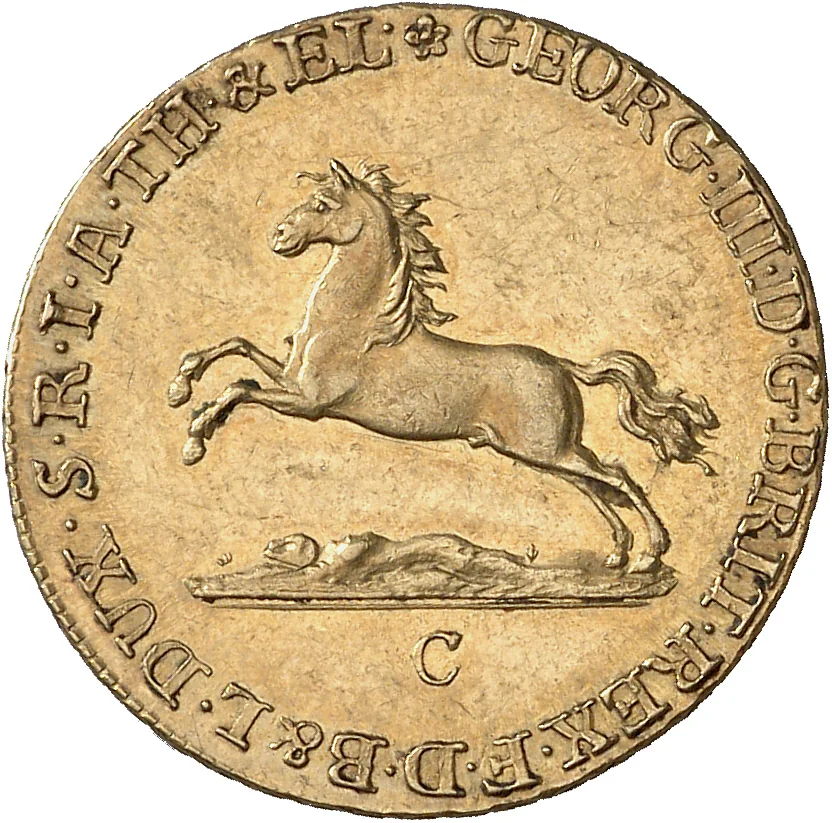
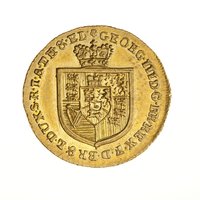
Obverse
Description:
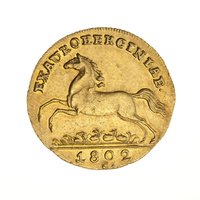
Horse leaping left.
Inscription:
GEORG III D G M BR F & H REX F D B & L DVX S R I A TH & EL
Translation:
GEORGE III BY THE GRACE OF GOD KING OF GREAT BRITAIN FRANCE AND IRELAND DUKE OF BRUNSWICK AND LUNEBURG ARCH-TREASURER AND ELECTOR OF THE HOLY ROMAN EMPIRE
Script: Latin
Reverse
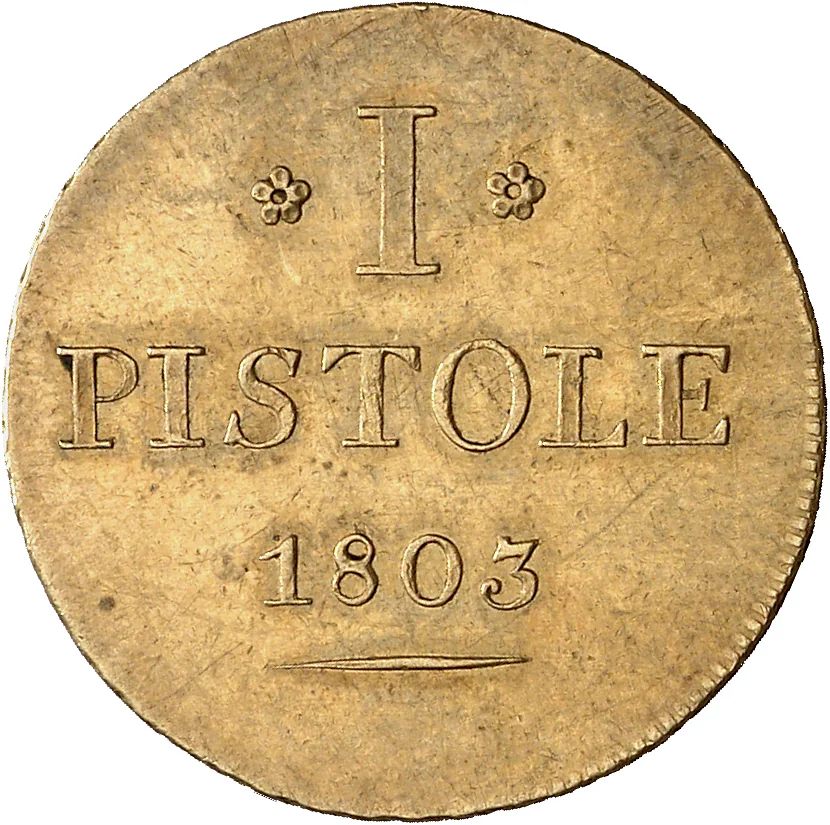
Inscription:
I
PISTOLE
1803
PISTOLE
1803
Script: Latin
Edge
Mints
| Name | Mark |
|---|---|
| Clausthal | — |
Mintings
| Year | Mint Mark | Mintage | Quality | Collection |
|---|---|---|---|---|
| 1803 | C | — |
Historical background
In 1803, the currency situation in the Duchy of Brunswick-Lüneburg, specifically the Principality of Calenberg (with its capital in Hanover), was complex and fragmented, reflecting the broader monetary disunity of the Holy Roman Empire. The region operated on the Reichsthaler (Imperial Thaler) as a standard accounting unit, but daily commerce relied on a confusing array of physical coins. These included various Thaler issues from Hanover itself, as well as a proliferation of smaller fractional coins like Gute Groschen, Mariengroschen, and Pfennige. Furthermore, the circulation of coins from neighboring states, each with its own intrinsic silver content, created chronic issues of valuation and exchange.
This monetary patchwork was exacerbated by the political context of the time. In 1803, the Duke of Brunswick-Lüneburg (the Elector of Hanover) was also the King of Great Britain, George III. The period was one of immense upheaval due to the Napoleonic Wars; Hanover had been occupied by French troops in 1803 following the rupture of the Peace of Amiens. This military occupation and the subsequent French administration introduced additional financial strain and uncertainty, potentially forcing the use of French-issued currency or requisitions, further destabilizing the local monetary system.
Consequently, trade and daily transactions were hindered by the need for constant conversion and the risk of debased coinage. There was no unified, state-controlled paper currency, and the system's stability relied entirely on the fluctuating silver value of myriad coins. This inefficient and cumbersome situation was typical of the era, highlighting the urgent need for the monetary consolidation that would only come later in the 19th century, after Hanover became a kingdom and, eventually, part of a unified German state.
This monetary patchwork was exacerbated by the political context of the time. In 1803, the Duke of Brunswick-Lüneburg (the Elector of Hanover) was also the King of Great Britain, George III. The period was one of immense upheaval due to the Napoleonic Wars; Hanover had been occupied by French troops in 1803 following the rupture of the Peace of Amiens. This military occupation and the subsequent French administration introduced additional financial strain and uncertainty, potentially forcing the use of French-issued currency or requisitions, further destabilizing the local monetary system.
Consequently, trade and daily transactions were hindered by the need for constant conversion and the risk of debased coinage. There was no unified, state-controlled paper currency, and the system's stability relied entirely on the fluctuating silver value of myriad coins. This inefficient and cumbersome situation was typical of the era, highlighting the urgent need for the monetary consolidation that would only come later in the 19th century, after Hanover became a kingdom and, eventually, part of a unified German state.
✨ Legendary