

Obverse
Description:
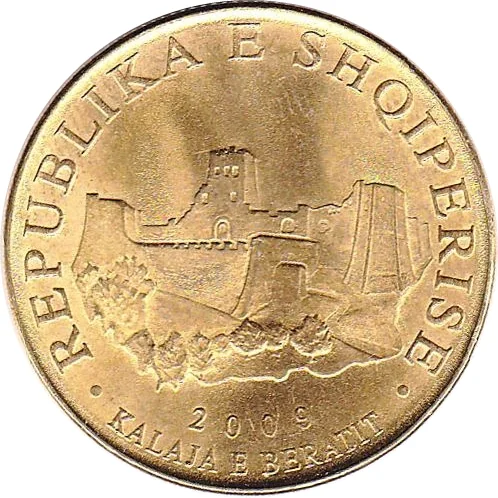
Berat Castle
Inscription:
·REPUBLIKA E SHQIPERISE·
2009
KALAJA E BERATIT
2009
KALAJA E BERATIT
Translation:
REPUBLIC OF ALBANIA
2009
BERAT CASTLE
2009
BERAT CASTLE
Script: Latin
Language: Albanian
Engraver: Namik Prizëreni
Reverse
Edge
Reeded
Categories
| Building> Castle or fortification |
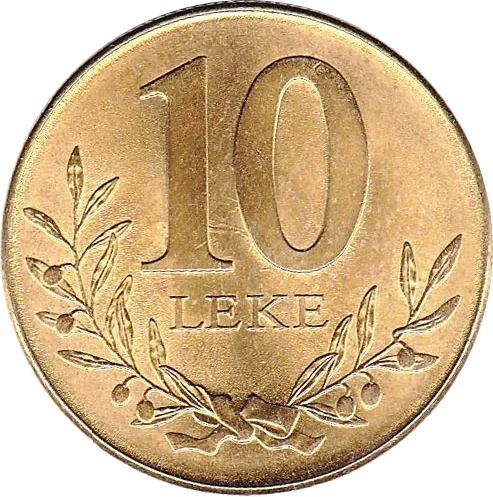
| Symbol> Wreath |
Mints
| Name | Mark |
|---|---|
| Mint of Poland | — |
Mintings
| Year | Mint Mark | Mintage | Quality | Collection |
|---|---|---|---|---|
| 2009 | — | — | ||
| 2013 | — | — | ||
| 2018 | — | — | ||
| 2023 | — | — |
Historical background
In 2009, Albania's currency situation was characterized by stability and resilience, largely insulated from the worst of the global financial crisis. The Albanian lek (ALL) operated under a free-floating exchange rate regime, managed by the Bank of Albania with a focus on controlling inflation rather than targeting a specific exchange rate. This period saw relative exchange rate stability against the euro, Albania's primary trading and financial partner, which was crucial for maintaining economic confidence. This stability was underpinned by steady remittance inflows from Albanians working abroad—a critical source of foreign currency—and a conservative banking sector with limited exposure to toxic international assets.
The broader economic context, however, presented challenges. While the lek itself was stable, Albania was grappling with the spillover effects of the international crisis, including a slowdown in GDP growth and a widening trade deficit. The current account deficit was a point of concern, financed largely by foreign direct investment and remittances. The Bank of Albania's monetary policy focused on maintaining price stability, and in early 2009, it cautiously cut its key interest rate to stimulate economic activity, reflecting a balancing act between supporting growth and safeguarding currency stability and inflation targets.
Overall, 2009 was a year of managed stability for the lek amidst external headwinds. The currency did not experience the severe volatility seen in other emerging European economies, thanks to Albania's relatively low financial integration and the central bank's prudent policies. The situation highlighted the economy's dependence on remittances and underscored ongoing structural issues like the large trade deficit, but the lek emerged from the year as a point of relative calm in the Albanian economic landscape.
The broader economic context, however, presented challenges. While the lek itself was stable, Albania was grappling with the spillover effects of the international crisis, including a slowdown in GDP growth and a widening trade deficit. The current account deficit was a point of concern, financed largely by foreign direct investment and remittances. The Bank of Albania's monetary policy focused on maintaining price stability, and in early 2009, it cautiously cut its key interest rate to stimulate economic activity, reflecting a balancing act between supporting growth and safeguarding currency stability and inflation targets.
Overall, 2009 was a year of managed stability for the lek amidst external headwinds. The currency did not experience the severe volatility seen in other emerging European economies, thanks to Albania's relatively low financial integration and the central bank's prudent policies. The situation highlighted the economy's dependence on remittances and underscored ongoing structural issues like the large trade deficit, but the lek emerged from the year as a point of relative calm in the Albanian economic landscape.
🌱 Very Common