

Obverse
Description:
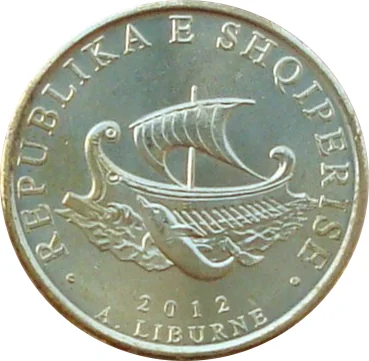
Liburne pattern
Inscription:
·REPUBLIKA E SHQIPERISE·
2012
A. LIBURNE
2012
A. LIBURNE
Translation:
REPUBLIC OF ALBANIA
2012
A. LIBURNE
2012
A. LIBURNE
Script: Latin
Language: Albanian
Engraver: Namik Prizëreni
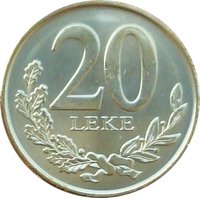
Reverse
Edge
Reeded
Categories
| Animal> Marine mammal |
| Transportation> Watercraft |
| Symbol> Wreath |
Mintings
| Year | Mint Mark | Mintage | Quality | Collection |
|---|---|---|---|---|
| 2012 | — | — | ||
| 2016 | — | — | ||
| 2020 | — | — | ||
| 2024 | — | — |
Historical background
In 2012, Albania's currency situation was characterized by stability and a continued reliance on a flexible exchange rate regime, with the Albanian Lek (ALL) as the sole legal tender. The Bank of Albania, the country's central bank, maintained its primary focus on price stability, targeting an inflation rate of 3%. This policy was largely successful, with annual inflation ending the year at a moderate 2.0%, down from 3.5% in 2011. This low and stable inflation environment helped anchor public expectations and provided a foundation for economic planning, although the economy was still recovering slowly from the global financial crisis's impact.
The exchange rate of the Lek exhibited relative stability against major currencies, particularly the Euro, which is crucial due to Albania's strong trade and financial ties with the Eurozone. The Lek experienced mild depreciation pressures during the year, partly due to domestic political uncertainty surrounding local elections and the broader European sovereign debt crisis, which affected investor sentiment towards emerging European markets. However, the central bank's interventions in the foreign exchange market were limited, as it allowed the currency to fluctuate within a managed float, using its reserves to smooth out excessive volatility rather than defend a specific peg.
Underlying this stable facade were persistent structural challenges. The economy faced a large trade deficit, high levels of informal economic activity, and significant euroization in the banking sector, where a large portion of loans and deposits were denominated in Euros. This "financial euroization" posed a risk, as it limited the effectiveness of the central bank's monetary policy and exposed the financial system to exchange rate risks. Consequently, while the currency situation in 2012 was outwardly calm, it operated within a framework of ongoing vulnerabilities that required careful management by monetary authorities.
The exchange rate of the Lek exhibited relative stability against major currencies, particularly the Euro, which is crucial due to Albania's strong trade and financial ties with the Eurozone. The Lek experienced mild depreciation pressures during the year, partly due to domestic political uncertainty surrounding local elections and the broader European sovereign debt crisis, which affected investor sentiment towards emerging European markets. However, the central bank's interventions in the foreign exchange market were limited, as it allowed the currency to fluctuate within a managed float, using its reserves to smooth out excessive volatility rather than defend a specific peg.
Underlying this stable facade were persistent structural challenges. The economy faced a large trade deficit, high levels of informal economic activity, and significant euroization in the banking sector, where a large portion of loans and deposits were denominated in Euros. This "financial euroization" posed a risk, as it limited the effectiveness of the central bank's monetary policy and exposed the financial system to exchange rate risks. Consequently, while the currency situation in 2012 was outwardly calm, it operated within a framework of ongoing vulnerabilities that required careful management by monetary authorities.
🌱 Very Common