

10 Pesos – Costa Rica
Costa Rica
Context
Years: 1870–1872
Issuer: Costa Rica 
Period:
(1848—1948)
Currency:
(1863—1896)
Demonetization: 14 August 1900
Total mintage: 54,710
Material
References
KM: #Click to copy to clipboard115
Numista: #26376
Value
Bullion value: $2140.41
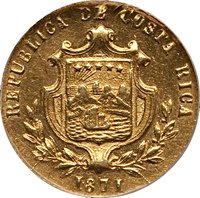
Obverse
Description:
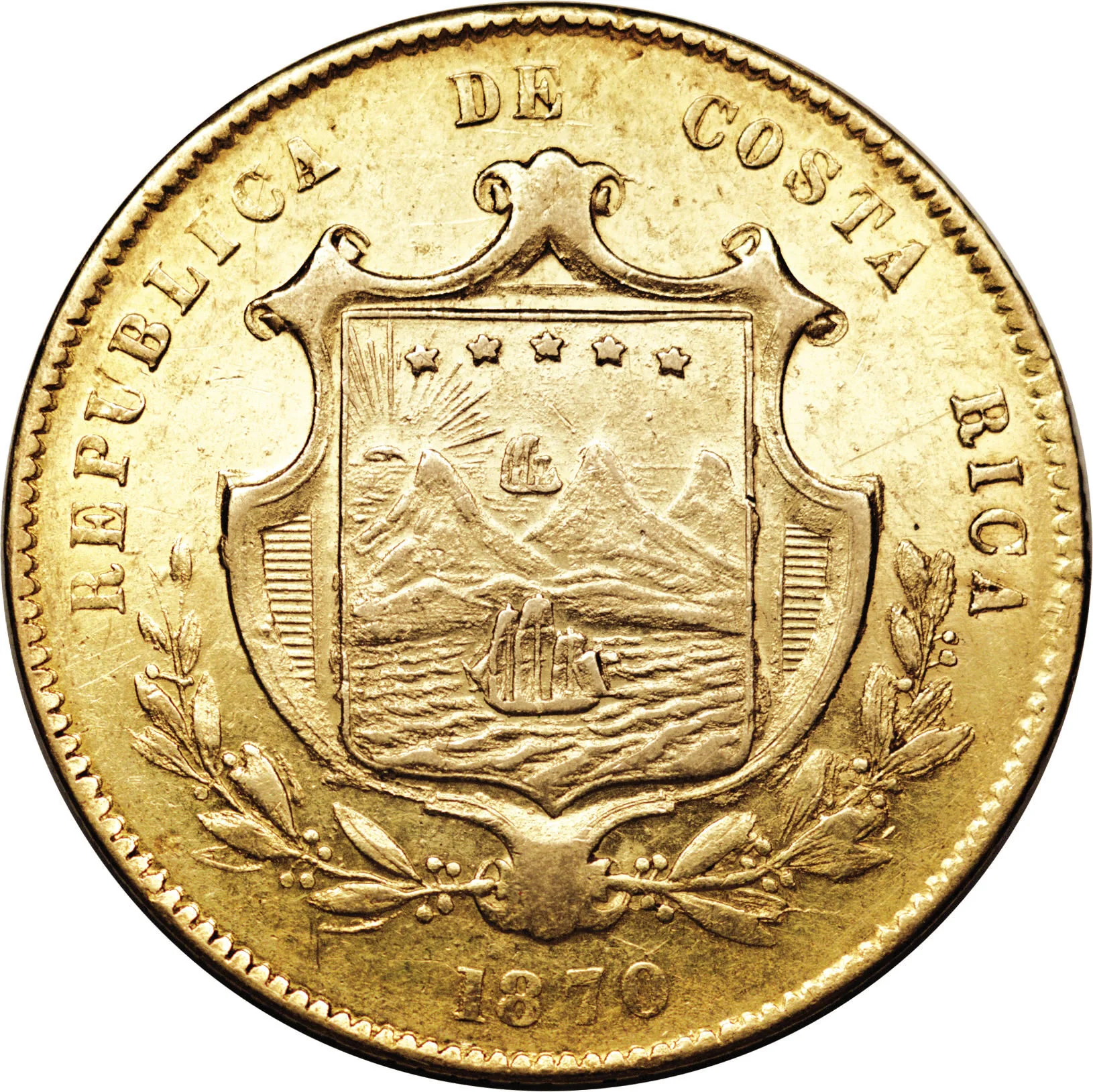
Coat of arms, legend above, date below.
Inscription:
REPUBLICA DE COSTA RICA
1870
1870
Translation:
REPUBLIC OF COSTA RICA
1870
1870
Script: Latin
Language: Spanish
Engraver: Guillermo Witting
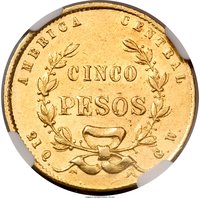
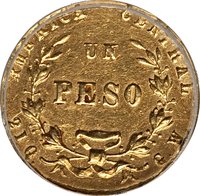
Reverse
Edge
Categories
| Symbols> Coat of Arms |
| Symbol> Wreath |
Mints
| Name | Mark |
|---|---|
| Casa Nacional de Moneda de Costa Rica | — |
Mintings
| Year | Mint Mark | Mintage | Quality | Collection |
|---|---|---|---|---|
| 1870 | — | 20,175 | ||
| 1871 | — | 29,980 | ||
| 1872 | — | 4,555 |
Historical background
In 1870, Costa Rica's currency situation was characterized by significant complexity and instability, a legacy of its colonial past and early independence. The country lacked a unified national currency, leading to a chaotic circulation of diverse coins. Spanish colonial coins, such as the gold escudo and silver real, circulated alongside coins from other Latin American nations, British sovereigns, and even Peruvian and Bolivian coins. This monetary pluralism created constant challenges for commerce, as the value of these coins was based on their intrinsic metal content (gold or silver), requiring merchants and officials to be adept at assaying and exchanging a bewildering array of foreign specie.
The primary unit of account was the silver peso, divided into eight reales, but its value in relation to gold fluctuated with international market prices for precious metals. Furthermore, the chronic shortage of small-denomination coinage (moneda menuda) for everyday transactions was a persistent problem that stifled local trade and caused public discontent. Attempts to address this, such as the authorization of low-value copper tokens by private banks and merchants, often led to inflation and loss of public trust, as these tokens were not always fully backed or widely accepted.
This fragmented and inefficient system underscored the pressing need for monetary reform, which was a topic of debate among the nation's coffee-exporting elite and political leaders. The 1870s would become a pivotal decade, setting the stage for transformative changes. Indeed, just a few years later, in 1877, the government would contract with the Paris Mint to produce the nation's first official coinage, the peso, and subsequently establish the gold standard in 1896, marking the beginning of a modern, unified monetary system for the growing coffee republic.
The primary unit of account was the silver peso, divided into eight reales, but its value in relation to gold fluctuated with international market prices for precious metals. Furthermore, the chronic shortage of small-denomination coinage (moneda menuda) for everyday transactions was a persistent problem that stifled local trade and caused public discontent. Attempts to address this, such as the authorization of low-value copper tokens by private banks and merchants, often led to inflation and loss of public trust, as these tokens were not always fully backed or widely accepted.
This fragmented and inefficient system underscored the pressing need for monetary reform, which was a topic of debate among the nation's coffee-exporting elite and political leaders. The 1870s would become a pivotal decade, setting the stage for transformative changes. Indeed, just a few years later, in 1877, the government would contract with the Paris Mint to produce the nation's first official coinage, the peso, and subsequently establish the gold standard in 1896, marking the beginning of a modern, unified monetary system for the growing coffee republic.
💎 Extremely Rare