

1 Peso – Costa Rica
Costa Rica
Context
Years: 1871–1872
Issuer: Costa Rica 
Period:
(1848—1948)
Currency:
(1863—1896)
Demonetization: 14 August 1900
Total mintage: 47,903
Material
References
KM: #Click to copy to clipboard116
Numista: #78707
Value
Bullion value: $223.08
Obverse
Description:
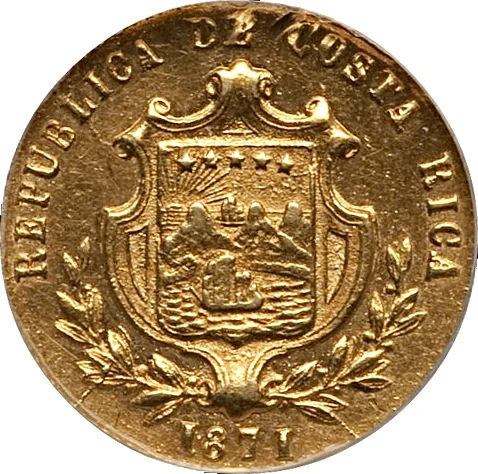
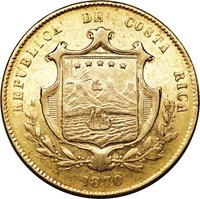
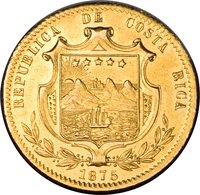
Coat of arms, legend above, date below.
Inscription:
REPUBLICA DE COSTA RICA
1871
1871
Translation:
REPUBLIC OF COSTA RICA
1871
1871
Script: Latin
Language: Spanish
Engraver: Guillermo Witting
Reverse
Description:
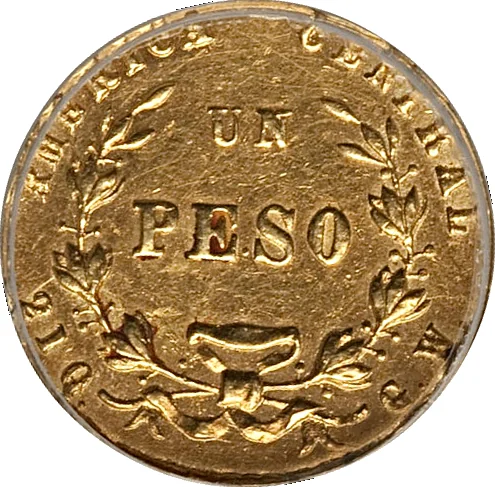
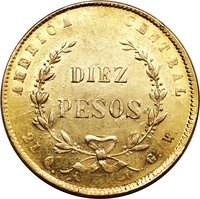
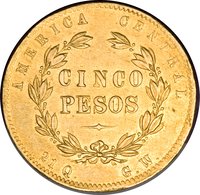
Wreath with value. Top: legend. Bottom: fineness and assayer's initials.
Inscription:
AMERICA CENTRAL
UN
PESO
21 Q G.W.
UN
PESO
21 Q G.W.
Translation:
Central America
One
Peso
21 Q G.W.
One
Peso
21 Q G.W.
Script: Latin
Language: Spanish
Engraver: Guillermo Witting
Edge
Categories
| Symbols> Coat of Arms |
| Symbol> Wreath |
Mints
| Name | Mark |
|---|---|
| Casa Nacional de Moneda de Costa Rica | — |
Mintings
| Year | Mint Mark | Mintage | Quality | Collection |
|---|---|---|---|---|
| 1871 | — | 10,895 | ||
| 1872 | — | 37,008 |
Historical background
In 1871, Costa Rica’s currency system was a complex and unstable mixture of foreign and domestic coins, reflecting its position as a small, agrarian nation integrated into the global economy. The primary circulating medium included silver pesos from Peru, Bolivia, and Chile, alongside British gold sovereigns and French francs. However, the most critical and problematic currency was the Costa Rican silver peso, which was officially on a bimetallic standard with gold but in practice suffered from severe debasement and fluctuating value. This created a chaotic environment where the intrinsic metal value of a coin often differed significantly from its official face value, leading to confusion in commerce and frequent disputes.
The root of this instability lay in chronic government budget deficits, which were financed by the repeated minting of debased silver coinage at the San José Mint. Successive administrations, lacking other sources of revenue, used seigniorage (the profit from minting coins) as a crucial fiscal tool. This practice led to a steady depreciation of the Costa Rican peso against gold-backed foreign currencies, causing Gresham’s Law to operate in earnest: "bad money drives out good." Full-weight foreign silver and gold coins were hoarded or exported, leaving the lighter, debased national coins in daily circulation, which further eroded public trust in the monetary system.
This chaotic currency situation posed a direct obstacle to President Tomás Guardia’s modernizing ambitions, particularly his flagship project of building a railroad to the Atlantic coast to export coffee. Foreign contractors and investors demanded payment in stable gold, exposing the weakness of the domestic currency. Consequently, the year 1871 was a pivotal moment of recognition, setting the stage for major monetary reforms later in the decade. The government began serious preparations to establish a gold standard and create a national banking system, steps that would culminate in the creation of the Colón in the 1890s, aiming to attract foreign capital and stabilize the economy.
The root of this instability lay in chronic government budget deficits, which were financed by the repeated minting of debased silver coinage at the San José Mint. Successive administrations, lacking other sources of revenue, used seigniorage (the profit from minting coins) as a crucial fiscal tool. This practice led to a steady depreciation of the Costa Rican peso against gold-backed foreign currencies, causing Gresham’s Law to operate in earnest: "bad money drives out good." Full-weight foreign silver and gold coins were hoarded or exported, leaving the lighter, debased national coins in daily circulation, which further eroded public trust in the monetary system.
This chaotic currency situation posed a direct obstacle to President Tomás Guardia’s modernizing ambitions, particularly his flagship project of building a railroad to the Atlantic coast to export coffee. Foreign contractors and investors demanded payment in stable gold, exposing the weakness of the domestic currency. Consequently, the year 1871 was a pivotal moment of recognition, setting the stage for major monetary reforms later in the decade. The government began serious preparations to establish a gold standard and create a national banking system, steps that would culminate in the creation of the Colón in the 1890s, aiming to attract foreign capital and stabilize the economy.
✨ Legendary