

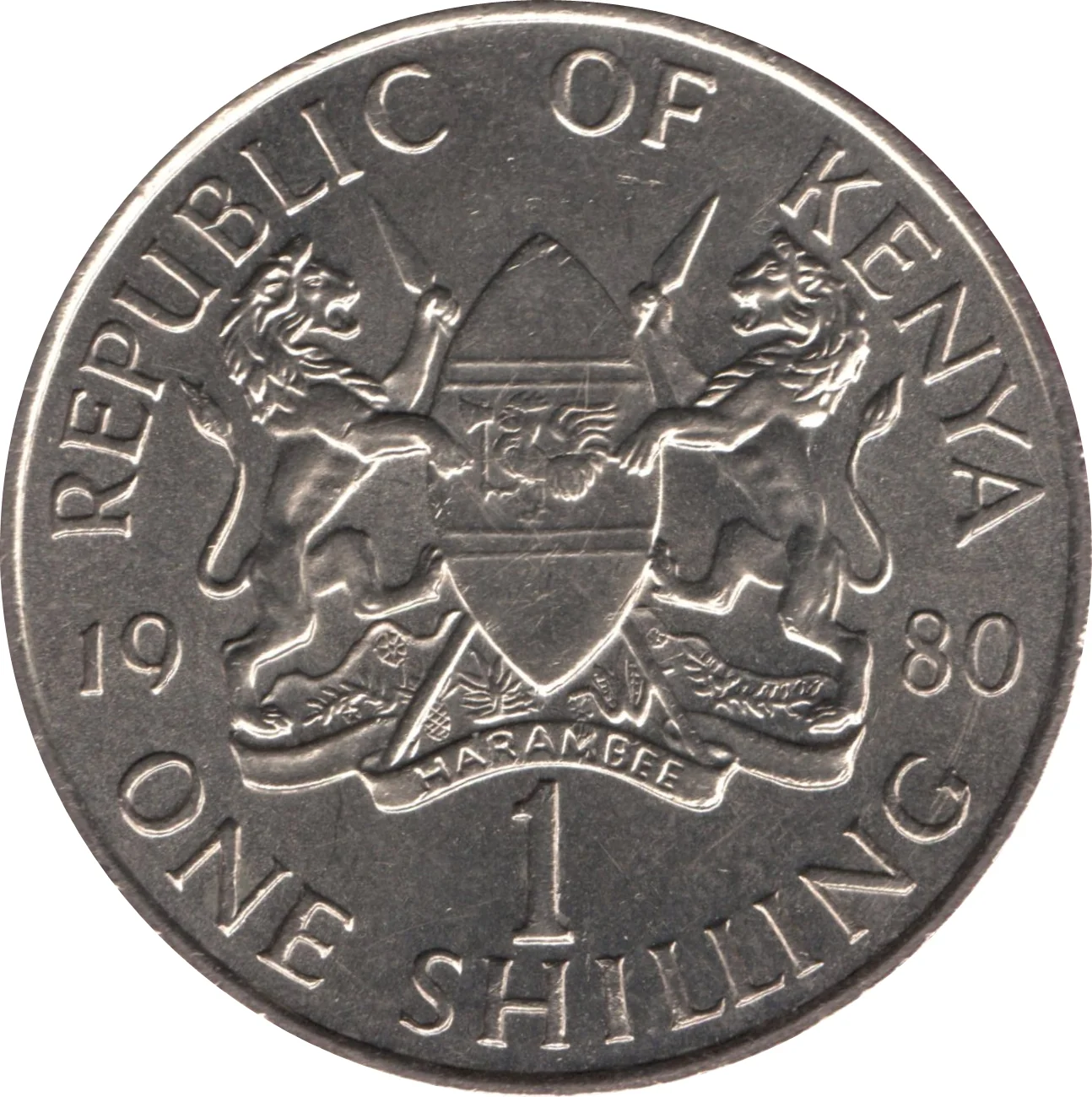
1 Shilling – Kenya
Kenya
Context
Material
Diameter: 27.8 mm
Weight: 7.9 g
Thickness: 1.65 mm
Shape: Round
Composition: Copper-nickel
Standard: Silver quarter ounce
Technique: Milled
Alignment: Medal alignment
flip
References
KM: #Click to copy to clipboard20
Numista: #2634
Value
Exchange value: 1 KES
Obverse
Reverse
Description:
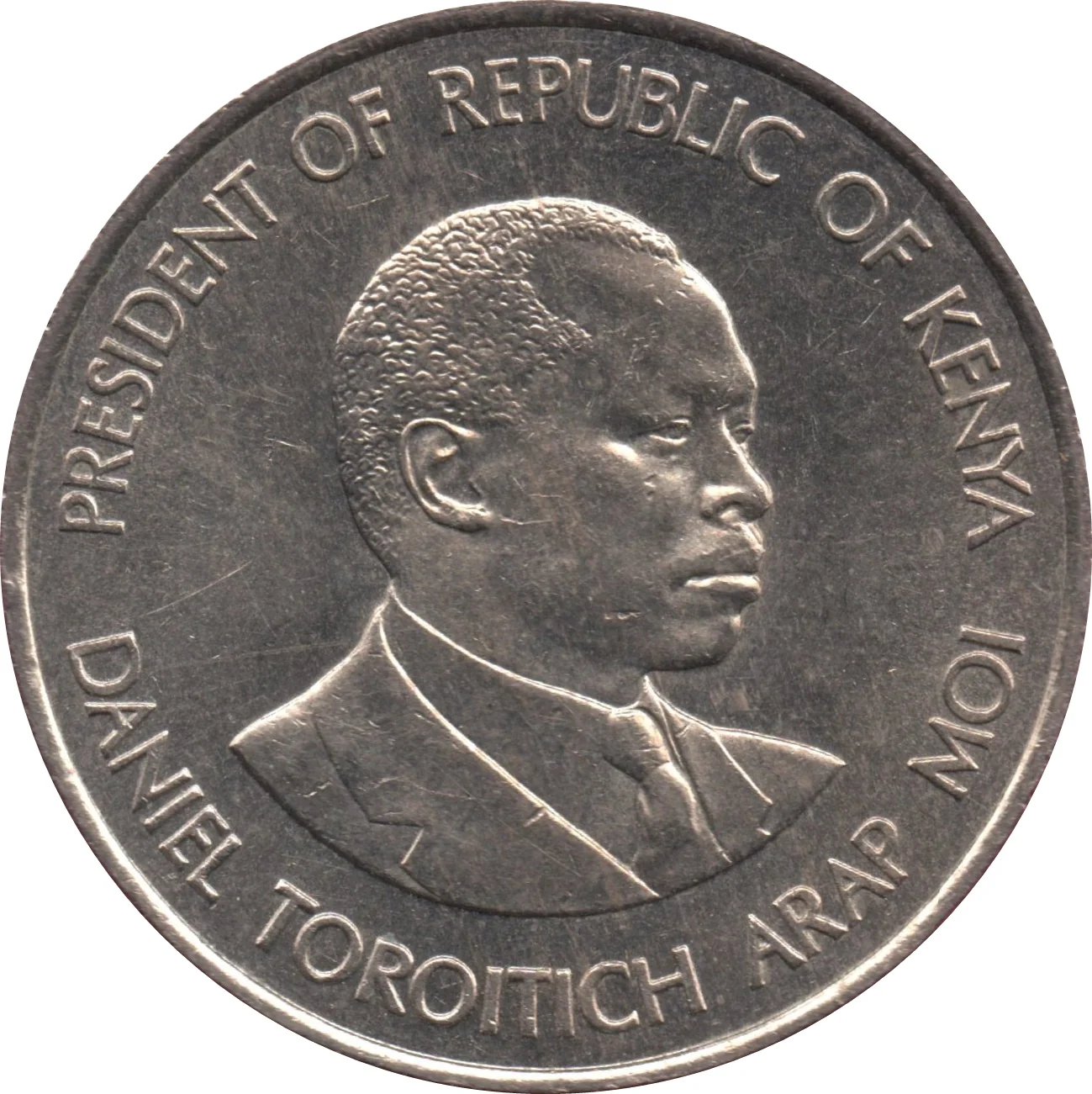
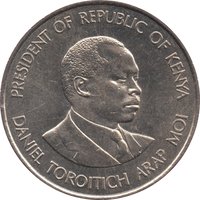
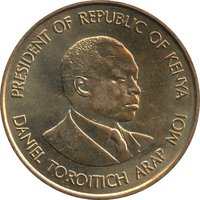
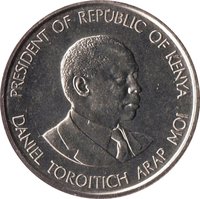
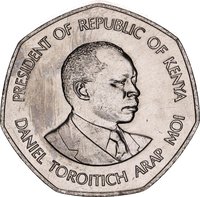
Bust of Daniel Arap Moi facing right.
Inscription:
PRESIDENT OF REPUBLIC OF KENYA
DANIEL TOROITICH ARAP MOI
DANIEL TOROITICH ARAP MOI
Script: Latin
Edge
Reeded
Categories
| Symbols> Coat of Arms |
| Person> Politician |
Mints
| Name | Mark |
|---|---|
| Royal Mint | — |
Mintings
| Year | Mint Mark | Mintage | Quality | Collection |
|---|---|---|---|---|
| 1978 | — | — | Proof | |
| 1980 | — | — | ||
| 1981 | — | — | Proof | |
| 1989 | — | — |
Historical background
In 1978, Kenya's currency situation was characterized by relative stability under the managed framework of the Bretton Woods system, though it existed in the shadow of significant regional change. The Kenyan Shilling (KES), pegged to the U.S. Dollar through a fixed exchange rate, was considered a strong and stable currency within East Africa. This stability was underpinned by a period of consistent economic growth, a robust agricultural export sector (notably coffee and tea), and conservative fiscal management. The Central Bank of Kenya maintained strict control over foreign exchange, and the shilling's credibility was a point of national pride, contrasting with the economic turmoil experienced by some neighboring countries.
However, this apparent stability faced mounting pressures. The year was marked by the death of President Jomo Kenyatta in August and the succession of Daniel arap Moi, introducing political uncertainty. Economically, the first shocks of the late 1970s oil crises were being felt, widening the current account deficit and putting downward pressure on foreign reserves. Furthermore, the collapse of the East African Community in 1977 had severed the currency union with Tanzania and Uganda, making the Kenyan Shilling a distinctly national currency for the first time in over a decade. This necessitated a complex restructuring of regional trade and payments systems.
Consequently, while the shilling's formal peg held in 1978, the groundwork for future devaluation was being laid. The fixed exchange rate, combined with rising import costs and inflationary pressures, began to overvalue the currency, hurting export competitiveness. The government and central bank were thus navigating a delicate transition, committed to stability but increasingly aware that the existing monetary policy would become difficult to sustain. The challenges of 1978 set the stage for the difficult economic adjustments and the eventual shift to a crawling peg and later a floating exchange rate regime in the 1980s.
However, this apparent stability faced mounting pressures. The year was marked by the death of President Jomo Kenyatta in August and the succession of Daniel arap Moi, introducing political uncertainty. Economically, the first shocks of the late 1970s oil crises were being felt, widening the current account deficit and putting downward pressure on foreign reserves. Furthermore, the collapse of the East African Community in 1977 had severed the currency union with Tanzania and Uganda, making the Kenyan Shilling a distinctly national currency for the first time in over a decade. This necessitated a complex restructuring of regional trade and payments systems.
Consequently, while the shilling's formal peg held in 1978, the groundwork for future devaluation was being laid. The fixed exchange rate, combined with rising import costs and inflationary pressures, began to overvalue the currency, hurting export competitiveness. The government and central bank were thus navigating a delicate transition, committed to stability but increasingly aware that the existing monetary policy would become difficult to sustain. The challenges of 1978 set the stage for the difficult economic adjustments and the eventual shift to a crawling peg and later a floating exchange rate regime in the 1980s.
Series: 1978 Kenya circulation coins
🌱 Very Common