

5 shillings – Kenya
Add to wishlist
Kenya
Context
Material
Diameter: 30 mm
Weight: 13.5 g
Thickness: 2.4 mm
Shape: Equilateral curve heptagon
Composition: Copper-nickel
Technique: Milled
Alignment: Medal alignment
flip
References
KM: #
Numista: #2264
Value
Exchange value: 5 KES
Obverse
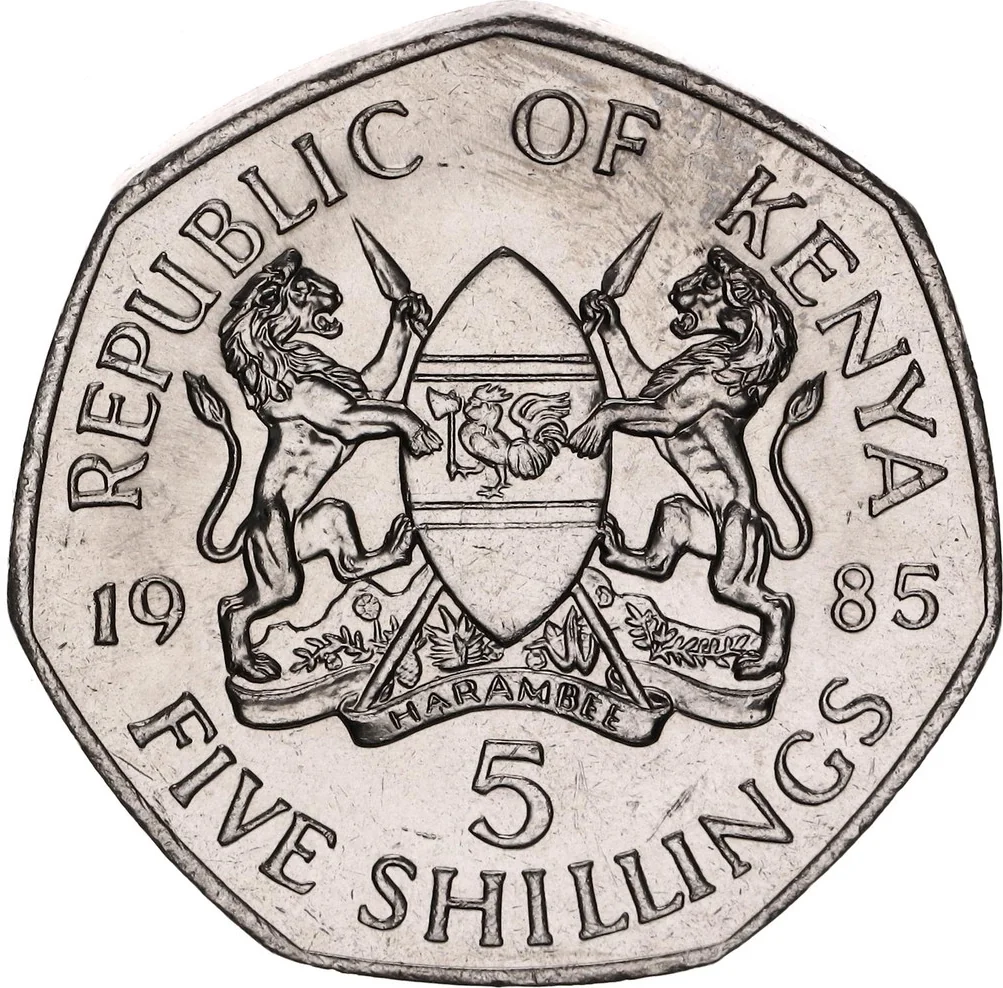
Reverse
Description:
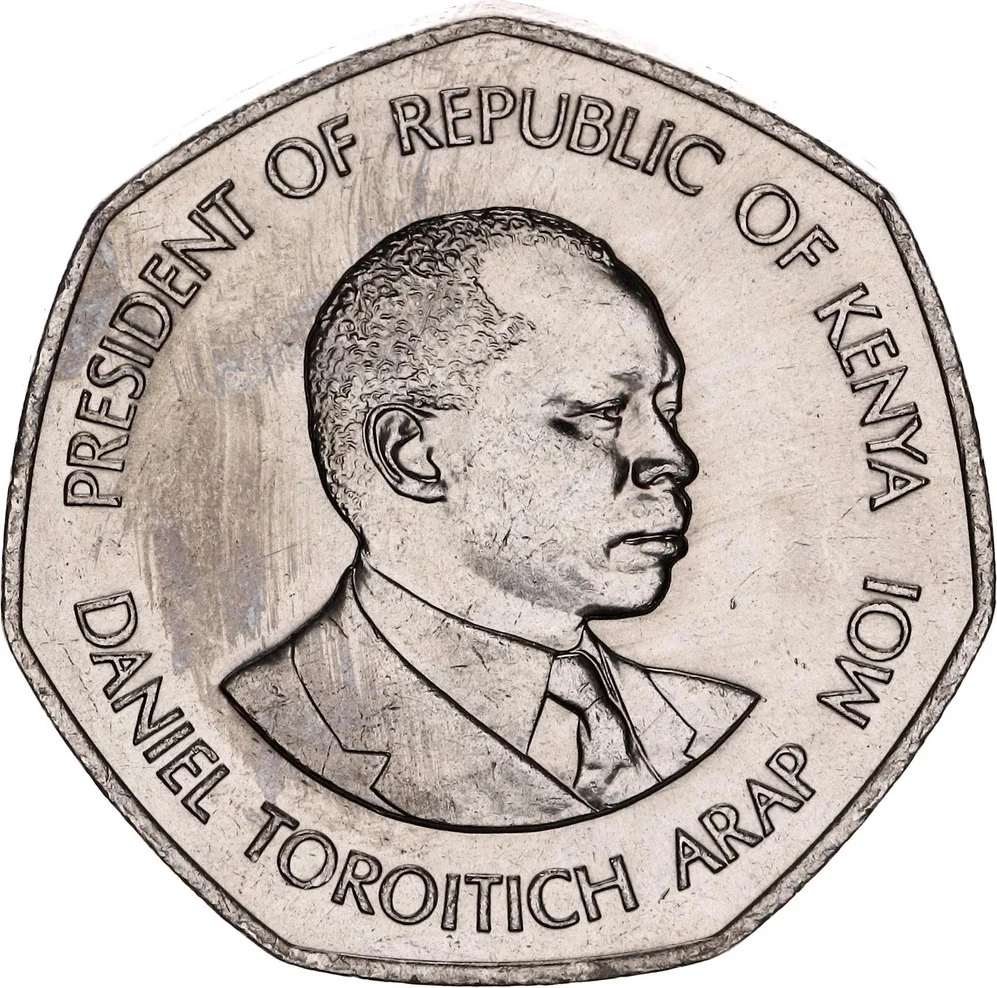
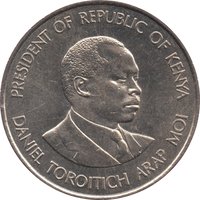
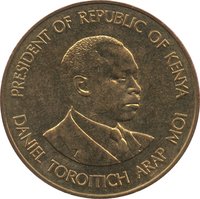
Bust of Daniel arap Moi facing right.
Inscription:
PRESIDENT OF REPUBLIC OF KENYA
DANIEL TOROITICH ARAP MOI
DANIEL TOROITICH ARAP MOI
Script: Latin
Edge
Plain
Categories
| Symbols> Coat of Arms |
| Person> Politician |
Mints
| Name | Mark |
|---|---|
| Royal Mint | — |
Mintings
| Year | Mint Mark | Mintage | Quality | Collection |
|---|---|---|---|---|
| 1985 | — | — |
Historical background
In 1985, Kenya's currency situation was characterized by a tightly controlled and overvalued Kenyan Shilling (KES) operating under a fixed exchange rate regime, pegged to a basket of currencies dominated by the US Dollar. This system was managed by the Central Bank of Kenya (CBK) and was a legacy of the Bretton Woods era, maintained to provide stability for import-dependent industries and to service foreign debt. However, the official exchange rate, approximately 16 KES to 1 USD, did not reflect economic realities, creating a significant disparity with the black-market rate where the shilling traded at a steep discount. This overvaluation masked underlying economic strains, including declining terms of trade for key exports like coffee and tea, and a growing balance of payments deficit.
The government of President Daniel arap Moi, adhering to the structural adjustment programs (SAPs) prescribed by the International Monetary Fund (IMF) and World Bank, was under increasing pressure to liberalize the economy. A major condition was the devaluation of the shilling to correct the overvaluation and boost export competitiveness. While a major devaluation would occur in the 1990s, the mid-80s period was one of mounting pressure and reluctant, incremental adjustments. The government resisted a large, one-off devaluation due to fears of triggering inflation, increasing the cost of essential imports (like oil and machinery), and causing public discontent.
Consequently, the currency environment in 1985 was one of controlled tension. Access to foreign exchange for businesses was restricted through an import licensing system, leading to shortages, inefficiencies, and a thriving parallel market. This system bred rent-seeking and corruption, as access to cheap dollars at the official rate became a lucrative privilege. Thus, the Kenyan shilling's predicament in 1985 was a microcosm of a broader economic crossroads: the struggle between state control and the push towards market-oriented reforms, setting the stage for the more dramatic financial liberalizations that would follow in the next decade.
The government of President Daniel arap Moi, adhering to the structural adjustment programs (SAPs) prescribed by the International Monetary Fund (IMF) and World Bank, was under increasing pressure to liberalize the economy. A major condition was the devaluation of the shilling to correct the overvaluation and boost export competitiveness. While a major devaluation would occur in the 1990s, the mid-80s period was one of mounting pressure and reluctant, incremental adjustments. The government resisted a large, one-off devaluation due to fears of triggering inflation, increasing the cost of essential imports (like oil and machinery), and causing public discontent.
Consequently, the currency environment in 1985 was one of controlled tension. Access to foreign exchange for businesses was restricted through an import licensing system, leading to shortages, inefficiencies, and a thriving parallel market. This system bred rent-seeking and corruption, as access to cheap dollars at the official rate became a lucrative privilege. Thus, the Kenyan shilling's predicament in 1985 was a microcosm of a broader economic crossroads: the struggle between state control and the push towards market-oriented reforms, setting the stage for the more dramatic financial liberalizations that would follow in the next decade.
🌱 Very Common