


Obverse
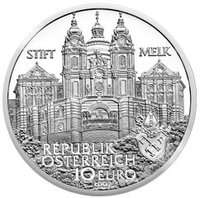
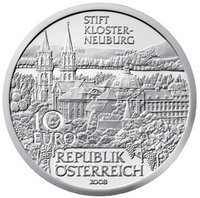
Description:
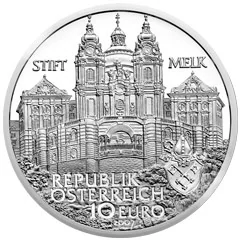
View of Melk Abbey.
Inscription:
STIFT MELK
REPUBLIK
ÖSTERREICH
10 EURO
2007
REPUBLIK
ÖSTERREICH
10 EURO
2007
Translation:
Melk Abbey
Republic
Austria
10 Euro
2007
Republic
Austria
10 Euro
2007
Script: Latin
Language: German
Engraver: Thomas Pesendorfer
Reverse
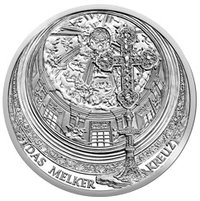
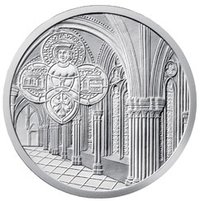
Description:
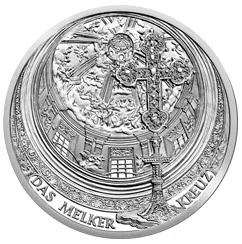
Interior of the Melk Abbey dome.
Inscription:
DAS MELKER KREUZ
H. WÄHNER
H. WÄHNER
Translation:
The Melk Cross
H. Wähner
H. Wähner
Script: Latin
Language: German
Engraver: Herbert Wähner
Edge
Plain
Categories
| Building> Religious building |
| Symbol> Cross |
Mints
| Name | Mark |
|---|---|
| Münze Österreich | — |
Mintings
| Year | Mint Mark | Mintage | Quality | Collection |
|---|---|---|---|---|
| 2007 | — | 130,000 | ||
| 2007 | — | 60,000 | Proof | |
| 2007 | — | 40,000 | BU |
Historical background
In 2007, Austria was a well-integrated member of the European Union's economic and monetary structures, having adopted the euro as its physical currency six years earlier in 2002. The country was part of the Eurozone, which provided a framework of monetary stability, with interest rates and broad monetary policy set by the European Central Bank (ECB) in Frankfurt. The Austrian schilling had been completely phased out, and the euro was firmly established in everyday transactions, contributing to price transparency and facilitating trade and investment within the single market.
The domestic economic context in 2007 was one of robust growth, with Austria benefiting from strong exports and deepening economic ties with the new EU member states in Central and Eastern Europe. However, beneath this stability, some underlying concerns were emerging. Like other Eurozone members, Austria experienced low but persistent inflation slightly above the ECB's target, driven in part by rising global energy and commodity prices. Furthermore, Austrian banks had aggressively expanded into the high-growth markets of Eastern Europe, accumulating significant exposure that would later pose a substantial risk during the global financial crisis.
Overall, the currency situation in Austria in 2007 was characterized by the quiet confidence of Eurozone membership. The primary debates around currency were not domestic but European, focusing on the ECB's interest rate policies and the management of the euro's external value against the US dollar and other major currencies. The specific vulnerabilities within the Austrian banking system, linked to foreign currency lending in Eastern Europe, were not yet a mainstream crisis but a growing concern among financial experts, foreshadowing the severe challenges that would erupt in late 2008.
The domestic economic context in 2007 was one of robust growth, with Austria benefiting from strong exports and deepening economic ties with the new EU member states in Central and Eastern Europe. However, beneath this stability, some underlying concerns were emerging. Like other Eurozone members, Austria experienced low but persistent inflation slightly above the ECB's target, driven in part by rising global energy and commodity prices. Furthermore, Austrian banks had aggressively expanded into the high-growth markets of Eastern Europe, accumulating significant exposure that would later pose a substantial risk during the global financial crisis.
Overall, the currency situation in Austria in 2007 was characterized by the quiet confidence of Eurozone membership. The primary debates around currency were not domestic but European, focusing on the ECB's interest rate policies and the management of the euro's external value against the US dollar and other major currencies. The specific vulnerabilities within the Austrian banking system, linked to foreign currency lending in Eastern Europe, were not yet a mainstream crisis but a growing concern among financial experts, foreshadowing the severe challenges that would erupt in late 2008.
Series: Austria and its People
🌟 Uncommon