

5 Dinars (Liberation) – Yugoslavia
Circulating commemorative coins
Commemoration: 30 Years of Liberation
Context
Year: 1975
Issuer: Yugoslavia
Issuing organization: National Bank of Yugoslavia
Period:
(1963—1992)
Currency:
(1966—1989)
Demonetization: 30 September 1988
Total mintage: 1,020,000
Material
References
KM: #Click to copy to clipboard60
Numista: #9936
Value
Exchange value: 5 YUD
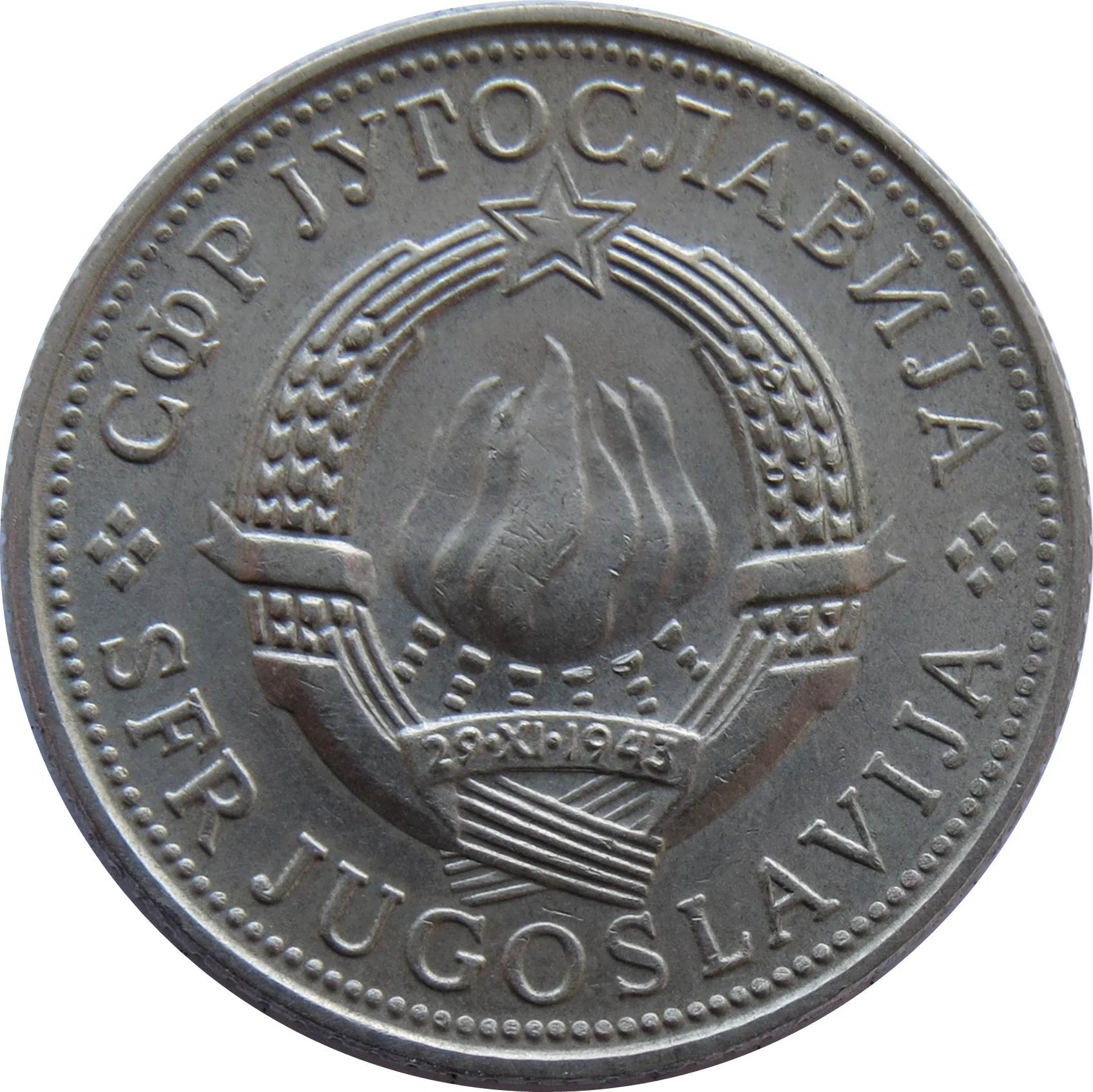
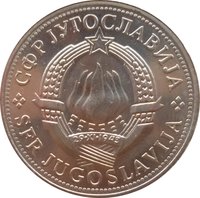
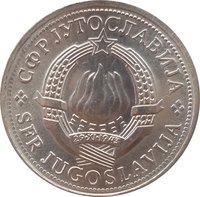
Obverse
Inscription:
СФР ЈУГОСЛАВИЈА
SFR JUGOSLAVIJA
SFR JUGOSLAVIJA
Translation:
SOCIALIST FEDERAL REPUBLIC OF YUGOSLAVIA
Languages: Serbian, Serbo-Croatian
Designer: Dragomir Mileusnić
Reverse
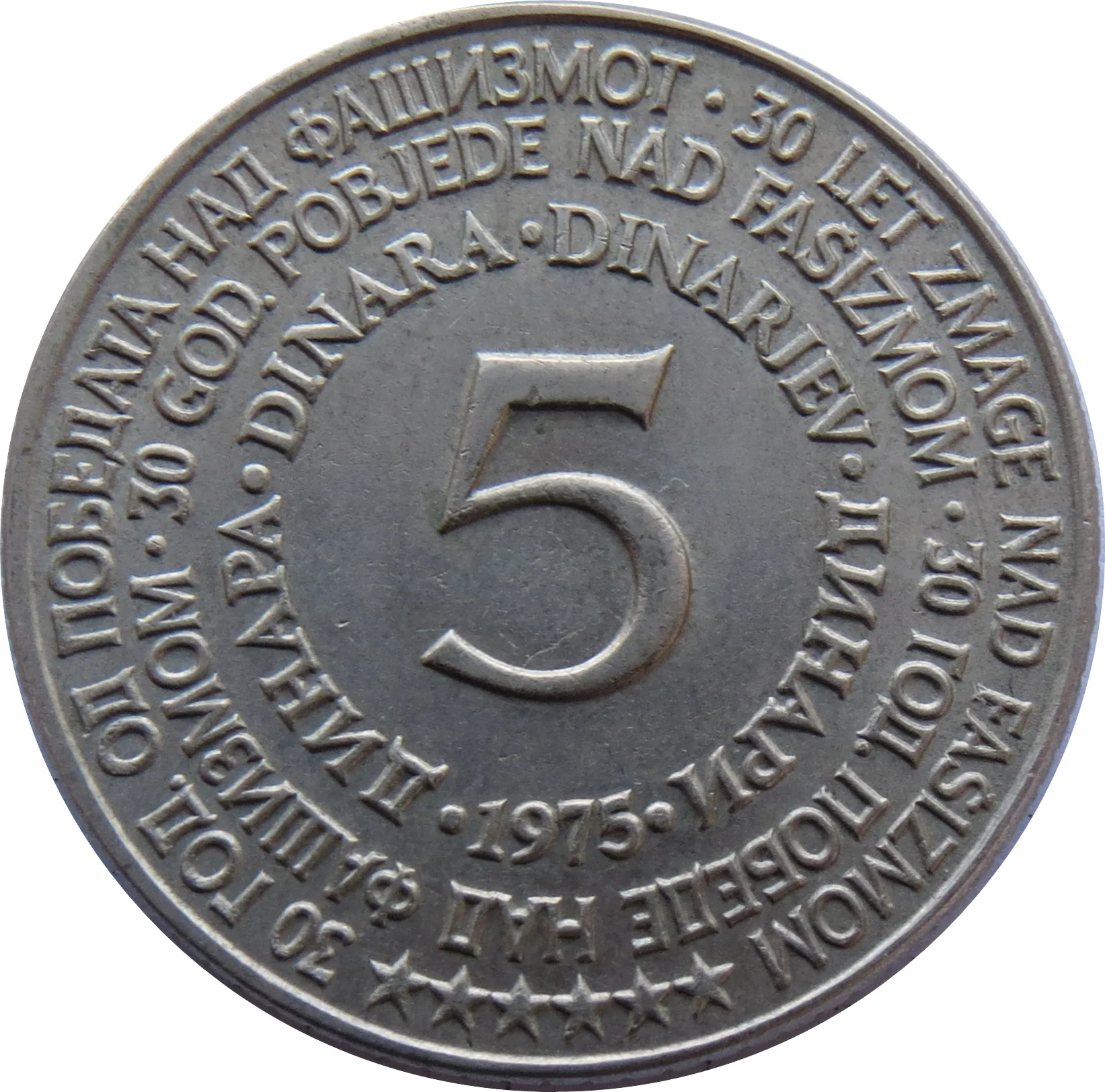
Inscription:
30 ГОД. ОД ПОБЕДАТА НАД ФАШИЗМОТ • 30 LET ZMAGE NAD FAŠIZMOM ******
30 GOD. POBJEDE NAD FAŠIZMOM • 30 ГОД. ПОБЕДЕ НАД ФАШИЗМОМ •
• ДИНАРА • DINARA • DINARJEV • ДИНАРИ •
5
1975
30 GOD. POBJEDE NAD FAŠIZMOM • 30 ГОД. ПОБЕДЕ НАД ФАШИЗМОМ •
• ДИНАРА • DINARA • DINARJEV • ДИНАРИ •
5
1975
Translation:
30 Years Since the Victory Over Fascism • 30 Years of Victory Over Fascism ******
30 Years of Victory Over Fascism • 30 Years of Victory Over Fascism •
• Dinara • Dinara • Dinars • Dinars •
5
1975
30 Years of Victory Over Fascism • 30 Years of Victory Over Fascism •
• Dinara • Dinara • Dinars • Dinars •
5
1975
Designer: Dragomir Mileusnić
Edge
Reeded
Categories
| Symbols> Coat of Arms |
Mints
| Name | Mark |
|---|---|
| Belgrade | — |
Mintings
| Year | Mint Mark | Mintage | Quality | Collection |
|---|---|---|---|---|
| 1975 | — | 1,020,000 |
Historical background
By 1975, Yugoslavia's unique socialist self-management system was grappling with significant economic strains that directly impacted its currency, the Yugoslav dinar. The country's heavy reliance on foreign loans to finance development and consumption, coupled with the global oil crisis of 1973, had led to soaring inflation, a growing trade deficit, and mounting external debt. While the dinar was not freely convertible, its stability was under pressure, and the complex federation of six republics and two autonomous provinces struggled to coordinate a unified monetary and fiscal policy, often resorting to the creation of new money to cover budgetary shortfalls.
Internally, the currency situation was managed under a system of "social accounting" where enterprises were theoretically self-financing. However, soft budget constraints and political pressure to maintain employment and living standards led to chronic monetary expansion by the National Bank of Yugoslavia. This fueled an inflationary spiral that was increasingly difficult to control, eroding the dinar's purchasing power. Externally, the dinar's official exchange rate was maintained through strict controls, but a thriving black market for foreign currency, especially hard currencies like the US dollar and Deutsche Mark, highlighted the gap between the official economy and reality.
The situation in 1975 was a precarious balancing act. The state maintained capital controls and relied on remittances from Yugoslav Gastarbeiter (guest workers) abroad and tourism revenues to bolster foreign exchange reserves. While a full-blown currency crisis was still a few years away, the foundational weaknesses were evident. The inherent contradictions between decentralized economic management and the need for macroeconomic stability were becoming unsustainable, setting the stage for the severe debt crises and hyperinflation that would cripple the country in the 1980s.
Internally, the currency situation was managed under a system of "social accounting" where enterprises were theoretically self-financing. However, soft budget constraints and political pressure to maintain employment and living standards led to chronic monetary expansion by the National Bank of Yugoslavia. This fueled an inflationary spiral that was increasingly difficult to control, eroding the dinar's purchasing power. Externally, the dinar's official exchange rate was maintained through strict controls, but a thriving black market for foreign currency, especially hard currencies like the US dollar and Deutsche Mark, highlighted the gap between the official economy and reality.
The situation in 1975 was a precarious balancing act. The state maintained capital controls and relied on remittances from Yugoslav Gastarbeiter (guest workers) abroad and tourism revenues to bolster foreign exchange reserves. While a full-blown currency crisis was still a few years away, the foundational weaknesses were evident. The inherent contradictions between decentralized economic management and the need for macroeconomic stability were becoming unsustainable, setting the stage for the severe debt crises and hyperinflation that would cripple the country in the 1980s.
🌱 Common