


Obverse
Description:
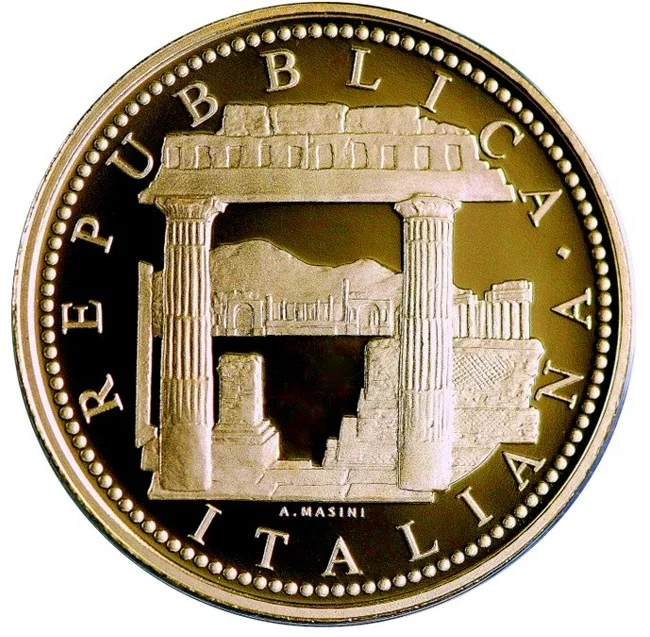
Pompeii ruins composition.
Author's name below.
Author's name below.
Inscription:
REPUBBLICA⠂ITALIANA
A. MASINI
A. MASINI
Translation:
Italian Republic
A. Masini
A. Masini
Script: Latin
Language: Italian
Engraver: Annalisa Masini
Reverse
Description:
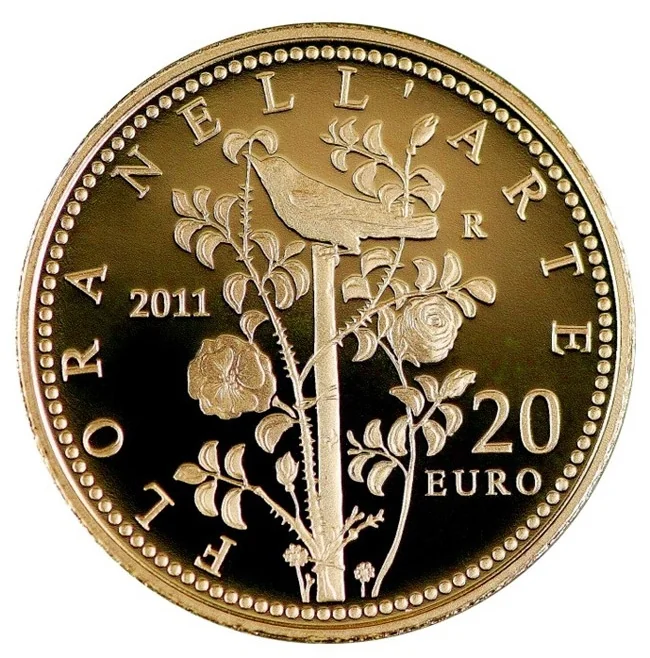
Pompeian fresco detail from the House of the Golden Bracelet, showing a garden with a jay and plants. Left: date. Right: value on two lines.
Inscription:
FLORA NELL'ARTE
R
2011
20
EURO
R
2011
20
EURO
Translation:
FLORA IN ART
R
2011
20
EURO
R
2011
20
EURO
Script: Latin
Language: Italian
Engraver: Annalisa Masini
Edge
Continuous milled.
Mints
| Name | Mark |
|---|---|
| Rome | R |
Mintings
| Year | Mint Mark | Mintage | Quality | Collection |
|---|---|---|---|---|
| 2011 | R | 1,500 | Proof |
Historical background
In 2011, Italy found itself at the epicenter of the Eurozone debt crisis, not as a small peripheral economy but as a systemically critical one. The country was burdened by a massive public debt exceeding 120% of GDP—a legacy of decades of high spending and low growth—coupled with a chronically uncompetitive economy. While its budget deficit was relatively modest, investor confidence evaporated as political paralysis under Prime Minister Silvio Berlusconi prevented the implementation of credible austerity measures and structural reforms. This triggered a vicious cycle where soaring borrowing costs on Italian government bonds (with yields surpassing 7%) raised fears of insolvency and threatened to collapse the entire euro project.
The situation created a dangerous standoff between financial markets and European institutions. The European Central Bank (ECB), under President Jean-Claude Trichet, initiated its Securities Markets Programme (SMP) to purchase Italian bonds on secondary markets, but this support was conditional on strict austerity. This "conditionality" highlighted a core tension: Italy was too big to fail but also too big for a straightforward bailout like those given to Greece, Ireland, and Portugal. The crisis exposed the fundamental flaw in the Eurozone's architecture—a shared currency without a common fiscal treasury or banking union to backstop member states.
The breaking point came in November 2011, as market pressure and loss of political credibility culminated in Berlusconi's resignation. He was replaced by a technocratic government led by former European Commissioner Mario Monti, who immediately implemented harsh austerity packages and labor market reforms to restore market confidence and meet ECB demands. While this temporarily lowered bond yields and stabilized the immediate crisis, it came at the cost of a deep recession, setting the stage for years of economic stagnation and political backlash against EU-mandated austerity in Italy.
The situation created a dangerous standoff between financial markets and European institutions. The European Central Bank (ECB), under President Jean-Claude Trichet, initiated its Securities Markets Programme (SMP) to purchase Italian bonds on secondary markets, but this support was conditional on strict austerity. This "conditionality" highlighted a core tension: Italy was too big to fail but also too big for a straightforward bailout like those given to Greece, Ireland, and Portugal. The crisis exposed the fundamental flaw in the Eurozone's architecture—a shared currency without a common fiscal treasury or banking union to backstop member states.
The breaking point came in November 2011, as market pressure and loss of political credibility culminated in Berlusconi's resignation. He was replaced by a technocratic government led by former European Commissioner Mario Monti, who immediately implemented harsh austerity packages and labor market reforms to restore market confidence and meet ECB demands. While this temporarily lowered bond yields and stabilized the immediate crisis, it came at the cost of a deep recession, setting the stage for years of economic stagnation and political backlash against EU-mandated austerity in Italy.









✨ Legendary