

10 Zlotys (People's Republic of Poland) – Poland
Circulating commemorative coins
Commemoration: 25th Anniversary of People's Republic of Poland
Poland
Context
Year: 1969
Issuer: Poland 
Period:
(1952—1989)
Currency:
(1949—1994)
Demonetization: 1 January 1978
Total mintage: 2,000,000
Material
Diameter: 28 mm
Weight: 9.5 g
Thickness: 2 mm
Shape: Round
Composition: Copper-nickel
Technique: Milled
Alignment: Medal alignment
flip
References
Y: #Click to copy to clipboard61
Numista: #9815
Value
Exchange value: 10 PLZ
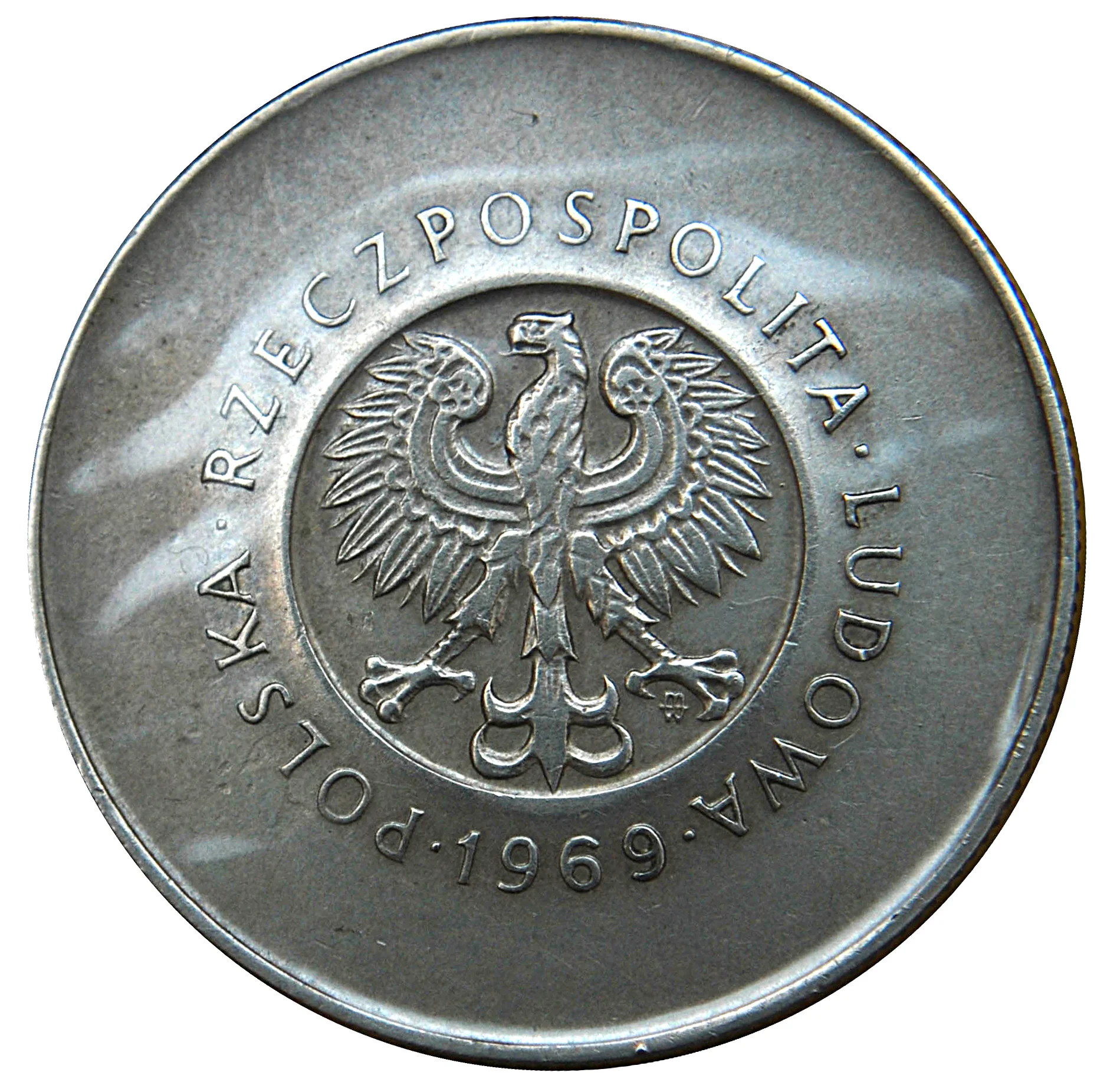
Obverse
Description:
The Polish national coat of arms.
Inscription:
POLSKA·RZECZPOSPOLITA·LUDOWA
·1969·
MW
·1969·
MW
Translation:
Polish People's Republic
1969
MW
1969
MW
Script: Latin
Language: Polish
Engraver: Jerzy Jarnuszkiewicz
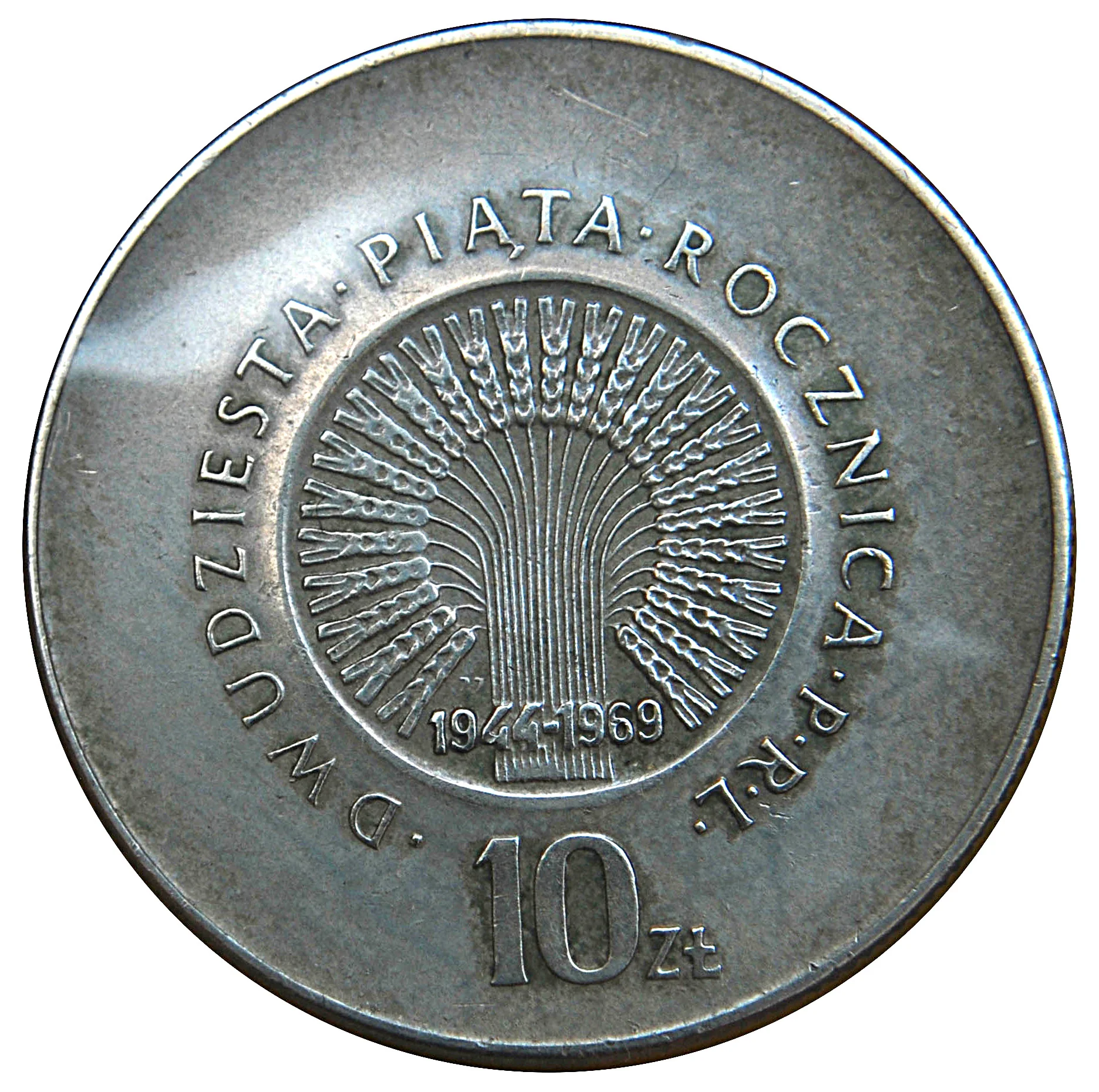
Reverse
Description:
A wheat sheaf of 25 ears with the denomination below.
Inscription:
•DWUDZIESTA•PIĄTA•ROCZNICA•P•R•L•
J J
1944-1969
10ZŁ
J J
1944-1969
10ZŁ
Translation:
TWENTY-FIFTH ANNIVERSARY OF THE P•R•L
J J
1944-1969
10 ZŁ
J J
1944-1969
10 ZŁ
Script: Latin
Language: Polish
Engraver: Jerzy Jarnuszkiewicz
Edge
Reeded
Mints
| Name | Mark |
|---|---|
| Mint of Poland | MW |
Mintings
| Year | Mint Mark | Mintage | Quality | Collection |
|---|---|---|---|---|
| 1969 | MW | 2,000,000 |
Historical background
In 1969, Poland's currency situation was defined by the rigidities and contradictions of its centrally planned economy under the communist Polish United Workers' Party. The official currency, the złoty (PLZ), was a non-convertible "soft currency," meaning it could not be freely exchanged for hard Western currencies like the US dollar or Deutsche Mark. Its value was administratively set by the state at an artificially high, overvalued official exchange rate (approximately 3.99 złoty to 1 US dollar for accounting purposes), which bore no relation to its real purchasing power or market value. This system was designed to control all foreign trade and isolate the domestic economy from global market fluctuations.
Beneath this official facade, a critical dual currency system thrived. For ordinary citizens, access to Western goods was severely limited in state-run Pewex and Baltona shops, where purchases required payment in hard currencies or special certificates. This created a pervasive black market where US dollars, in particular, commanded a premium many times higher than the official rate. The difference between the two rates highlighted the złoty's weakness and the economy's underlying inefficiencies, including persistent consumer goods shortages and suppressed inflation. The government tacitly tolerated this dual system as a necessary pressure valve, as remittances from Poles abroad provided a vital source of hard currency for the state.
The year 1969 fell within a period of relative economic stability following the reforms of the mid-1960s, but it was a stability built on heavy borrowing from the West that would later contribute to the debt crisis of the 1970s. There were no major devaluations or currency reforms that year; instead, the situation was one of managed stagnation. The currency regime effectively subsidized heavy industry at the expense of consumers and acted as a tool for economic control, reflecting the broader political priorities of the state while masking growing imbalances that would eventually necessitate future economic shocks and reforms.
Beneath this official facade, a critical dual currency system thrived. For ordinary citizens, access to Western goods was severely limited in state-run Pewex and Baltona shops, where purchases required payment in hard currencies or special certificates. This created a pervasive black market where US dollars, in particular, commanded a premium many times higher than the official rate. The difference between the two rates highlighted the złoty's weakness and the economy's underlying inefficiencies, including persistent consumer goods shortages and suppressed inflation. The government tacitly tolerated this dual system as a necessary pressure valve, as remittances from Poles abroad provided a vital source of hard currency for the state.
The year 1969 fell within a period of relative economic stability following the reforms of the mid-1960s, but it was a stability built on heavy borrowing from the West that would later contribute to the debt crisis of the 1970s. There were no major devaluations or currency reforms that year; instead, the situation was one of managed stagnation. The currency regime effectively subsidized heavy industry at the expense of consumers and acted as a tool for economic control, reflecting the broader political priorities of the state while masking growing imbalances that would eventually necessitate future economic shocks and reforms.
🌱 Common