

10 Zlotys (Provincial Annexations) – Poland
Circulating commemorative coins
Commemoration: 25th Anniversary of Provincial Annexations
Poland
Context
Year: 1970
Issuer: Poland 
Period:
(1952—1989)
Currency:
(1949—1994)
Demonetization: 1 January 1978
Total mintage: 2,000,000
Material
Diameter: 28 mm
Weight: 9.5 g
Thickness: 2 mm
Shape: Round
Composition: Copper-nickel
Technique: Milled
Alignment: Medal alignment
flip
References
Y: #Click to copy to clipboard62
Numista: #10534
Value
Exchange value: 10 PLZ
Obverse
Description:
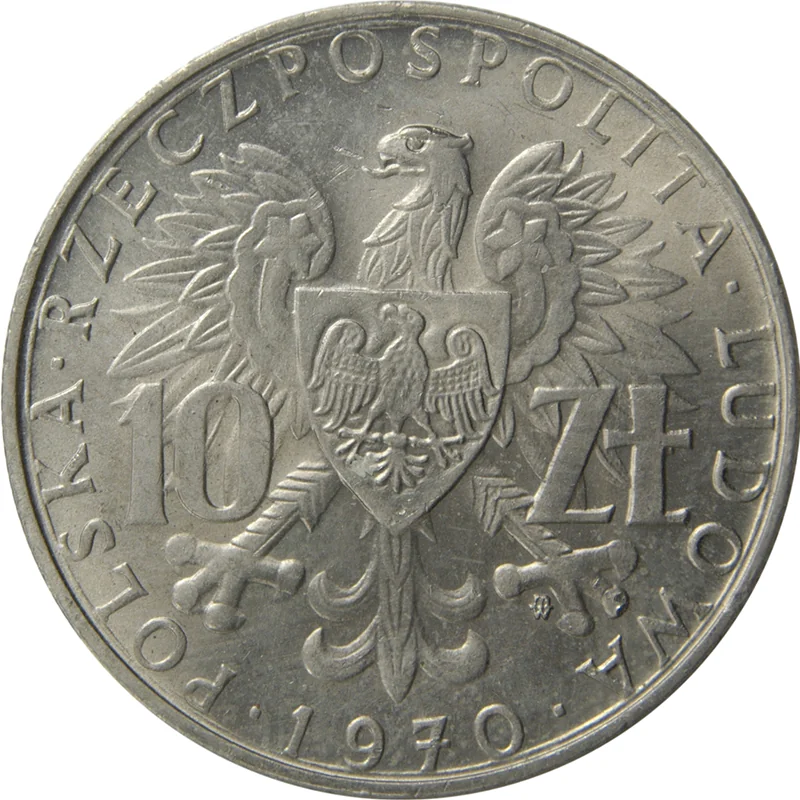
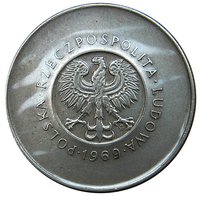
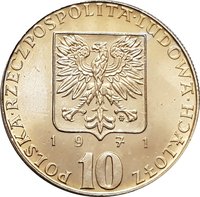
White Eagle, Poland's national emblem, on a divided shield.
Inscription:
POLSKA·RZECZPOSPOLITA·LUDOWA
10 ZŁ
mw
·1970·
10 ZŁ
mw
·1970·
Translation:
People's Republic of Poland
10 Złotych
mw
1970
10 Złotych
mw
1970
Script: Latin
Language: Polish
Engraver: Jerzy Jarnuszkiewicz
Reverse
Description:
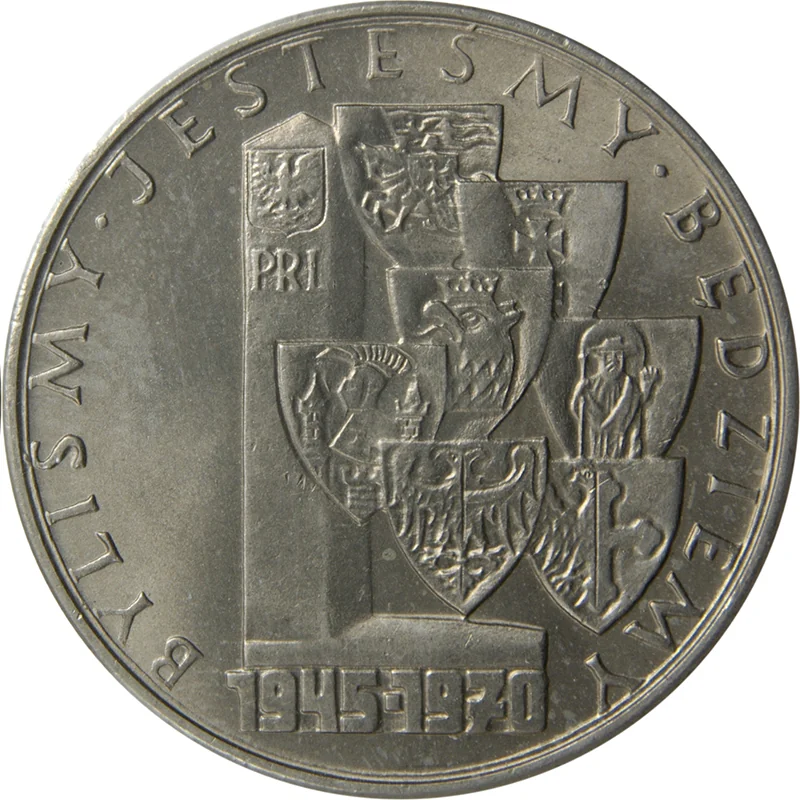
Various shields
Inscription:
BYLIŚMY·JESTEŚMY·BĘDZIEMY
1945·1970
1945·1970
Translation:
WE WERE·WE ARE·WE WILL BE
1945·1970
1945·1970
Script: Latin
Language: Polish
Engraver: Jerzy Jarnuszkiewicz
Edge
Reeded
Categories
| Symbols> Coat of Arms |
Mints
| Name | Mark |
|---|---|
| Mint of Poland | (MW) |
Mintings
| Year | Mint Mark | Mintage | Quality | Collection |
|---|---|---|---|---|
| 1970 | MW | 2,000,000 |
Historical background
By 1970, Poland's currency situation was a reflection of the deep-seated economic failures of its centrally planned system under the Polish United Workers' Party. The official exchange rate of the złoty was fixed at an artificially high level by the state, bearing no relation to its real purchasing power or the black-market rate. This created a dual-currency reality: a worthless złoty for domestic use, plagued by chronic shortages and suppressed inflation, and a separate system of "hard currency" (like US dollars) available in special state-run Pewex shops, which offered high-quality, otherwise unavailable goods. This duality visibly stratified society between those with access to foreign currency and those without.
The root cause was an economy buckling under the weight of heavy industrialization, inefficient state enterprises, and massive subsidies for basic goods. To maintain political stability, the government of Władysław Gomułka froze prices on essential items like food and fuel for over a decade, despite rising production costs. This created huge budgetary burdens and masked inflationary pressures, leading to widespread shortages as supply could not meet demand at the artificially low prices. The currency's lack of convertibility and the growing foreign debt further isolated Poland from the global economy.
This unsustainable façade collapsed in December 1970, when the government, desperate to address the economic imbalances, abruptly announced drastic price hikes on basic foodstuffs just before Christmas. The move triggered violent worker protests on the Baltic coast, most famously in Gdańsk, Gdynia, and Szczecin. The state's brutal suppression of these protests resulted in dozens of deaths and ultimately forced Gomułka's resignation. While the price increases were temporarily reversed, the crisis of 1970 laid bare the fundamental link between the dysfunctional currency, the failing command economy, and social unrest, a tension that would continue to simmer until the system's final collapse in 1989.
The root cause was an economy buckling under the weight of heavy industrialization, inefficient state enterprises, and massive subsidies for basic goods. To maintain political stability, the government of Władysław Gomułka froze prices on essential items like food and fuel for over a decade, despite rising production costs. This created huge budgetary burdens and masked inflationary pressures, leading to widespread shortages as supply could not meet demand at the artificially low prices. The currency's lack of convertibility and the growing foreign debt further isolated Poland from the global economy.
This unsustainable façade collapsed in December 1970, when the government, desperate to address the economic imbalances, abruptly announced drastic price hikes on basic foodstuffs just before Christmas. The move triggered violent worker protests on the Baltic coast, most famously in Gdańsk, Gdynia, and Szczecin. The state's brutal suppression of these protests resulted in dozens of deaths and ultimately forced Gomułka's resignation. While the price increases were temporarily reversed, the crisis of 1970 laid bare the fundamental link between the dysfunctional currency, the failing command economy, and social unrest, a tension that would continue to simmer until the system's final collapse in 1989.
🌱 Common