

10 Zlotys (Polish Army) – Poland
Circulating commemorative coins
Commemoration: 25th anniversary of Polish Army
Poland
Context
Year: 1968
Issuer: Poland 
Period:
(1952—1989)
Currency:
(1949—1994)
Demonetization: 1 January 1978
Total mintage: 2,000,000
Material
Diameter: 28 mm
Weight: 9.5 g
Thickness: 2 mm
Shape: Round
Composition: Copper-nickel
Technique: Milled
Alignment: Medal alignment
flip
References
Y: #Click to copy to clipboard60
Numista: #9814
Value
Exchange value: 10 PLZ
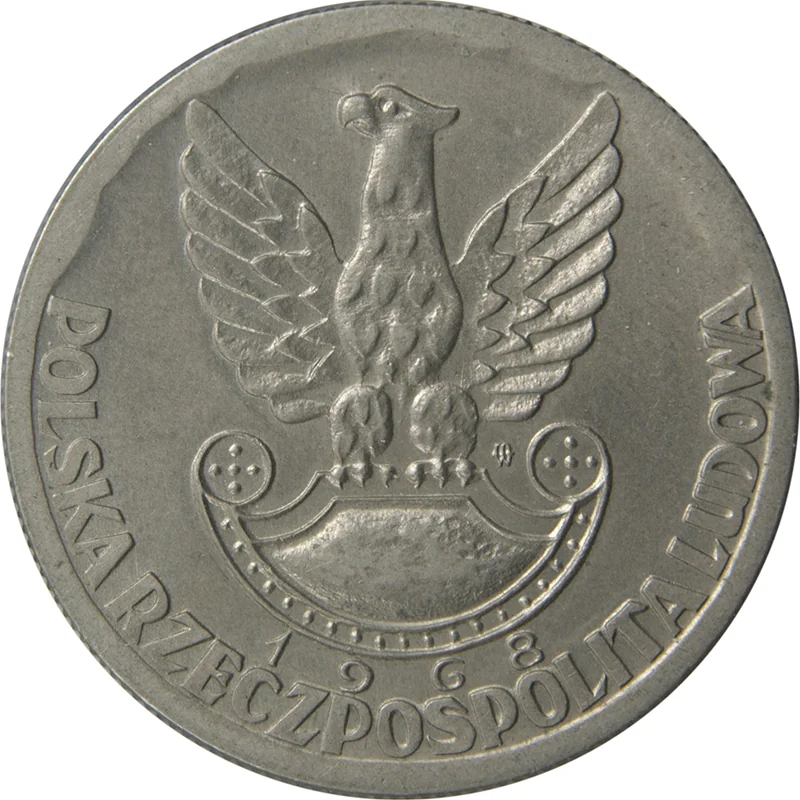
Obverse
Description:
The Polish national coat of arms.
Inscription:
mw
1968
POLSKA RZECZPOSPOLITA LUDOWA
1968
POLSKA RZECZPOSPOLITA LUDOWA
Translation:
Polish People's Republic
1968
1968
Script: Latin
Language: Polish
Engraver: Józef Markiewicz-Nieszcz
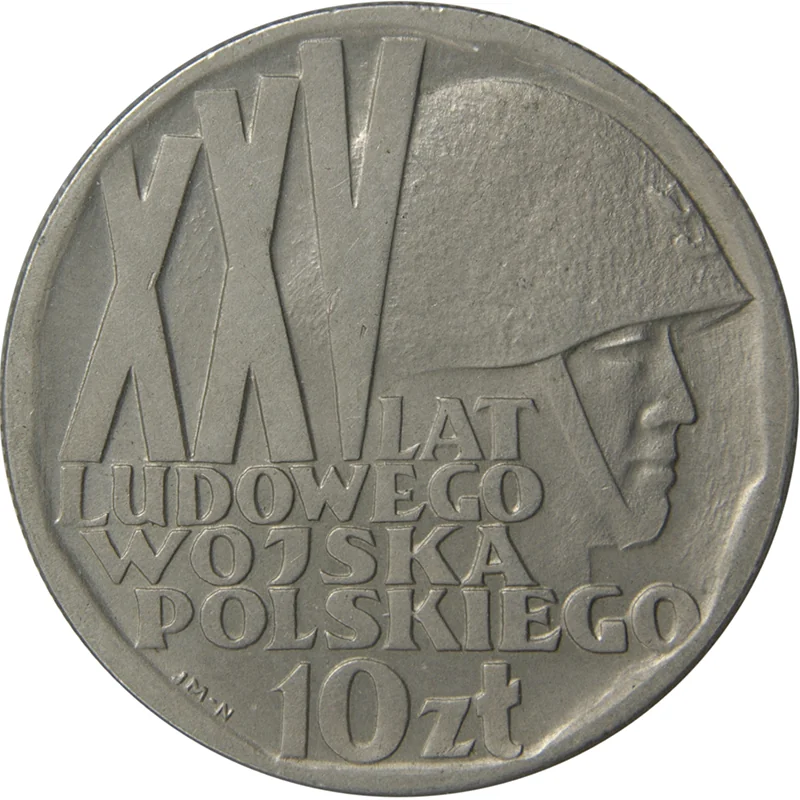
Reverse
Description:
XXV, helmeted head right.
Inscription:
XXV LAT
LUDOWEGO
WOJSKA
POLSKIEGO
J M-N 10 zł
LUDOWEGO
WOJSKA
POLSKIEGO
J M-N 10 zł
Translation:
Twenty-Fifth Anniversary
of Ludwig's
Army
of Poland
J M-N 10 zł
of Ludwig's
Army
of Poland
J M-N 10 zł
Script: Latin
Language: Polish
Engraver: Józef Markiewicz-Nieszcz
Edge
Milled
Mints
| Name | Mark |
|---|---|
| Mint of Poland | (MW) |
Mintings
| Year | Mint Mark | Mintage | Quality | Collection |
|---|---|---|---|---|
| 1968 | MW | 2,000,000 |
Historical background
In 1968, Poland's currency situation was fundamentally defined by its position within the Soviet Bloc's centrally planned economic system. The Polish złoty (PLN) was a non-convertible currency, meaning it could not be freely exchanged for foreign currencies like the US dollar or even the Soviet ruble on international markets. Its value was set administratively by the state and bore little relation to market forces. Domestically, this system created a chronic imbalance where an excess of złoty in circulation chased a limited supply of consumer goods, leading to suppressed inflation, persistent shortages, and a thriving black market where hard currencies commanded a significant premium.
The government maintained a complex and discriminatory multi-tier exchange rate system. The official rate, used for state accounting and some foreign trade transactions, was artificially strong (around 4 złoty to 1 US dollar). However, for most practical purposes, such as tourism or remittances, a far less favorable "tourist rate" was applied through state-owned Bank Pekao, offering more złoty per dollar but still below the black-market value. The most critical rate was the "bon rate," used in state-run Pewex and Baltona hard-currency shops. These stores, stocked with Western goods and quality domestic products unavailable in regular shops, created a dual economy where access to dollars or other convertible currencies provided a vastly superior standard of living, deepening social stratification.
The currency rigidity of 1968 was a symptom of the broader economic stagnation of the Gomułka era. While the political crisis of March 1968 was primarily ideological and nationalist in character, the underlying economic discontent, including the frustrating currency regime and consumer goods shortages, contributed to a wider sense of public malaise. The system effectively insulated the state from external financial pressures but at the cost of economic inefficiency, isolating Poland from the global economy and creating pervasive incentives for corruption and illicit trade in foreign currency.
The government maintained a complex and discriminatory multi-tier exchange rate system. The official rate, used for state accounting and some foreign trade transactions, was artificially strong (around 4 złoty to 1 US dollar). However, for most practical purposes, such as tourism or remittances, a far less favorable "tourist rate" was applied through state-owned Bank Pekao, offering more złoty per dollar but still below the black-market value. The most critical rate was the "bon rate," used in state-run Pewex and Baltona hard-currency shops. These stores, stocked with Western goods and quality domestic products unavailable in regular shops, created a dual economy where access to dollars or other convertible currencies provided a vastly superior standard of living, deepening social stratification.
The currency rigidity of 1968 was a symptom of the broader economic stagnation of the Gomułka era. While the political crisis of March 1968 was primarily ideological and nationalist in character, the underlying economic discontent, including the frustrating currency regime and consumer goods shortages, contributed to a wider sense of public malaise. The system effectively insulated the state from external financial pressures but at the cost of economic inefficiency, isolating Poland from the global economy and creating pervasive incentives for corruption and illicit trade in foreign currency.

🌱 Common