

Obverse
Description:
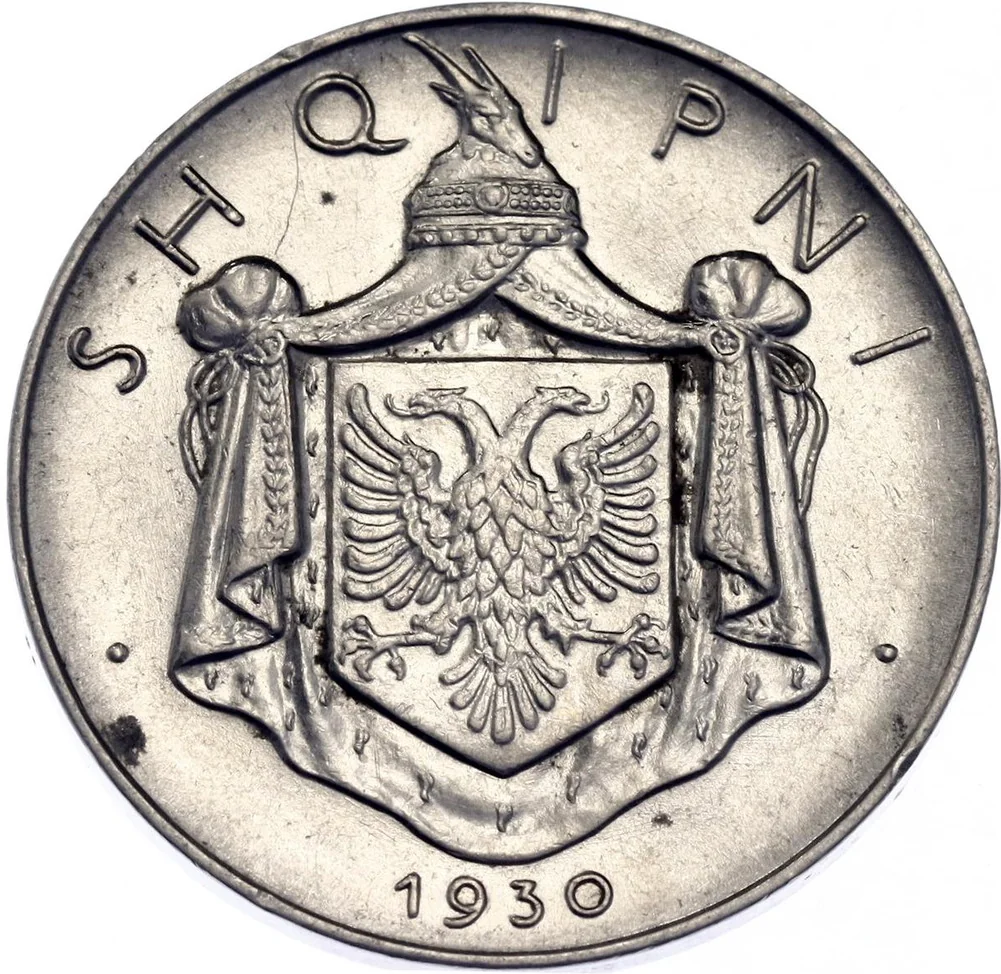
Coat of arms with inscription and date.
Inscription:
.SHQIPNI.
1931
1931
Translation:
Albania. 1931.
Script: Latin
Language: Albanian
Engravers: Giuseppe Romagnoli, Attilio Silvio Motti
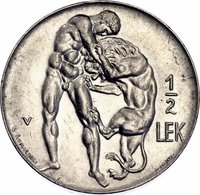
Reverse
Description:
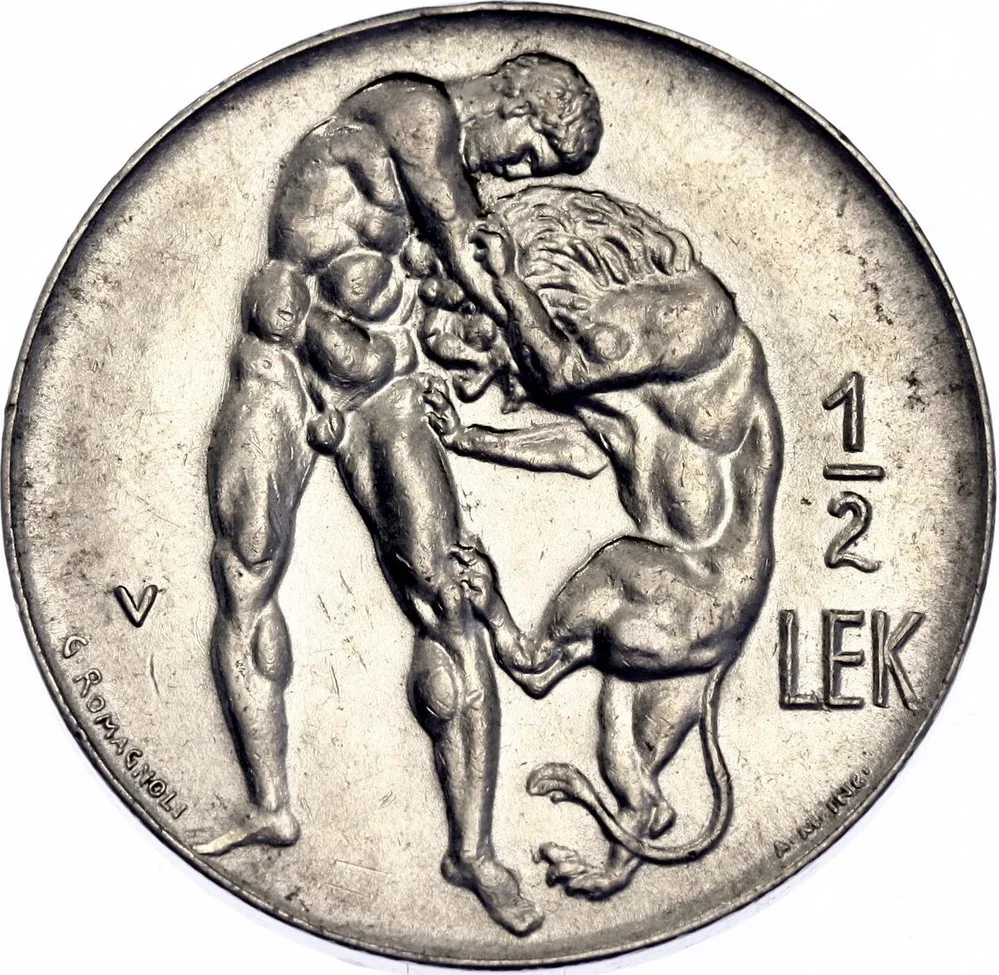
Hercules fights the Nemean lion.
Inscription:
1/2
LEK
L
G.Romagnoli
A. M. ING.
LEK
L
G.Romagnoli
A. M. ING.
Translation:
HALF
L
G.Romagnoli
A. M. ING.
L
G.Romagnoli
A. M. ING.
Script: Latin
Language: Italian
Engravers: Giuseppe Romagnoli, Attilio Silvio Motti
Edge
Plain
Categories
| Animal> Bird |
| Mythology |
| Symbols> Coat of Arms |
| Symbol> Double-headed eagle |
| Animal> Feline |
Mints
| Name | Mark |
|---|---|
| Royal Mint (Tower Hill) | L |
| Münze Österreich | V |
Historical background
In 1930, Albania's currency situation was defined by its reliance on the gold franc (Fr.A) as the official unit of account, a system established under the League of Nations' financial supervision in the 1920s. The country did not yet have its own central bank or a national circulating currency. Instead, monetary circulation was a chaotic mix of foreign coins and notes, primarily the Italian lira, but also the Greek drachma, Turkish gold lira, and Yugoslav dinar, reflecting its regional trade ties and lack of a unified financial system. This dependence on foreign specie made Albania's economy vulnerable to external monetary policies and exchange rate fluctuations.
Economically, the period was one of fragile stability overshadowed by the onset of the Great Depression. While the late 1920s had seen some infrastructural investments under King Zog I, Albania remained Europe's poorest nation, with an economy based overwhelmingly on subsistence agriculture and raw material exports. The global downturn began to depress prices for its key exports like skins, cheese, and eggs, straining the country's limited gold and foreign exchange reserves. This pressure exposed the fundamental weakness of having no monetary authority to manage liquidity or act as a lender of last resort.
Consequently, the primary financial issue of 1930 was the growing political and economic push to create a national bank. Negotiations, heavily influenced by Italy, were underway to establish the Bank of Albania, which would have the sole right to issue a national currency. This move was seen as crucial for asserting monetary sovereignty and modernizing the state, but it also risked deepening Albania's dependence on Italian capital. Thus, the currency situation in 1930 was a transitional stalemate, caught between an outdated, fragmented system and an impending shift toward a centralized—but potentially externally influenced—monetary framework.
Economically, the period was one of fragile stability overshadowed by the onset of the Great Depression. While the late 1920s had seen some infrastructural investments under King Zog I, Albania remained Europe's poorest nation, with an economy based overwhelmingly on subsistence agriculture and raw material exports. The global downturn began to depress prices for its key exports like skins, cheese, and eggs, straining the country's limited gold and foreign exchange reserves. This pressure exposed the fundamental weakness of having no monetary authority to manage liquidity or act as a lender of last resort.
Consequently, the primary financial issue of 1930 was the growing political and economic push to create a national bank. Negotiations, heavily influenced by Italy, were underway to establish the Bank of Albania, which would have the sole right to issue a national currency. This move was seen as crucial for asserting monetary sovereignty and modernizing the state, but it also risked deepening Albania's dependence on Italian capital. Thus, the currency situation in 1930 was a transitional stalemate, caught between an outdated, fragmented system and an impending shift toward a centralized—but potentially externally influenced—monetary framework.
🌱 Common