

2 euro – Malta
Add to wishlist
Circulating commemorative coins
Commemoration: First Elected Representatives of 1849
Malta
Obverse
Description:
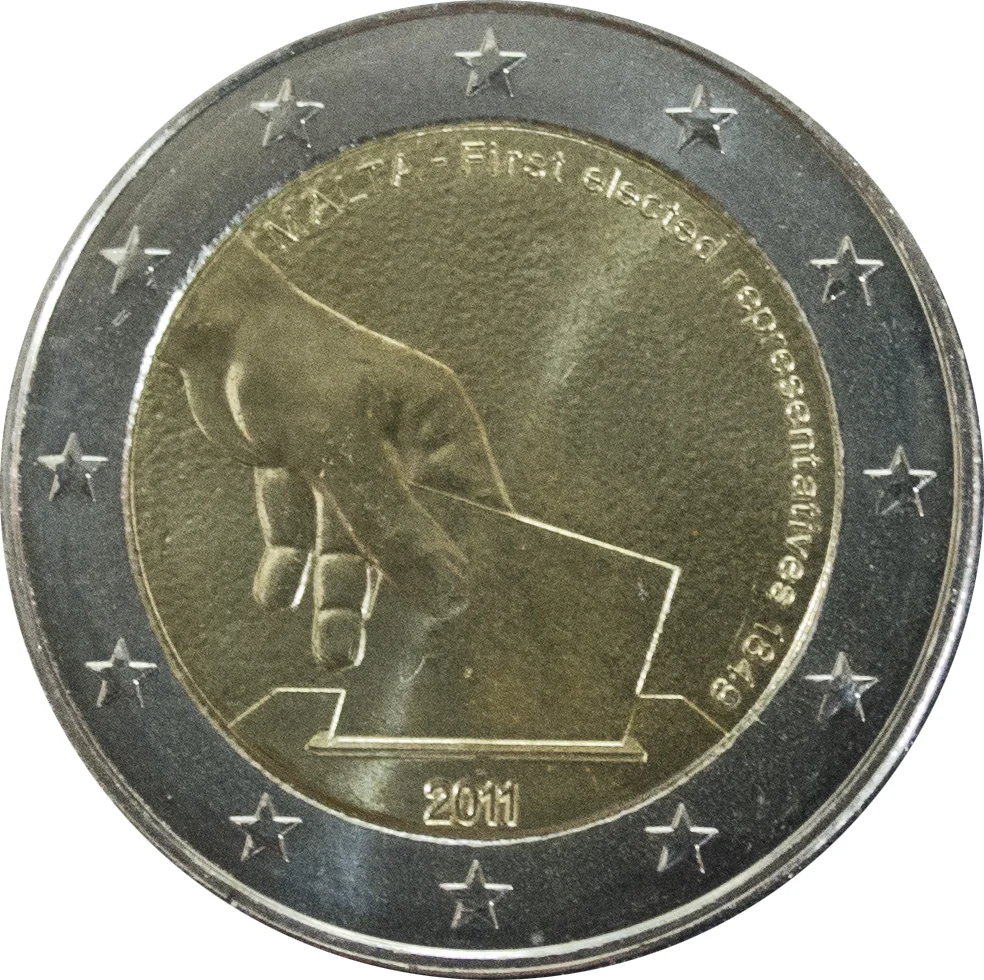
This coin, the first in a five-year series marking Malta’s constitutional milestones, shows a hand inserting a ballot. It commemorates the 1849 election of the first Maltese representatives to the Council Government under British rule. The inner part bears the text “MALTA – First elected representatives 1849,” and the outer ring features the 12 stars of the European Union.
Inscription:
MALTA - First elected representatives 1849
2011
2011
Translation:
MALTA - First elected representatives 1849
2011
2011
Script: Latin
Language: English
Designer: Ganni Bonnici
Reverse
Mintings
| Year | Mint Mark | Mintage | Quality | Collection |
|---|---|---|---|---|
| 2011 | — | 50,000 | In sets | |
| 2011 | — | 5,000 | Proof | |
| 2011 | — | 375,000 |
Historical background
In 2011, Malta was firmly integrated into the Eurozone, having adopted the euro as its official currency on 1 January 2008. This transition replaced the Maltese lira, which had been pegged to a basket of currencies and later to the euro itself. By 2011, the euro was well-established in daily use, providing Malta with monetary stability, lower transaction costs for trade, and enhanced investor confidence. This was particularly significant as the country positioned itself as a financial services hub within the European Union.
The broader Eurozone context, however, presented substantial challenges in 2011. The sovereign debt crisis was at its peak, with Greece, Ireland, and Portugal requiring international bailouts. While Malta's economy was relatively stable with a lower debt-to-GDP ratio than the Eurozone average, it was not immune to the contagion effects. The crisis raised concerns about the stability of the single currency itself, leading to heightened market volatility and pressure on European banking systems, including those in Malta. The Maltese government and Central Bank of Malta therefore focused on maintaining fiscal discipline to safeguard the country's financial stability within the troubled currency union.
Domestically, Malta's adherence to the euro in 2011 was largely seen as a net positive, insulating it from the speculative currency pressures that might have affected a small island nation with its own independent currency. However, the common monetary policy set by the European Central Bank, tailored for the entire bloc, was not always perfectly aligned with Malta's specific economic conditions. Furthermore, like other member states, Malta had to navigate the implications of euro-area governance reforms proposed in response to the crisis, which aimed to enforce stricter fiscal coordination and economic surveillance among member states.
The broader Eurozone context, however, presented substantial challenges in 2011. The sovereign debt crisis was at its peak, with Greece, Ireland, and Portugal requiring international bailouts. While Malta's economy was relatively stable with a lower debt-to-GDP ratio than the Eurozone average, it was not immune to the contagion effects. The crisis raised concerns about the stability of the single currency itself, leading to heightened market volatility and pressure on European banking systems, including those in Malta. The Maltese government and Central Bank of Malta therefore focused on maintaining fiscal discipline to safeguard the country's financial stability within the troubled currency union.
Domestically, Malta's adherence to the euro in 2011 was largely seen as a net positive, insulating it from the speculative currency pressures that might have affected a small island nation with its own independent currency. However, the common monetary policy set by the European Central Bank, tailored for the entire bloc, was not always perfectly aligned with Malta's specific economic conditions. Furthermore, like other member states, Malta had to navigate the implications of euro-area governance reforms proposed in response to the crisis, which aimed to enforce stricter fiscal coordination and economic surveillance among member states.
Series: Malta 2 euro commemoratives
🌱 Very Common