

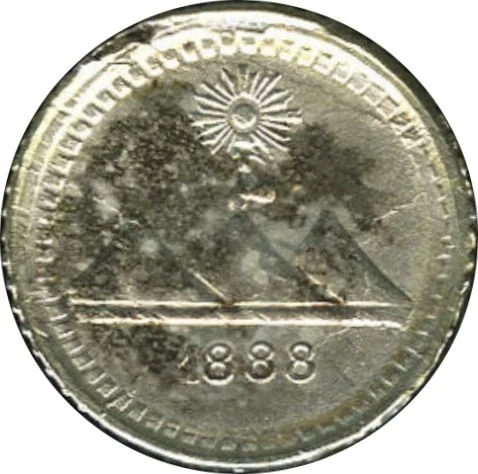
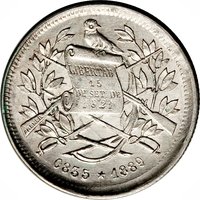
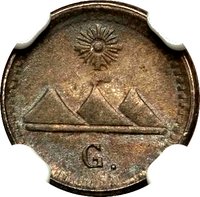
Obverse
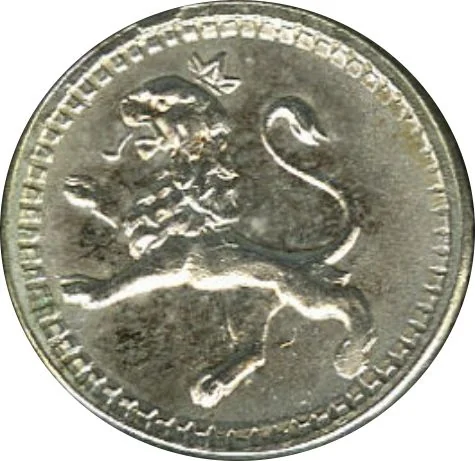
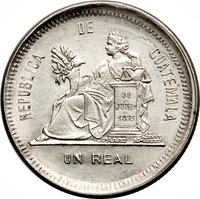
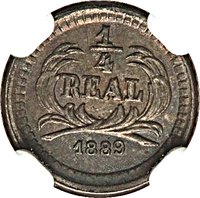
Reverse
Description:
Rampant left-facing lion
Edge
Milled
Mints
| Name | Mark |
|---|---|
| Casa de Moneda de Guatemala | — |
Mintings
| Year | Mint Mark | Mintage | Quality | Collection |
|---|---|---|---|---|
| 1887 | — | — | ||
| 1888 | — | — |
Historical background
In 1887, Guatemala's currency situation was characterized by a period of transition and instability, deeply rooted in the economic policies of President Justo Rufino Barrios (1873-1885). His liberal reforms had aggressively promoted coffee exports, integrating Guatemala into the global market but creating a dependency on imported manufactured goods. The monetary system was a complex and often chaotic mix of foreign and domestic coins. Spanish, Peruvian, Bolivian, and especially Mexican silver pesos circulated alongside a limited supply of gold coins, while fractional currency was scarce, hindering daily small-scale commerce.
The government had taken steps toward reform with the Monetary Law of 1881, which officially adopted the gold standard and defined the Guatemalan peso as equal to one United States dollar. However, this law was largely aspirational in 1887. The country lacked sufficient gold reserves or nationally minted coinage to enforce it, so the older, often worn, silver coins from across Latin America remained the primary media of exchange. Their value fluctuated based on weight and purity, leading to confusion and inefficiency. This period was one of a de facto silver standard operating within a de jure gold standard framework.
This monetary confusion acted as a brake on economic modernization and state-building. President Manuel Lisandro Barillas (1885-1892), in office in 1887, recognized the problem but faced significant fiscal constraints. The push for a unified, stable currency was driven by the coffee-growing elite who needed reliable credit and banking services. The situation in 1887 was therefore a prelude to more decisive action, culminating in the creation of the quetzal in 1924, but at the time, it represented an ongoing challenge of establishing monetary sovereignty and stability in a small, export-dependent nation.
The government had taken steps toward reform with the Monetary Law of 1881, which officially adopted the gold standard and defined the Guatemalan peso as equal to one United States dollar. However, this law was largely aspirational in 1887. The country lacked sufficient gold reserves or nationally minted coinage to enforce it, so the older, often worn, silver coins from across Latin America remained the primary media of exchange. Their value fluctuated based on weight and purity, leading to confusion and inefficiency. This period was one of a de facto silver standard operating within a de jure gold standard framework.
This monetary confusion acted as a brake on economic modernization and state-building. President Manuel Lisandro Barillas (1885-1892), in office in 1887, recognized the problem but faced significant fiscal constraints. The push for a unified, stable currency was driven by the coffee-growing elite who needed reliable credit and banking services. The situation in 1887 was therefore a prelude to more decisive action, culminating in the creation of the quetzal in 1924, but at the time, it represented an ongoing challenge of establishing monetary sovereignty and stability in a small, export-dependent nation.
⭐ Rare