

Obverse
Description:
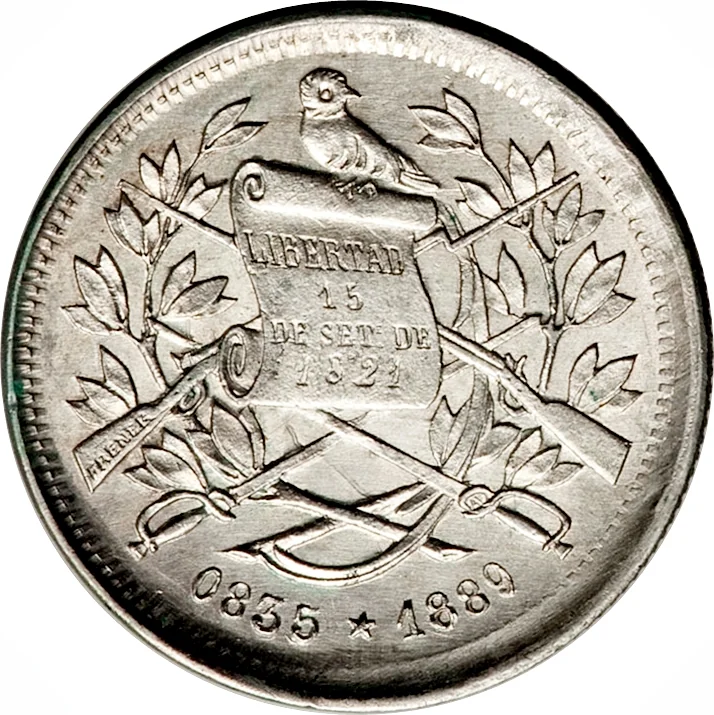
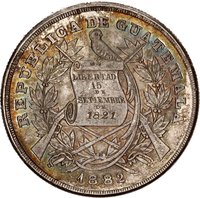
Coat of arms (Long-tailed quetzal) with fineness and date below. Engraver's name on left rifle stock.
Inscription:
LIBERTAD
15 DE SET.DE
1821
0835*1891
FRENER
15 DE SET.DE
1821
0835*1891
FRENER
Translation:
LIBERTY
SEPTEMBER 15,
1821
0835*1891
FRENER
SEPTEMBER 15,
1821
0835*1891
FRENER
Script: Latin
Language: Spanish
Engraver: Johann-Baptist Frener
Reverse
Description:
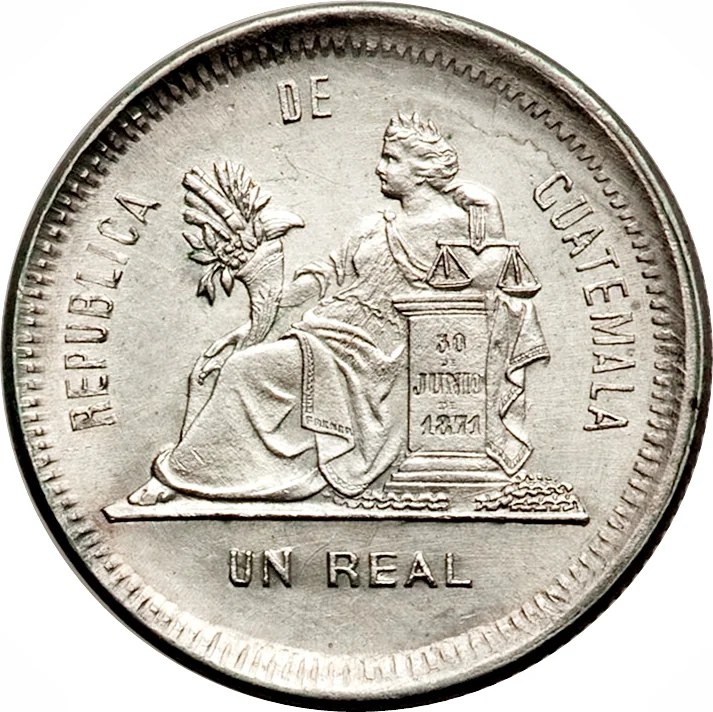
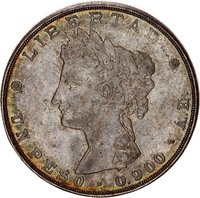
Justice seated, holding scales and cornucopia, supported by the Constitution, with legend around and value below.
Inscription:
REPUBLICA DE GUATEMALA
30
DE
JUNIO
DE
1821
1 REAL
30
DE
JUNIO
DE
1821
1 REAL
Translation:
REPUBLIC OF GUATEMALA
30
OF
JUNE
OF
1821
1 REAL
30
OF
JUNE
OF
1821
1 REAL
Script: Latin
Language: Spanish
Engraver: Johann-Baptist Frener
Edge
Reeded
Categories
| Symbol> Allegory |
| Symbols> Coat of Arms |
Mints
| Name | Mark |
|---|---|
| Casa de Moneda de Guatemala | — |
Mintings
| Year | Mint Mark | Mintage | Quality | Collection |
|---|---|---|---|---|
| 1883 | — | 46,000 | ||
| 1889 | — | 332,330 | ||
| 1890 | — | — | ||
| 1891 | — | — | ||
| 1893 | — | — |
Historical background
In 1883, Guatemala’s currency system was in a state of transition and disarray, caught between the colonial legacy of the Spanish monetary system and the pressures of a modernizing global economy. The official currency was the Guatemalan Peso, theoretically on a silver standard, but its value and circulation were inconsistent. The country faced a chronic shortage of minted coinage, leading to a chaotic circulation of foreign silver coins—primarily Peruvian, Bolivian, and Chilean pesos—alongside the limited domestic issues. This proliferation of foreign coins of varying silver content created significant challenges for commerce, as their values had to be constantly assessed and negotiated, hindering efficient trade and economic planning.
This monetary instability was exacerbated by the government's fiscal policies. President Justo Rufino Barrios, pursuing a sweeping liberal reform agenda focused on coffee export-led growth, had accumulated substantial foreign debt to fund infrastructure projects. To service this debt and finance government operations, the administration resorted to issuing fiat paper money known as billetes fiscales (fiscal bills). These notes, not backed by precious metal reserves, rapidly depreciated in value, leading to a problematic dual system where silver coins commanded a premium over the paper notes. Public trust in the paper currency was low, and it often circulated at a steep discount, further complicating all financial transactions.
Consequently, 1883 represents a pivotal year within a longer monetary crisis. The government recognized the untenable situation and was moving toward a fundamental reform. Just two years later, in 1885, this would culminate in the creation of a new national currency, the Quetzal, named after the national bird and explicitly intended to restore stability by being firmly pegged to and backed by the US dollar. Thus, the currency situation of 1883 was one of the final chapters of an unstable era, characterized by a fragmented metallic circulation and discredited paper money, setting the stage for the comprehensive monetary overhaul that would soon follow.
This monetary instability was exacerbated by the government's fiscal policies. President Justo Rufino Barrios, pursuing a sweeping liberal reform agenda focused on coffee export-led growth, had accumulated substantial foreign debt to fund infrastructure projects. To service this debt and finance government operations, the administration resorted to issuing fiat paper money known as billetes fiscales (fiscal bills). These notes, not backed by precious metal reserves, rapidly depreciated in value, leading to a problematic dual system where silver coins commanded a premium over the paper notes. Public trust in the paper currency was low, and it often circulated at a steep discount, further complicating all financial transactions.
Consequently, 1883 represents a pivotal year within a longer monetary crisis. The government recognized the untenable situation and was moving toward a fundamental reform. Just two years later, in 1885, this would culminate in the creation of a new national currency, the Quetzal, named after the national bird and explicitly intended to restore stability by being firmly pegged to and backed by the US dollar. Thus, the currency situation of 1883 was one of the final chapters of an unstable era, characterized by a fragmented metallic circulation and discredited paper money, setting the stage for the comprehensive monetary overhaul that would soon follow.
⭐ Somewhat Rare