

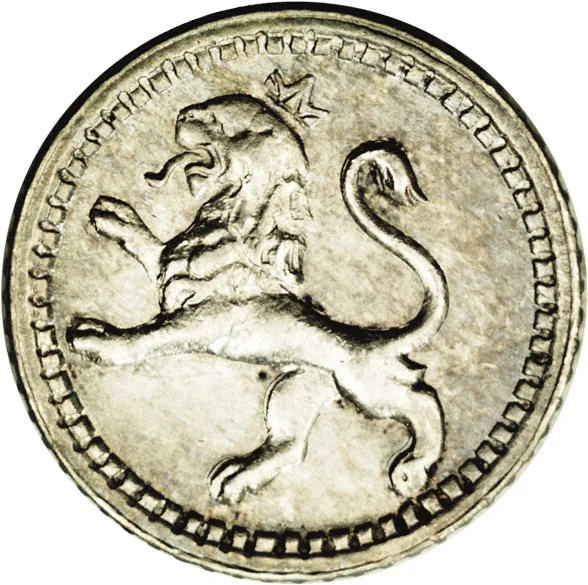
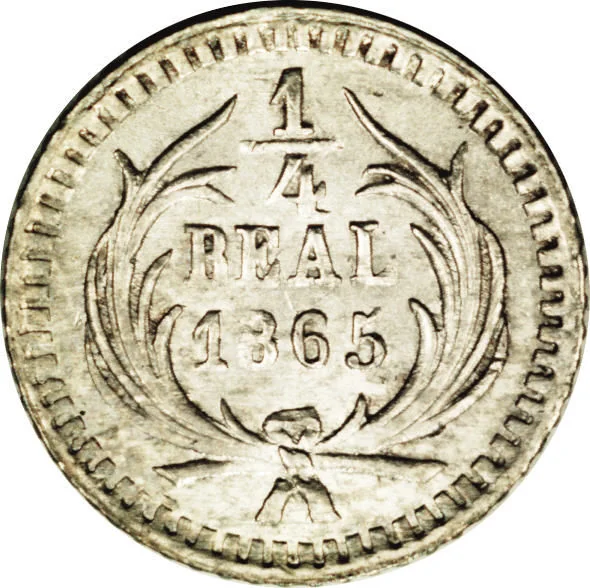
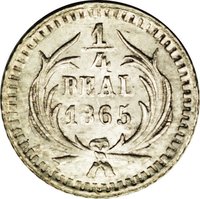
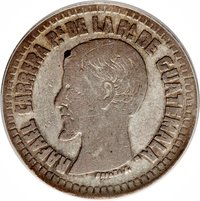
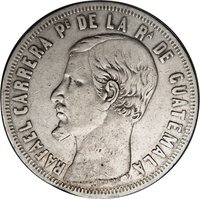
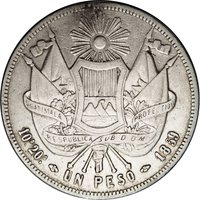
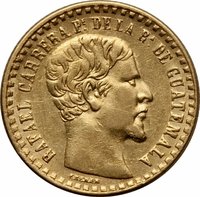
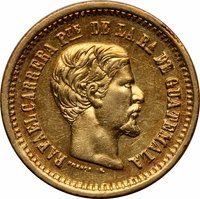
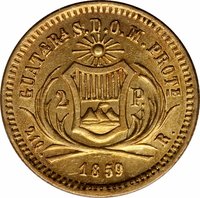
Obverse
Description:
Lion rampant crowned.
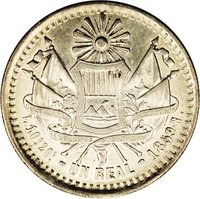
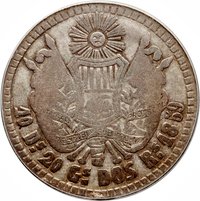
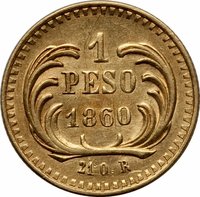
Reverse
Edge
Mints
| Name | Mark |
|---|---|
| Casa de Moneda de Guatemala | — |
Mintings
| Year | Mint Mark | Mintage | Quality | Collection |
|---|---|---|---|---|
| 1859 | — | 10,175 | ||
| 1860 | — | 115,561 | ||
| 1861 | — | 281,696 | ||
| 1862 | — | 212,872 | ||
| 1863 | — | 51,639 | ||
| 1864 | — | 48,303 | ||
| 1865 | — | 23,444 | ||
| 1866 | — | 205,385 | ||
| 1867 | — | 168,982 | ||
| 1868 | — | 148,491 | ||
| 1869 | — | 241,767 |
Historical background
In 1859, Guatemala’s currency system was a complex and unstable mixture of foreign and domestic coins, reflecting the economic and political turbulence following independence from Spain in 1821. The official currency was the Guatemalan Peso, but the economy relied heavily on the circulation of Spanish colonial coins, particularly silver reales, as well as coins from other nations like Mexico, Peru, and Great Britain. This multiplicity created significant confusion in trade and daily transactions, as the value of coins depended not only on their metallic content but also on their origin and wear, leading to frequent disputes and inefficiency.
The situation was exacerbated by a chronic shortage of state-minted coinage. The national mint in Guatemala City struggled with outdated equipment and insufficient silver bullion, failing to produce enough currency to meet the needs of the economy. Consequently, cut or defaced foreign coins (known as macuquinas) remained in common use, further degrading the monetary standard. This scarcity and disorder hindered commerce, tax collection, and government finance, creating a pressing need for monetary reform to establish a uniform and trustworthy currency.
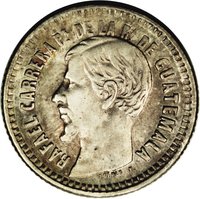
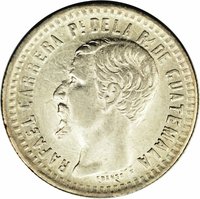
Politically, this monetary chaos occurred during the conservative regime of President Rafael Carrera, a period marked by efforts to consolidate state authority and economic control. The government recognized the problem, and the 1859 monetary context was a prelude to more definitive reforms. Just a few years later, in 1869, Guatemala would decimalize its currency, introducing the Guatemalan Peso divided into 100 centavos and begin a more systematic minting of national coins, aiming to replace the chaotic system with a modern, uniform standard.
The situation was exacerbated by a chronic shortage of state-minted coinage. The national mint in Guatemala City struggled with outdated equipment and insufficient silver bullion, failing to produce enough currency to meet the needs of the economy. Consequently, cut or defaced foreign coins (known as macuquinas) remained in common use, further degrading the monetary standard. This scarcity and disorder hindered commerce, tax collection, and government finance, creating a pressing need for monetary reform to establish a uniform and trustworthy currency.
Politically, this monetary chaos occurred during the conservative regime of President Rafael Carrera, a period marked by efforts to consolidate state authority and economic control. The government recognized the problem, and the 1859 monetary context was a prelude to more definitive reforms. Just a few years later, in 1869, Guatemala would decimalize its currency, introducing the Guatemalan Peso divided into 100 centavos and begin a more systematic minting of national coins, aiming to replace the chaotic system with a modern, uniform standard.
Series: System: 1859-1870
⭐ Somewhat Rare