

1 lira – Italy
Add to wishlist
Italy
Context
Years: 1922–1935
Issuer: Italy
Ruler: Vittorio Emanuele III
Currency:
(1861—2001)
Demonetized: Yes
Total mintage: 151,726,226
Material
References
KM: #
Numista: #2595
Value
Exchange value: 1 ITL
Obverse
Description:
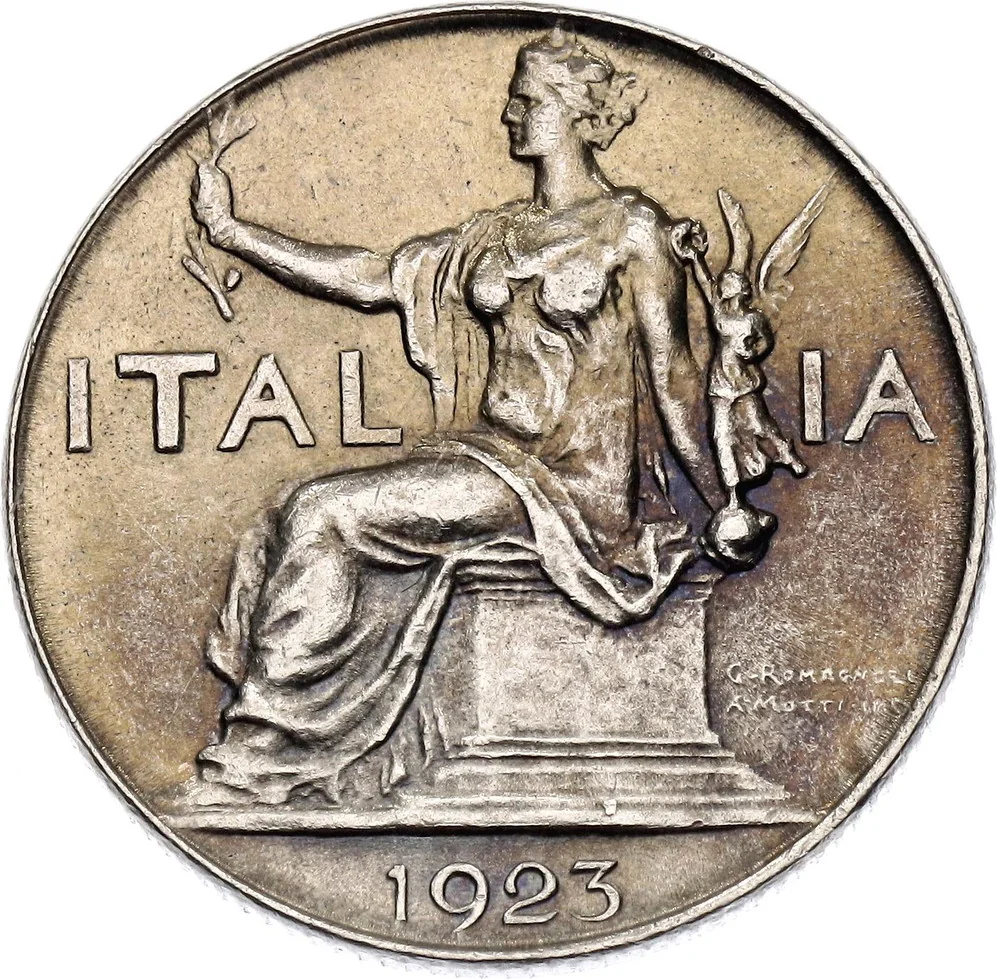
Seated female figure facing left, holding a small winged Victory statue in her lowered left hand and an olive branch in her outstretched right. Lettering is divided by the figure, with the date below the exergue line. The author’s and engraver’s names appear to the right of the pillar.
Inscription:
ITALIA
1922
G.ROMAGNOLI
A.MOTTI.INC.
1922
G.ROMAGNOLI
A.MOTTI.INC.
Translation:
Italy
1922
G. Romagnoli
A. Motti Inc.
1922
G. Romagnoli
A. Motti Inc.
Script: Latin
Language: Italian
Engravers: Giuseppe Romagnoli, Attilio Motti
Reverse
Description:
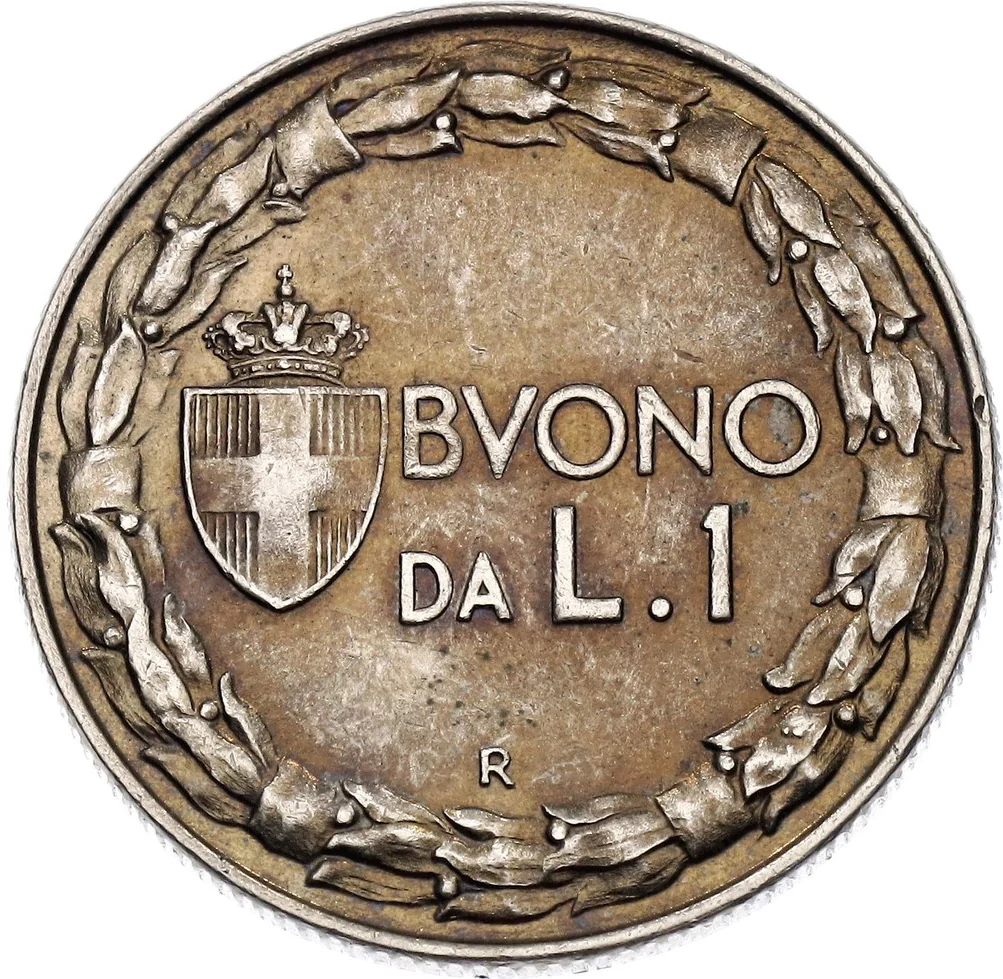
Value on two lines.
Crowned Savoy Shield left.
Mintmark below.
All within laurel circle.
Crowned Savoy Shield left.
Mintmark below.
All within laurel circle.
Inscription:
BVONO
DA L.1
R
DA L.1
R
Script: Latin
Engravers: Giuseppe Romagnoli, Attilio Motti
Edge
Reeded
Mints
| Name | Mark |
|---|---|
| Rome | R |
Mintings
Historical background
By 1922, Italy's currency situation was a symptom of profound national crisis following World War I. The war had been financed through massive borrowing and money printing, leading to rampant inflation and a severe depreciation of the lira. The country was burdened with heavy domestic and foreign debt, while the post-war industrial slump and social unrest further undermined economic confidence. The lira's external value plummeted, and the government, facing a series of weak coalition cabinets, seemed incapable of implementing the fiscal discipline needed to stabilize the currency.
Internally, inflation eroded savings and wages, causing widespread hardship and fueling the social tensions between industrial workers, landowners, and a growing disillusioned middle class. Externally, the falling lira increased the cost of vital imports like coal and grain, worsening trade imbalances. This economic distress became a central political weapon for Benito Mussolini's Fascist movement, which blamed the liberal government and socialist agitation for the national humiliation of a weak currency, linking economic stability directly to national strength and prestige.
When Mussolini marched on Rome in October 1922, he inherited this fragile monetary system. The currency's instability was both a result and a cause of the political vacuum that allowed Fascism to seize power. Stabilizing the lira would subsequently become a key propaganda goal for the regime, culminating in the 1927 "Battle for the Lira," which revalued the currency at a punishingly high rate to project fascist power, albeit at the cost of crippling Italian exports. Thus, the currency turmoil of 1922 was not merely a financial issue but a critical factor in the collapse of liberal Italy.
Internally, inflation eroded savings and wages, causing widespread hardship and fueling the social tensions between industrial workers, landowners, and a growing disillusioned middle class. Externally, the falling lira increased the cost of vital imports like coal and grain, worsening trade imbalances. This economic distress became a central political weapon for Benito Mussolini's Fascist movement, which blamed the liberal government and socialist agitation for the national humiliation of a weak currency, linking economic stability directly to national strength and prestige.
When Mussolini marched on Rome in October 1922, he inherited this fragile monetary system. The currency's instability was both a result and a cause of the political vacuum that allowed Fascism to seize power. Stabilizing the lira would subsequently become a key propaganda goal for the regime, culminating in the 1927 "Battle for the Lira," which revalued the currency at a punishingly high rate to project fascist power, albeit at the cost of crippling Italian exports. Thus, the currency turmoil of 1922 was not merely a financial issue but a critical factor in the collapse of liberal Italy.
🌱 Very Common