

2 lire – Italy
Add to wishlist
Italy
Context
Years: 1923–1935
Issuer: Italy
Ruler: Vittorio Emanuele III
Currency:
(1861—2001)
Demonetized: Yes
Total mintage: 98,671,674
Material
References
KM: #
Numista: #2682
Value
Exchange value: 2 ITL
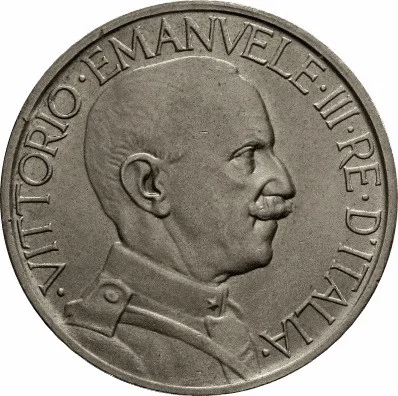
Obverse
Description:
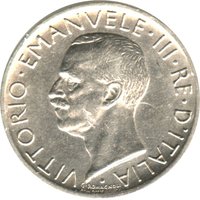
Bust of King Vittorio Emanuele III in uniform, with encircling legend.
Inscription:
·VITTORIO·EMANVELE·III·RE·D'ITALIA·
Translation:
Victor Emmanuel III King of Italy
Script: Latin
Language: Italian
Engraver: Attilio Silvio Motti
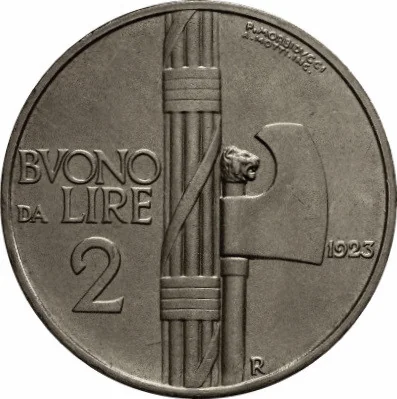
Reverse
Description:
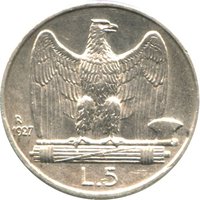
A large lion-headed axe fasces leans right. Left: value on three lines. Right: author, engraver, date, and mintmark.
Inscription:
P.MORBIDUCCI
A•MOTTI•INC•
BVONO
DA LIRE
2
1923
R
A•MOTTI•INC•
BVONO
DA LIRE
2
1923
R
Script: Latin
Engraver: Attilio Silvio Motti
Edge
Plain
Mints
| Name | Mark |
|---|---|
| Rome | R |
Mintings
Historical background
In 1923, Italy’s currency situation was precarious and deeply intertwined with the political and economic turmoil following World War I. The lira had been under severe pressure since the war, as the government had financed the conflict largely through borrowing and printing money, leading to significant inflation and a sharp decline in its external value. By 1922, the lira had lost nearly three-quarters of its pre-war value against the British pound. This economic instability contributed to the social unrest that brought Benito Mussolini and the Fascist Party to power in October 1922.
Mussolini, seeking to project strength and secure his regime, identified the stability of the lira as a critical point of national prestige. In 1923, his government pursued a deflationary policy aimed at forcibly revaluing the currency, famously encapsulated in his battle for the "quota 90" – the goal of pegging the lira at 90 to the British pound, a stark appreciation from its low of nearly 150 in 1922. This policy was implemented not for purely economic benefit but as a political symbol of Fascist discipline and a return to Italy's perceived former glory.
The immediate consequences in 1923 were a mix of symbolic victory and economic strain. The aggressive revaluation was achieved through tight monetary policy, high interest rates, and foreign borrowing, which did temporarily stabilize the currency. However, it placed immense pressure on Italian exporters and industries, as their goods became more expensive on the international market. This set the stage for a period of economic difficulty for the productive sectors of the economy, even as the regime celebrated the stronger lira as a triumph of national will over market forces.
Mussolini, seeking to project strength and secure his regime, identified the stability of the lira as a critical point of national prestige. In 1923, his government pursued a deflationary policy aimed at forcibly revaluing the currency, famously encapsulated in his battle for the "quota 90" – the goal of pegging the lira at 90 to the British pound, a stark appreciation from its low of nearly 150 in 1922. This policy was implemented not for purely economic benefit but as a political symbol of Fascist discipline and a return to Italy's perceived former glory.
The immediate consequences in 1923 were a mix of symbolic victory and economic strain. The aggressive revaluation was achieved through tight monetary policy, high interest rates, and foreign borrowing, which did temporarily stabilize the currency. However, it placed immense pressure on Italian exporters and industries, as their goods became more expensive on the international market. This set the stage for a period of economic difficulty for the productive sectors of the economy, even as the regime celebrated the stronger lira as a triumph of national will over market forces.
🌱 Very Common